Begin of page section:
Page sections:

  • Go to contents (Accesskey 1)
  • Go to position marker (Accesskey 2)
  • Go to main navigation (Accesskey 3)
  • Go to sub navigation (Accesskey 4)
  • Go to additional information (Accesskey 5)
  • Go to page settings (user/language) (Accesskey 8)
  • Go to search (Accesskey 9)

End of this page section. Go to overview of page sections

Begin of page section:
Page settings:

English en
Deutsch de
Search
Login

End of this page section. Go to overview of page sections

Begin of page section:
Search:

Search for details about Uni Graz
Close

End of this page section. Go to overview of page sections


Search

Begin of page section:
Main navigation:

Page navigation:

  • University

    University
    • About the University
    • Organisation
    • Faculties
    • Library
    • Working at University of Graz
    • Campus
    Developing solutions for the world of tomorrow - that is our mission. Our students and our researchers take on the great challenges of society and carry the knowledge out.
  • Research Profile

    Research Profile
    • Our Expertise
    • Research Questions
    • Research Portal
    • Promoting Research
    • Research Transfer
    • Ethics in Research
    Scientific excellence and the courage to break new ground. Research at the University of Graz creates the foundations for making the future worth living.
  • Studies

    Studies
    • Prospective Students
    • Students
  • Community

    Community
    • International
    • Location
    • Research and Business
    • Alumni
    The University of Graz is a hub for international research and brings together scientists and business experts. Moreover, it fosters the exchange and cooperation in study and teaching.
  • Spotlight
Topics
  • Our digital Advent calendar
  • Sustainable University
  • Researchers answer
  • Work for us
Close menu

End of this page section. Go to overview of page sections

Begin of page section:
You are here:

University of Graz News Ganz in Grün

End of this page section. Go to overview of page sections

Thursday, 23 September 2021

Ganz in Grün

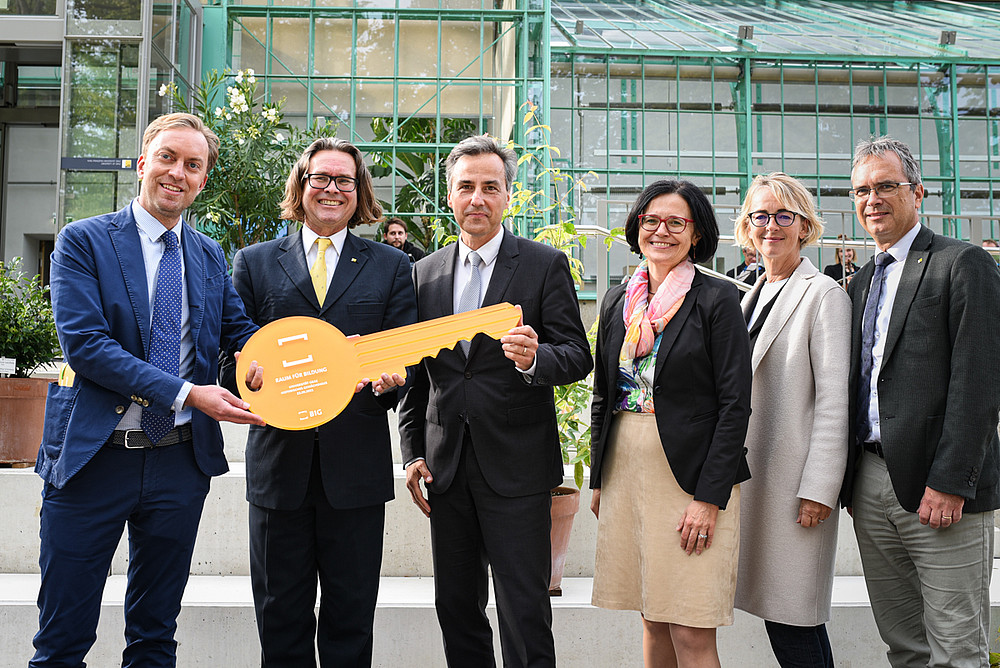
Aufgesperrt: Ferdinand Harnoncourt-Unverzagt überreichte den BIG-Schlüssel an Rektor Martin Polaschek und Peter Riedler. Bürgermeister Siegfried Nagl sowie die Landtagsabgeordneten Sandra Holasek und Alexandra Pichler-Jessenko waren unter den ersten BesucherInnen. Foto: Uni Graz

Aufgesperrt: Ferdinand Harnoncourt-Unverzagt überreichte den BIG-Schlüssel an Rektor Martin Polaschek und Peter Riedler. Bürgermeister Siegfried Nagl sowie die Landtagsabgeordneten Sandra Holasek und Alexandra Pichler-Jessenko waren unter den ersten BesucherInnen. Foto: Uni Graz

Mit einem verspäteten Sommerfest wurde der Uni Graz der Schlüssel für das Historische Gewächshaus im Botanischen Garten offiziell überreicht

Grün, gläsern und gigantisch: Das Historische Gewächshaus von 1889 im Botanischen Garten erstrahlt nach zwei Jahren Sanierung in neuem Glanz. Grund genug, um es mit einem Spätsommerfest sanft aus dem Schlaf zu wecken und es der Öffentlichkeit vorzustellen. „Ich freue mich, dass wir dieses beeindruckende Gebäude gemeinsam mit der Bundesimmobiliengesellschaft und den Fördergebern Stadt Graz und Land Steiermark revitalisieren konnten“, betonte Rektor Martin Polaschek im Rahmen der Eröffnungsfeier. Das Baujuwel wurde nicht nur optisch in den Original-Zustand zurückversetzt, sondern auch modernisiert. Es liefert nun genügend Platz für Forschung und Lehre. In einem Seminarraum können ganze Schulklassen in einer Art „Freilandlabor“ empfangen werden. Zudem wurden spezielle Fenstergläser verwendet, die das komplette UV-Strahlenspektrum des Lichts durchlassen, um so den Pflanzen optimale Bedingungen für ihr Wachstum zu bieten. Das Gewächshaus als Forschungsstandort sei für die Universitätsstadt Graz von enormer Bedeutung, strich Bürgermeister Siegfried Nagl hervor.

Im Rahmen der Arbeiten wurden die Wege im Botanischen Garten einer Frischekur unterzogen. Dazu rief die Universität Graz in der Vergangenheit zu einer Fundraising-Aktion namens „Lass Wissen wachsen“ auf. Viele Botanik-Begeisterte konnten damals Pflanzenpatenschaften übernehmen und die Forschung unterstützen. „Der Reinerlös der Aktion floss in die Aufbereitung und Neugestaltung des Wegenetzes“, so Peter Riedler, Vizerektor für Finanzen, Personal und Standortentwicklung. Als zukünftige NutzerInnen des Gewächshauses bekamen Polaschek und Riedler symbolisch den orangen Schlüssel der Bundesimmobiliengesellschaft (BIG) von Ferdinand Harnoncourt-Unverzagt, Leiter der Unternehmensstrategie und Kommunikation der BIG überreicht.
 

Tag des Denkmals am 26. September 2021
Ein großer Teil der Gebäude am Campus der Universität Graz sind historisch und mehr als hundert Jahre alt. Bei der Sanierung und Erweiterung der Häuser wird stets eng mit dem Bundesdenkmalschutz zusammengearbeitet. Das Historische Gewächshaus wird deshalb im Rahmen des österreichweiten „Tag des Denkmals“ am Sonntag, dem 26. September 2021, von acht bis 16:30 Uhr geöffnet.

Der Botanische Garten der Uni Graz organisiert an diesem Tag 30-minütige Führungen um zehn, elf, 13 und 14 Uhr. Eine Anmeldung dazu ist unter garten(at)uni-graz.at oder 0316 380 8839 verpflichtend. Es gelten die aktuellen Covid-Regelungen, ein gültiger 3-G-Nachweis ist notwendig.

created by Konstantin Tzivanopoulos

Related news

Preserving knowledge: Book sponsorship success story cracks the 100,000 euro mark

The special collections of Graz University Library comprise around 300,000 valuable objects from 25 centuries: Papyri, manuscripts, incunabula, maps and printed books. The sensational find from 2023 is also kept here: the Graz Mummy Book, the world's oldest known book fragment in codex form.

Semester abroad without barriers: University of Graz wins award for promoting inclusion

The University of Graz has been awarded the Internationalization Award for its new inclusion initiative. Students with fewer opportunities now also receive financial support for their semester abroad outside Europe.

Fair distribution: Researchers determine just greenhouse gas budgets for all EU regions

Ten years ago, on 12 December 2015, the Paris Climate Agreement was signed at the UN Climate Conference. In order to limit global warming to well below two degrees, only a certain amount of CO2 may be emitted worldwide. While the focus was originally on national emission targets, more than 200 subnational regions and almost 300 cities have now adopted their own targets. But how many emissions are they fairly entitled to? Researchers at the University of Graz have now developed transparent criteria for fair distribution at the subnational level for the first time and determined corresponding greenhouse gas budgets for all European regions. The paper was published today in the scientific journal Nature Communications.

Chemical Christmas show at the University of Graz: An explosive evening at the Schauspielh

At the beginning of December, the University of Graz transformed the theater into a laboratory: as part of “Chemical Life,” teacher training students staged a chemical Christmas show for Styrian school classes—complete with ethanol rockets, nitrogen snow, and glowing effects. An evening designed to inspire interest in studying chemistry.

Begin of page section:
Additional information:

University of Graz
Universitaetsplatz 3
8010 Graz
Austria
  • Contact
  • Web Editors
  • Moodle
  • UNIGRAZonline
  • Imprint
  • Data Protection Declaration
  • Accessibility Declaration
Weatherstation
Uni Graz

End of this page section. Go to overview of page sections

End of this page section. Go to overview of page sections

Begin of page section:

End of this page section. Go to overview of page sections