



Begin of page section:
Page sections:

  • Go to contents (Accesskey 1)
  • Go to position marker (Accesskey 2)
  • Go to main navigation (Accesskey 3)
  • Go to sub navigation (Accesskey 4)
  • Go to additional information (Accesskey 5)
  • Go to page settings (user/language) (Accesskey 8)
  • Go to search (Accesskey 9)

End of this page section. Go to overview of page sections

Begin of page section:
Page settings:

English en
Deutsch de
Search
Login

End of this page section. Go to overview of page sections

Begin of page section:
Search:

Search for details about Uni Graz
Close

End of this page section. Go to overview of page sections


Search

Begin of page section:
Main navigation:

Page navigation:

  • University

    University
    • About the University
    • Organisation
    • Faculties
    • Library
    • Working at University of Graz
    • Campus
    Developing solutions for the world of tomorrow - that is our mission. Our students and our researchers take on the great challenges of society and carry the knowledge out.
  • Research Profile

    Research Profile
    • Our Expertise
    • Research Questions
    • Research Portal
    • Promoting Research
    • Research Transfer
    • Ethics in Research
    • Commission for Scientific Integrity
    Scientific excellence and the courage to break new ground. Research at the University of Graz creates the foundations for making the future worth living.
  • Studies

    Studies
    • Prospective Students
    • Students
    • Registration for Study Programme (Winter semester 2026/27)
  • Community

    Community
    • International
    • Location
    • Research and Business
    • Alumni
    The University of Graz is a hub for international research and brings together scientists and business experts. Moreover, it fosters the exchange and cooperation in study and teaching.
Topics
  • Sustainable University
  • Researchers answer
  • Work for us
Close menu

End of this page section. Go to overview of page sections

Begin of page section:
You are here:

University of Graz News Future Lecture 2019

End of this page section. Go to overview of page sections

Thursday, 05 December 2019

Future Lecture 2019

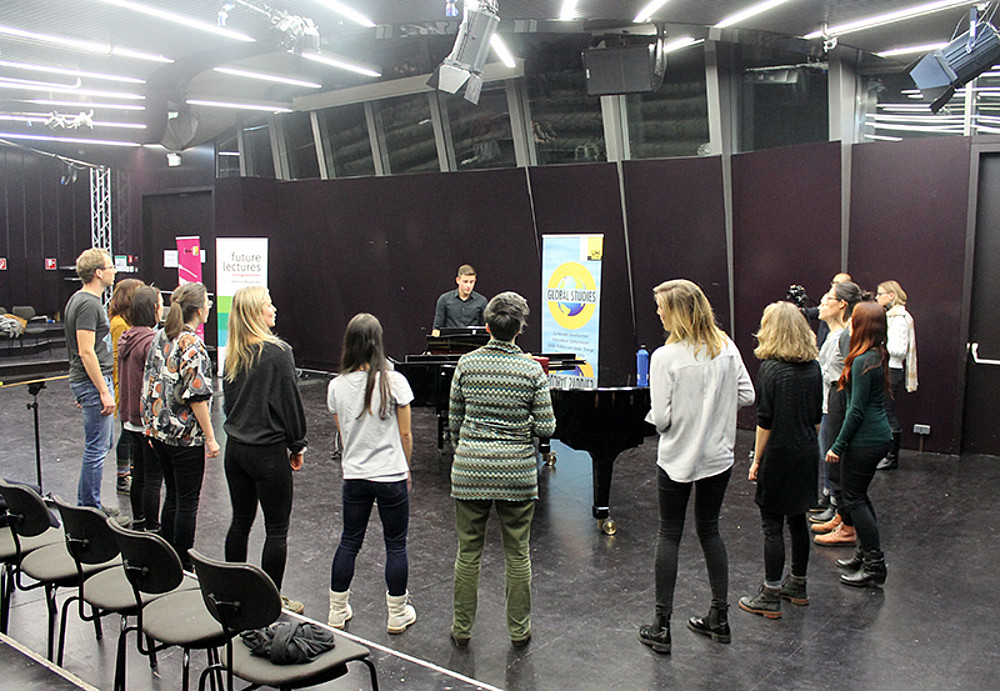
Die Future Lecture 2019 fragte danach, wie Musik und Nachhaltigkeit zusammenpassen. Foto: Uni Graz.

Die Future Lecture 2019 fragte danach, wie Musik und Nachhaltigkeit zusammenpassen. Foto: Uni Graz.

Nachhaltigkeit einmal anders: Universität Graz und KUG organisieren Music4Sustainability

„Wir Kinder, wir alle träumen, dass alle Menschen in Frieden leben und lieben und Freunde sind.“ Mit diesen Worten begann die diesjährige Future Lecture unter dem Titel “Music4Sustainability“, ein gemeinsames Event der Universität Graz und der Kunstuniversität Graz mit Unterstützung des Forums Umweltbildung im MUMUTH. Gleich zu Beginn sang diese Botschaft der integrative Superar-Chor, in dem Grazer VolksschülerInnen unterschiedlichster Herkunft Musik als universelle Sprache erleben, Deutsch lernen und ihre Chancen auf gesellschaftliche Teilhabe erhöhen. Wie Musik und Nachhaltigkeit zusammenhängen, war Thema der Future Lecture 2019.

Alejandro Perdomo, Absolvent der Universität Graz aus Venezuela, gab zunächst Einblicke in seiner Masterarbeit, die sich dem venezolanische Musikschulprojekt „El Sistema“ widmet. „El Sistema“ fängt Kindern aus armen und bildungsbenachteiligten Schichten durch gemeinsames Musizieren auf, um sie vor Missbrauch und Gewalt zu schützen und ihnen positive Werte zu vermitteln. Berühmtester Absolvent von „El Sistema“ ist der international renommierte Dirigent Gustavo Dudamel, der bislang jüngste Dirigent des Neujahrskonzerts der Wiener Philharmoniker.

Heute binden von „El Sistema“ inspirierte Projekte wie das Grazer Chorprojekt „Superar“ weltweit Kinder aus allen Schichten ein und nutzen Musik, um Barrieren zu überwinden, Vorurteile aufzulösen und nachhaltig ein Zeichen der Gemeinschaft zu setzen. Bei der Future Lecture stellten Studierende und Lehrende des Masterstudiums Global Studies an der Universität Graz und KollegInnen der Kunstuniversität Graz sowie von Superar, Fair Styria und Klangforum Wien in einer bunten Collage jeweils ihre Sicht auf das Thema vor.

Anschließend konnte man sich in verschiedenen musikalischen Workshops  - darunter waren Percussion, Gesang und das Herstellen von Musikinstrumenten aus Müll -  sowie sozialwissenschaftlichen Workshops praktisch und theoretisch davon überzeugen, dass Musik die menschliche und soziale Entwicklung prägt und sie positiv beeinflusst. Sie trägt zu den 17 Sustainable Development Goals (SDGs) der UN bei: Bildung, Gesundheit, Verringerung von Ungleichheit, nachhaltige Gemeinschaften, Frieden und Partnerschaft zur Erreichung der Ziele.

Die Veranstaltung erreichte ein bunt gemischtes Publikum von mehr als 100 Personen. Ausklingen lassen durften die Teilnehmenden die Veranstaltung bei einem köstlichen vegetarischen Buffet des Grazer Sozialprojektes „Heidenspaß“ und von SPAR zur Verfügung gestellten regionalen Getränken. Organisatorin Ulrike Gelbmann vom Institut für Systemwissenschaften, Innovations- und Nachhaltigkeitsforschung der Universität Graz zog ein begeistertes Fazit: „Von dieser wunderbar kreativen Future Lecture bleibt der Auftrag an alle Beteiligten, sich nachdrücklich für eine bessere Welt einzusetzen – unter anderem auch mit den Mitteln der Musik!“

 

>> Mehr zu "Music4Sustainability" im AirCampus-Podcast

created by Ulrike Gelbmann & Gerhild Leljak

Related news

Staying fit during the holidays: summer sports on the University of Graz campus

The Kleeblattlauf is not the end of the fitness term. Following last year’s successful launch, the University of Graz is once again offering summer sports on campus this year. From 30 June to 16 July 2026, there will be a free exercise programme in the open air. On the shady Südwiese (between the main building and Universitätsplatz 2), anyone interested can get in shape in the afternoons with body workouts, fascia training and yoga.

Getting even hotter: Researchers predict global warming of 1.7 degrees by 2027

While Europe is currently sweltering in the heat, global temperatures are also rising towards concerning record levels. In 2026, Earth’s surface air temperature is expected to reach 1.62 degrees, and in 2027 even 1.71 degrees Celsius above pre-industrial levels. The long-term temperature rise – an average over a 20-year period – is predicted to exceed the 1.5-degree threshold of the Paris Agreement as of 2026 already. For the first time, researchers at the University of Graz have been able to make such a forecast so far in advance. The intensifying El Niño climate event favors forecast skill and thereby facilitates a reliable computation.

Forest fire at Rosenhain: Volunteer fire brigade carried out an evacuation drill at the Jesuit refectory

Thick smoke in the stairwell, flames at the edge of the forest, people missing in the Jesuit refectory at the University of Graz: at Rosenhain, the Graz Volunteer Fire Brigade carried out a drill simulating a scenario that is becoming increasingly realistic given the heat and drought

Full effort in the heat: the Sports Centre was in full swing at the Kleeblattlauf

On 19 June 2026, 2,000 runners and hundreds of supporters made their way to the Rosenhain for a sporting end-of-term event.

Begin of page section:
Additional information:

University of Graz
Universitaetsplatz 3
8010 Graz
Austria
  • Contact
  • Web Editors
  • Moodle
  • UNIGRAZonline
  • Imprint
  • Data Protection Declaration
  • Accessibility Declaration
Weatherstation
Uni Graz

End of this page section. Go to overview of page sections

End of this page section. Go to overview of page sections

Begin of page section:

End of this page section. Go to overview of page sections

