Begin of page section:
Page sections:

  • Go to contents (Accesskey 1)
  • Go to position marker (Accesskey 2)
  • Go to main navigation (Accesskey 3)
  • Go to sub navigation (Accesskey 4)
  • Go to additional information (Accesskey 5)
  • Go to page settings (user/language) (Accesskey 8)
  • Go to search (Accesskey 9)

End of this page section. Go to overview of page sections

Begin of page section:
Page settings:

English en
Deutsch de
Search
Login

End of this page section. Go to overview of page sections

Begin of page section:
Search:

Search for details about Uni Graz
Close

End of this page section. Go to overview of page sections


Search

Begin of page section:
Main navigation:

Page navigation:

  • University

    University
    • About the University
    • Organisation
    • Faculties
    • Library
    • Working at University of Graz
    • Campus
    Developing solutions for the world of tomorrow - that is our mission. Our students and our researchers take on the great challenges of society and carry the knowledge out.
  • Research Profile

    Research Profile
    • Our Expertise
    • Research Questions
    • Research Portal
    • Promoting Research
    • Research Transfer
    • Ethics in Research
    Scientific excellence and the courage to break new ground. Research at the University of Graz creates the foundations for making the future worth living.
  • Studies

    Studies
    • Prospective Students
    • Students
  • Community

    Community
    • International
    • Location
    • Research and Business
    • Alumni
    The University of Graz is a hub for international research and brings together scientists and business experts. Moreover, it fosters the exchange and cooperation in study and teaching.
  • Spotlight
Topics
  • Our digital Advent calendar
  • Sustainable University
  • Researchers answer
  • Work for us
Close menu

End of this page section. Go to overview of page sections

Begin of page section:
You are here:

University of Graz News Future Lecture 2019

End of this page section. Go to overview of page sections

Thursday, 05 December 2019

Future Lecture 2019

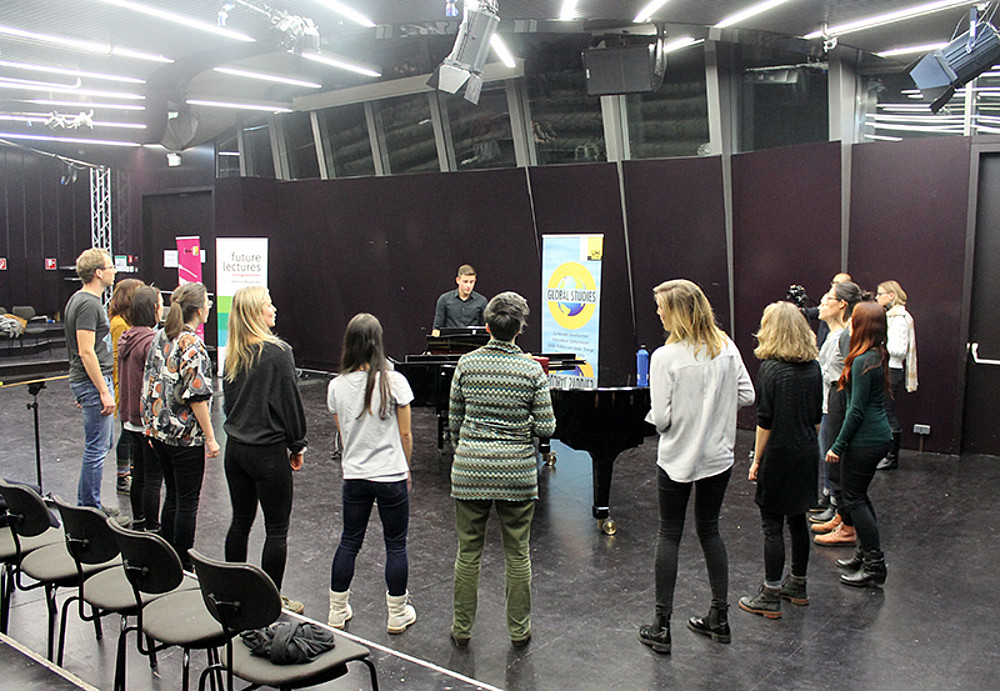
Die Future Lecture 2019 fragte danach, wie Musik und Nachhaltigkeit zusammenpassen. Foto: Uni Graz.

Die Future Lecture 2019 fragte danach, wie Musik und Nachhaltigkeit zusammenpassen. Foto: Uni Graz.

Nachhaltigkeit einmal anders: Universität Graz und KUG organisieren Music4Sustainability

„Wir Kinder, wir alle träumen, dass alle Menschen in Frieden leben und lieben und Freunde sind.“ Mit diesen Worten begann die diesjährige Future Lecture unter dem Titel “Music4Sustainability“, ein gemeinsames Event der Universität Graz und der Kunstuniversität Graz mit Unterstützung des Forums Umweltbildung im MUMUTH. Gleich zu Beginn sang diese Botschaft der integrative Superar-Chor, in dem Grazer VolksschülerInnen unterschiedlichster Herkunft Musik als universelle Sprache erleben, Deutsch lernen und ihre Chancen auf gesellschaftliche Teilhabe erhöhen. Wie Musik und Nachhaltigkeit zusammenhängen, war Thema der Future Lecture 2019.

Alejandro Perdomo, Absolvent der Universität Graz aus Venezuela, gab zunächst Einblicke in seiner Masterarbeit, die sich dem venezolanische Musikschulprojekt „El Sistema“ widmet. „El Sistema“ fängt Kindern aus armen und bildungsbenachteiligten Schichten durch gemeinsames Musizieren auf, um sie vor Missbrauch und Gewalt zu schützen und ihnen positive Werte zu vermitteln. Berühmtester Absolvent von „El Sistema“ ist der international renommierte Dirigent Gustavo Dudamel, der bislang jüngste Dirigent des Neujahrskonzerts der Wiener Philharmoniker.

Heute binden von „El Sistema“ inspirierte Projekte wie das Grazer Chorprojekt „Superar“ weltweit Kinder aus allen Schichten ein und nutzen Musik, um Barrieren zu überwinden, Vorurteile aufzulösen und nachhaltig ein Zeichen der Gemeinschaft zu setzen. Bei der Future Lecture stellten Studierende und Lehrende des Masterstudiums Global Studies an der Universität Graz und KollegInnen der Kunstuniversität Graz sowie von Superar, Fair Styria und Klangforum Wien in einer bunten Collage jeweils ihre Sicht auf das Thema vor.

Anschließend konnte man sich in verschiedenen musikalischen Workshops  - darunter waren Percussion, Gesang und das Herstellen von Musikinstrumenten aus Müll -  sowie sozialwissenschaftlichen Workshops praktisch und theoretisch davon überzeugen, dass Musik die menschliche und soziale Entwicklung prägt und sie positiv beeinflusst. Sie trägt zu den 17 Sustainable Development Goals (SDGs) der UN bei: Bildung, Gesundheit, Verringerung von Ungleichheit, nachhaltige Gemeinschaften, Frieden und Partnerschaft zur Erreichung der Ziele.

Die Veranstaltung erreichte ein bunt gemischtes Publikum von mehr als 100 Personen. Ausklingen lassen durften die Teilnehmenden die Veranstaltung bei einem köstlichen vegetarischen Buffet des Grazer Sozialprojektes „Heidenspaß“ und von SPAR zur Verfügung gestellten regionalen Getränken. Organisatorin Ulrike Gelbmann vom Institut für Systemwissenschaften, Innovations- und Nachhaltigkeitsforschung der Universität Graz zog ein begeistertes Fazit: „Von dieser wunderbar kreativen Future Lecture bleibt der Auftrag an alle Beteiligten, sich nachdrücklich für eine bessere Welt einzusetzen – unter anderem auch mit den Mitteln der Musik!“


>> Mehr zu "Music4Sustainability" im AirCampus-Podcast

created by Ulrike Gelbmann & Gerhild Leljak

Related news

Semester abroad without barriers: University of Graz wins award for promoting inclusion

The University of Graz has been awarded the Internationalization Award for its new inclusion initiative. Students with fewer opportunities now also receive financial support for their semester abroad outside Europe.

Fair distribution: Researchers determine just greenhouse gas budgets for all EU regions

Ten years ago, on 12 December 2015, the Paris Climate Agreement was signed at the UN Climate Conference. In order to limit global warming to well below two degrees, only a certain amount of CO2 may be emitted worldwide. While the focus was originally on national emission targets, more than 200 subnational regions and almost 300 cities have now adopted their own targets. But how many emissions are they fairly entitled to? Researchers at the University of Graz have now developed transparent criteria for fair distribution at the subnational level for the first time and determined corresponding greenhouse gas budgets for all European regions. The paper was published today in the scientific journal Nature Communications.

Chemical Christmas show at the University of Graz: An explosive evening at the Schauspielh

At the beginning of December, the University of Graz transformed the theater into a laboratory: as part of “Chemical Life,” teacher training students staged a chemical Christmas show for Styrian school classes—complete with ethanol rockets, nitrogen snow, and glowing effects. An evening designed to inspire interest in studying chemistry.

Train by train: Koralm railway accelerates exchange between the Universities

Lectures at the University of Klagenfurt in the morning, seminars at the University of Graz in the afternoon: Austria's longest tunnel and a journey time of around 45 minutes make it easy. The Koralm railway increases the speed of networking between the two university locations. The collaboration builds on existing cooperation - for example in the areas of teacher training, Slavic studies and as employers, the universities are well coordinated.

Begin of page section:
Additional information:

University of Graz
Universitaetsplatz 3
8010 Graz
Austria
  • Contact
  • Web Editors
  • Moodle
  • UNIGRAZonline
  • Imprint
  • Data Protection Declaration
  • Accessibility Declaration
Weatherstation
Uni Graz

End of this page section. Go to overview of page sections

End of this page section. Go to overview of page sections

Begin of page section:

End of this page section. Go to overview of page sections