Begin of page section:
Page sections:

  • Go to contents (Accesskey 1)
  • Go to position marker (Accesskey 2)
  • Go to main navigation (Accesskey 3)
  • Go to sub navigation (Accesskey 4)
  • Go to additional information (Accesskey 5)
  • Go to page settings (user/language) (Accesskey 8)
  • Go to search (Accesskey 9)

End of this page section. Go to overview of page sections

Begin of page section:
Page settings:

English en
Deutsch de
Search
Login

End of this page section. Go to overview of page sections

Begin of page section:
Search:

Search for details about Uni Graz
Close

End of this page section. Go to overview of page sections


Search

Begin of page section:
Main navigation:

Page navigation:

  • University

    University
    • About the University
    • Organisation
    • Faculties
    • Library
    • Working at University of Graz
    • Campus
    Developing solutions for the world of tomorrow - that is our mission. Our students and our researchers take on the great challenges of society and carry the knowledge out.
  • Research Profile

    Research Profile
    • Our Expertise
    • Research Questions
    • Research Portal
    • Promoting Research
    • Research Transfer
    • Ethics in Research
    Scientific excellence and the courage to break new ground. Research at the University of Graz creates the foundations for making the future worth living.
  • Studies

    Studies
    • Prospective Students
    • Students
  • Community

    Community
    • International
    • Location
    • Research and Business
    • Alumni
    The University of Graz is a hub for international research and brings together scientists and business experts. Moreover, it fosters the exchange and cooperation in study and teaching.
  • Spotlight
Topics
  • Our digital Advent calendar
  • Sustainable University
  • Researchers answer
  • Work for us
Close menu

End of this page section. Go to overview of page sections

Begin of page section:
You are here:

University of Graz News From the lab to the market

End of this page section. Go to overview of page sections

Tuesday, 27 April 2021

From the lab to the market

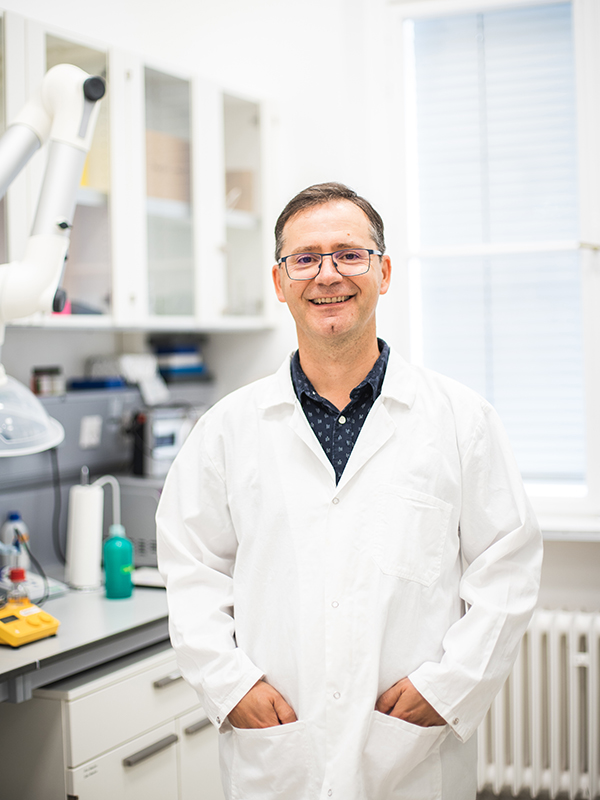
Crickets, bees, locusts and, most recently, weasels: all these creatures have inspired biologist Manfred Hartbauer to invent new products and technologies. Photo: Lukas Elsneg.

Crickets, bees, locusts and, most recently, weasels: all these creatures have inspired biologist Manfred Hartbauer to invent new products and technologies. Photo: Lukas Elsneg.

Biologist Manfred Hartbauer about how basic research can find its way to application

Crickets, bees, locusts and, most recently, weasels: all these creatures have inspired biologist Manfred Hartbauer to invent new products and technologies. In this interview we talked about research that makes its way out of the laboratory and onto the market, with the potential to solve global problems.
 
Some insects, like the oriental fruit fly or certain kinds of shield bugs are a source of serious concern for Austrian fruit farmers and winegrowers. In parts of Africa and Pakistan, swarms of locusts rob the local people of their basic foodstuffs, by regularly consuming up to 60 per cent of food crops. How does your research help to combat these problems? 

We have developed an environmentally-friendly pesticide, LinoEx – based on linseed oil, which is particularly effective against locusts in hot climates, when the outdoor temperatures are over 25 degrees. Our experiments, both in the lab and in the field, showed that it kills the insects swiftly, so that most plants remain undamaged. However, to enable us to export this product to the areas where it is urgently needed – including several large countries south of the equator, and parts of India – we need support from investors. The affected countries themselves often cannot afford to meet even the most fundamental needs. So the situation in these countries is becoming increasingly difficult, because they do not have the equipment or resources needed to control the locusts. 

What will happen if nothing is done to address this? 
In East Africa in particular the problem is escalating: as a result of climate change, it is getting increasingly difficult to cultivate enough food crops. Then these destructive pests come along as well. When people are facing starvation, often the only option is to move away. Another tactic used in Africa today is to burn huge quantities of plastic waste in order to drive off the locusts – with catastrophic effects for the environment. As we have seen from the ongoing debate on glyphosate, toxic pesticides are a source of friction within the EU as well. Our product is environmentally friendly and could prompt a rethink in the market. 

You come from the world of basic research. How important are the practical applications of your projects? Is it a “nice-to-have” aspect, or is this what gives your work deeper meaning? 
It is always highly motivating to make a contribution to solving problems of relevance to society – for the students too, who throw themselves into the work with a special intensity if this is a prospect. But we always go back to the basics, because an idea often needs to be revised, or a product refined and improved. If the objective of the project is ultimately to serve a specific purpose, in my experience there is less risk of getting lost in the details. And: application-oriented research opens up new prospects in the jobs market, which is particularly important for postdocs, since they often have only fixed-term contracts in universities.   

Nature provides the model, humans imitate it: this type of research is known as “bionics”. It shows that innovative technologies based on the capabilities of animals and insects could offer solutions for many challenging problems. What are you researching at the moment?   
We are working with the radiology department at Graz on a pilot study to investigate how we can make mammography images clear and “noise-free”. That would allow the radiation dose to be minimised for screening checks. The idea came to us when we were studying the eyes of certain nocturnal bees. Another example of this approach is our work with the locusts – they are not only destructive pests, but also masters in avoiding collisions. So we took them as our model for developing a collision detector for drones. And right now we are designing a robot to locate people buried under landslides or avalanches more quickly. Our inspirations for that were the energy-efficient way that weasels move, and the precise directional hearing of field crickets. 

Bionics has been a hot topic in research for some time now, and is clearly here to stay. How will this trend be reflected in what the students learn?
The bachelor’s programme in biology will include a lecture on bionics as a standard element. I’d also like to ensure that in future when our master’s students graduate, they leave here with a basic knowledge of modelling, manufacturing, programming and entrepreneurship, as well as patent law. When you reach the stage where a spin-off enterprise is a possibility, researchers need the support of the university. The new “Unicorn”, as a point of interaction between research and industry, will certainly make this process easier in future. 


>> Mehr über LinoEX im Video - German only

created by Gerhild Leljak

Related news

Semester abroad without barriers: University of Graz wins award for promoting inclusion

The University of Graz has been awarded the Internationalization Award for its new inclusion initiative. Students with fewer opportunities now also receive financial support for their semester abroad outside Europe.

Fair distribution: Researchers determine just greenhouse gas budgets for all EU regions

Ten years ago, on 12 December 2015, the Paris Climate Agreement was signed at the UN Climate Conference. In order to limit global warming to well below two degrees, only a certain amount of CO2 may be emitted worldwide. While the focus was originally on national emission targets, more than 200 subnational regions and almost 300 cities have now adopted their own targets. But how many emissions are they fairly entitled to? Researchers at the University of Graz have now developed transparent criteria for fair distribution at the subnational level for the first time and determined corresponding greenhouse gas budgets for all European regions. The paper was published today in the scientific journal Nature Communications.

Chemical Christmas show at the University of Graz: An explosive evening at the Schauspielh

At the beginning of December, the University of Graz transformed the theater into a laboratory: as part of “Chemical Life,” teacher training students staged a chemical Christmas show for Styrian school classes—complete with ethanol rockets, nitrogen snow, and glowing effects. An evening designed to inspire interest in studying chemistry.

Train by train: Koralm railway accelerates exchange between the Universities

Lectures at the University of Klagenfurt in the morning, seminars at the University of Graz in the afternoon: Austria's longest tunnel and a journey time of around 45 minutes make it easy. The Koralm railway increases the speed of networking between the two university locations. The collaboration builds on existing cooperation - for example in the areas of teacher training, Slavic studies and as employers, the universities are well coordinated.

Begin of page section:
Additional information:

University of Graz
Universitaetsplatz 3
8010 Graz
Austria
  • Contact
  • Web Editors
  • Moodle
  • UNIGRAZonline
  • Imprint
  • Data Protection Declaration
  • Accessibility Declaration
Weatherstation
Uni Graz

End of this page section. Go to overview of page sections

End of this page section. Go to overview of page sections

Begin of page section:

End of this page section. Go to overview of page sections