



Begin of page section:
Page sections:

  • Go to contents (Accesskey 1)
  • Go to position marker (Accesskey 2)
  • Go to main navigation (Accesskey 3)
  • Go to sub navigation (Accesskey 4)
  • Go to additional information (Accesskey 5)
  • Go to page settings (user/language) (Accesskey 8)
  • Go to search (Accesskey 9)

End of this page section. Go to overview of page sections

Begin of page section:
Page settings:

English en
Deutsch de
Search
Login

End of this page section. Go to overview of page sections

Begin of page section:
Search:

Search for details about Uni Graz
Close

End of this page section. Go to overview of page sections


Search

Begin of page section:
Main navigation:

Page navigation:

  • University

    University
    • About the University
    • Organisation
    • Faculties
    • Library
    • Working at University of Graz
    • Campus
    Developing solutions for the world of tomorrow - that is our mission. Our students and our researchers take on the great challenges of society and carry the knowledge out.
  • Research Profile

    Research Profile
    • Our Expertise
    • Research Questions
    • Research Portal
    • Promoting Research
    • Research Transfer
    • Ethics in Research
    • Commission for Scientific Integrity
    Scientific excellence and the courage to break new ground. Research at the University of Graz creates the foundations for making the future worth living.
  • Studies

    Studies
    • Prospective Students
    • Students
  • Community

    Community
    • International
    • Location
    • Research and Business
    • Alumni
    The University of Graz is a hub for international research and brings together scientists and business experts. Moreover, it fosters the exchange and cooperation in study and teaching.
Topics
  • Sustainable University
  • Researchers answer
  • Work for us
Close menu

End of this page section. Go to overview of page sections

Begin of page section:
You are here:

University of Graz News Forschungspreise

End of this page section. Go to overview of page sections

Friday, 06 December 2013

Forschungspreise

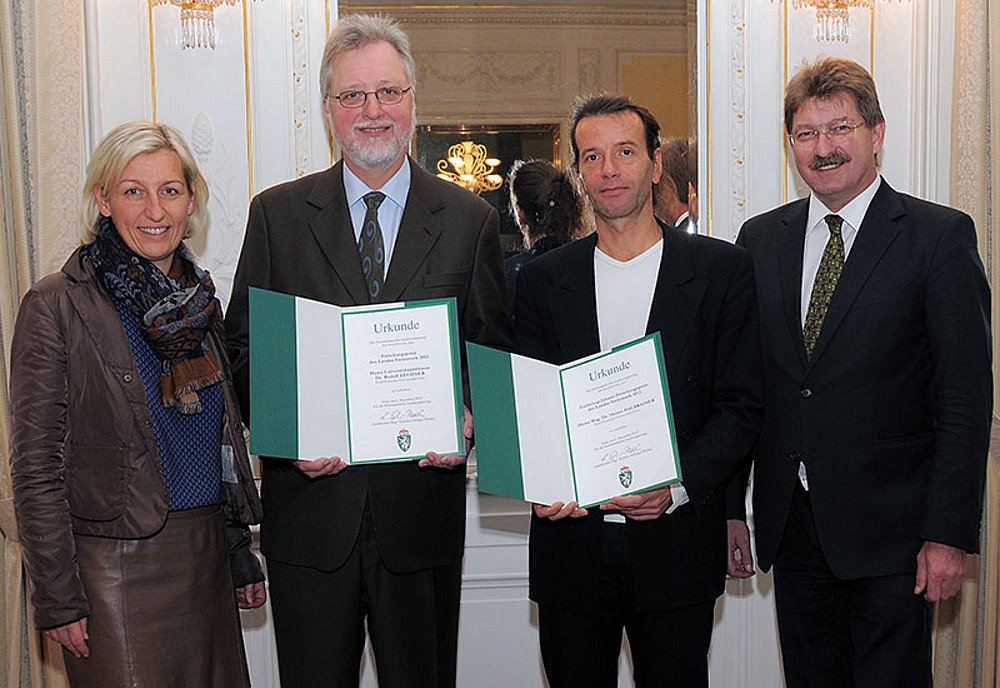
Landesrätin Kristina Edlinger-Ploder mit den Preisträgern Rudolf Zechner und Heimo Halbrainer sowie Peter Scherrer, Vizerektor für Forschung und Nachwuchsförderung der Uni Graz (v.l.)

Landesrätin Kristina Edlinger-Ploder mit den Preisträgern Rudolf Zechner und Heimo Halbrainer sowie Peter Scherrer, Vizerektor für Forschung und Nachwuchsförderung der Uni Graz (v.l.)

Land Steiermark zeichnet Biochemiker und Historiker der Uni Graz aus

Begehrte Auszeichnung für zwei Wissenschafter der Karl-Franzens-Universität Graz: Der Biochemiker Univ.-Prof. Dr. Rudolf Zechner erhält den Forschungspreis des Landes Steiermark 2013. Der Erzherzog-Johann-Forschungspreis 2013 geht an den Historiker Dr. Heimo Halbrainer. Landesrätin Kristina Edlinger-Ploder überreichte die Auszeichnungen am 6. Dezember 2013 im Weißen Saal der Grazer Burg.


Rudolf Zechner vom Institut für Molekulare Biowissenschaften der Uni Graz zählt zu den führenden WissenschafterInnen auf dem Gebiet der Lipidforschung. Im Mittelpunkt seiner Arbeit stehen die molekularen Ursachen von Fettstoffwechselstörungen und damit verbundenen Krankheiten, wie zum Beispiel Adipositas oder Diabetes.

Den mit 10.900 Euro dotierten Forschungspreis des Landes Steiermark 2013 erhielt Rudolf Zechner für die Aufklärung der Funktion des Proteins Adiponutrin im Fettstoffwechsel. Menschen mit bestimmten Strukturvarianten von Adiponutrin erkranken besonders häufig an Leberverfettung. Zechners Arbeitsgruppe konnte erstmals zeigen, welcher molekulare Mechanismus dafür verantwortlich ist. „Durch die pathogenen Strukturvarianten von Adiponutrin kommt es zu einer vermehrten Fettsynthese, was zur Leberverfettung führen kann“, fasst der Preisträger zusammen. Die Forschungsergebnisse wurden im international höchst renommierten Journal Cell Metabolism veröffentlicht.

Rudolf Zechner leitet seit 2007 den vom Österreichischen Wissenschaftsfonds FWF geförderten Spezialforschungsbereich LIPOTOX. Für seine Arbeiten erhielt der Biochemiker bereits mehrere hoch dotierte Auszeichnungen, unter anderem den Wittgensteinpreis 2007. 2013 wurde Zechner ein mit 2,5 Millionen Euro dotierter ERC Advanced Grant des Europäischen Forschungsrates zuerkannt.


Heimo Halbrainer forscht am Centrum für Jüdische Studien der Uni Graz. Der Historiker ist Autor zahlreicher Publikationen und wissenschaftlicher Leiter von CLIO – Verein für Geschichts- und Bildungsarbeit. Mit dem Erzherzog-Johann-Forschungspreis 2013, dotiert mit 10.900 Euro, wurde das heuer im CLIO-Verlag erschienene zweibändige Werk „Die Eisenstraße 1938–1945: NS-Terror – Widerstand – Neues Erinnern“ ausgezeichnet.

Die von Halbrainer mitherausgegebene Publikation dokumentiert den Widerstand gegen den Nationalsozialismus, der ab 1943 mit Anschlägen das NS-Regime zu schwächen versuchte und im Mai 1945 dafür sorgte, dass die Alpine Donawitz gemäß dem so genannten „Nero-Plan“ nicht zerstört wurde. Es berichtet aber auch von den Verfolgungen und dem Massaker an ungarisch-jüdischen ZwangsarbeiterInnen am Präbichl. „Zudem zeigt es, wie man nach 1945 mit der nationalsozialistischen Zeit in der Region umging, wie erinnert wurde und ob beziehungsweise wie die NS-Verbrechen geahndet wurden“, ergänzt Halbrainer. Darüber hinaus werden in einem eigenen Band über 500 Opfer des NS-Regimes – WiderstandskämpferInnen, Jüdinnen und Juden, Deserteure, KZ-Häftlinge, Kriegsgefangene und ZwangsarbeiterInnen – biografisch vorgestellt.

created by Gudrun Pichler

Related news

Complying with the norm: Why Do Standards Shape Our Lives, Elisabeth Staudegger?

Standards determine whether a sheet of paper fits in a printer or whether a charging plug can power multiple devices. These standards shape our everyday lives. But who actually sets these standards? Where are the weaknesses, and how could science help to improve them? Elisabeth Staudegger, Head of the ‘Law and IT’ Department at the Institute for Legal Foundations at the University of Graz, host the Academic Standards Day on 16 June. Here she relays how sciences can contribute to the topic of standardisation and reveals her personal favourite standard.

More body awareness than a culture war

In Italy, sex education lessons will in future only be permitted with parental consent, and will be banned entirely in nurseries and primary schools. At the same time, Pride Month highlights why knowledge about the body, relationships, boundaries and diversity is important for young people. A study by the University of Graz shows how important knowledge about the body, contraception, relationship skills and protection against violence is

Will Austria win the World Cup? Mathematician reveals calculation method

Michael Fischer uses the football tournament as a practical example for highschool lessons.

Survival strategies: How plants respond to drought

According to Geosphere Austria, this spring was the driest in Austria since records began around 170 years ago. The low rainfall put particular pressure on the agricultural sector. And climate change is set to make the situation even worse in the coming decades. We asked Johannes Liesche, a professor at the Department of Biology at the University of Graz, how plants react to water shortages and how they survive periods of drought.

Begin of page section:
Additional information:

University of Graz
Universitaetsplatz 3
8010 Graz
Austria
  • Contact
  • Web Editors
  • Moodle
  • UNIGRAZonline
  • Imprint
  • Data Protection Declaration
  • Accessibility Declaration
Weatherstation
Uni Graz

End of this page section. Go to overview of page sections

End of this page section. Go to overview of page sections

Begin of page section:

End of this page section. Go to overview of page sections