Begin of page section:
Page sections:

  • Go to contents (Accesskey 1)
  • Go to position marker (Accesskey 2)
  • Go to main navigation (Accesskey 3)
  • Go to sub navigation (Accesskey 4)
  • Go to additional information (Accesskey 5)
  • Go to page settings (user/language) (Accesskey 8)
  • Go to search (Accesskey 9)

End of this page section. Go to overview of page sections

Begin of page section:
Page settings:

English en
Deutsch de
Search
Login

End of this page section. Go to overview of page sections

Begin of page section:
Search:

Search for details about Uni Graz
Close

End of this page section. Go to overview of page sections


Search

Begin of page section:
Main navigation:

Page navigation:

  • University

    University
    • About the University
    • Organisation
    • Faculties
    • Library
    • Working at University of Graz
    • Campus
    Developing solutions for the world of tomorrow - that is our mission. Our students and our researchers take on the great challenges of society and carry the knowledge out.
  • Research Profile

    Research Profile
    • Our Expertise
    • Research Questions
    • Research Portal
    • Promoting Research
    • Research Transfer
    • Ethics in Research
    • Commission for Scientific Integrity
    Scientific excellence and the courage to break new ground. Research at the University of Graz creates the foundations for making the future worth living.
  • Studies

    Studies
    • Prospective Students
    • Students
  • Community

    Community
    • International
    • Location
    • Research and Business
    • Alumni
    The University of Graz is a hub for international research and brings together scientists and business experts. Moreover, it fosters the exchange and cooperation in study and teaching.
  • Spotlight
Topics
  • Sustainable University
  • Researchers answer
  • Work for us
Close menu

End of this page section. Go to overview of page sections

Begin of page section:
You are here:

University of Graz News Forschung voraus!

End of this page section. Go to overview of page sections

Tuesday, 28 September 2021

Forschung voraus!

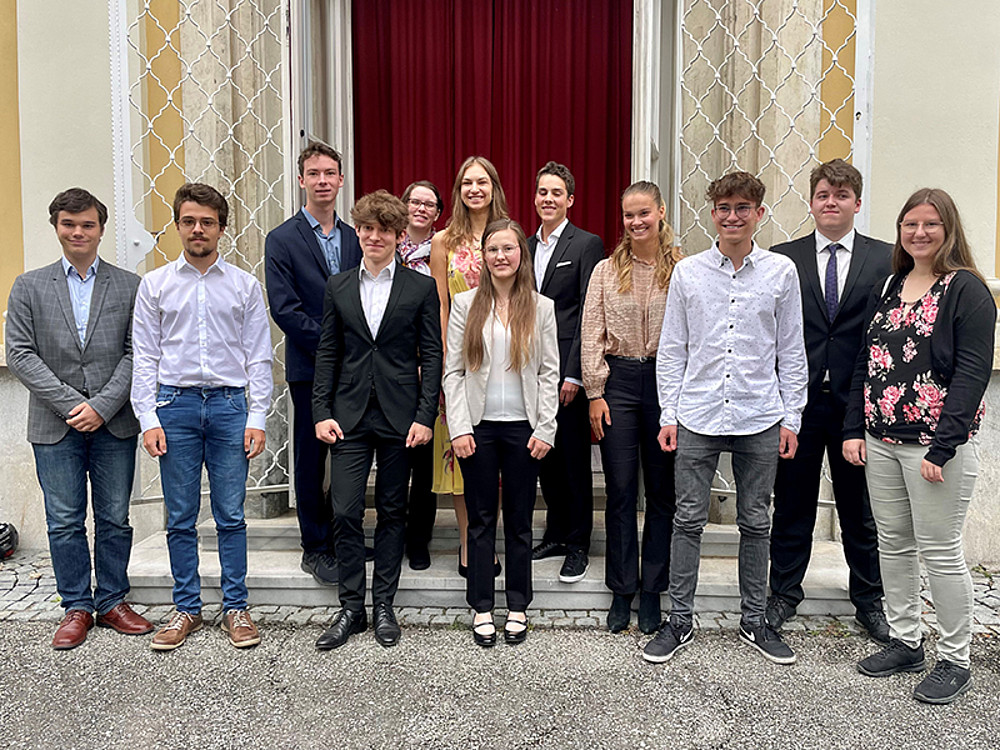
Die PreisträgerInnen der Dr. Hans Riegel-Fachpreise 2021. Foto: Martin Teufel.

Die PreisträgerInnen der Dr. Hans Riegel-Fachpreise 2021. Foto: Martin Teufel.

Dr. Hans Riegel-Fachpreise, JuniorAcademic und SPRADI: Drei Preise ehren die besten vorwissenschaftlichen Arbeiten

SchülerInnen der AHS, die in naturwissenschaftlichen Fächern – konkret Biologie, Chemie, Informatik, Mathematik und Physik – ausgezeichnete vorwissenschaftliche Arbeiten ablegen, haben eine Chance auf den Gewinn der begehrten Dr. Hans Riegel-Fachpreise.  Vergeben wird der Preis jährlich von der Kaiserschild-Stiftung, die damit das Interesse der jungen Generation an Wissenschaft und Forschung fördern möchte. Und es ist nicht nur Ehre allein, die die SchülerInnen erfahren: Sie werden auch einerseits persönlich mit Preisgeldern im Wert von insgesamt 6000 Euro bedacht, andererseits erhalten ihre Schulen Gutescheine im Wert von insgesamt 1250 Euro zur Förderung des naturwissenschaftlichen Unterrichts. 

Aber auch SchülerInnen, die ebenso exzellente vorwissenschaftliche Arbeiten in den Geistes- und Kulturwissenschaften ablegen, werden von der Universität Graz geehrt: mit dem JuniorAcademic- bzw. dem SPRADI-Preis. Hier stehen die Fächer Geschichte, Philosophie/Psychologie, Musik sowie Fremdsprachen im Mittelpunkt. Die SchülerInnen und deren Schulen erhalten Büchergutscheine im Wert von insgesamt 2800 Euro, damit das Interesse an dem Bereich weiter gepflegt werden kann. 

An der Universität Graz gingen vor Kurzem beide Preisverleihungen unter strenger Einhaltung der Corona-Schutzmaßnahmen über die Bühne. Als Ehrengäste waren alternierend Landesrätin Juliane Bogner-Strauß, Landtagsabgeordneter Klaus Zenz, Stadtrat Günter Riegler, Gemeinderätin Elisabeth Potzinger sowie die VizerektorInnen Catherine Walter-Laager und Peter Riedler vor Ort. Alle nutzten die Gelegenheit, den „ForscherInnen von morgen“ zu ihren Leistungen zu gratulieren und sie anzuspornen, ihre Interessen weiter zu verfolgen. 

Das sind die PreisträgerInnen 2021:


Dr. Hans Riegel-Fachpreise 

Biologie:

  • Katja Bisping, Die Rolle der Spiegelneuronen bei Handlungsantizipation und Empathie
  • Florian Waltl, Die Grenzen und Möglichkeiten der Homöopathie
  • Katharina Binder, Untersuchung von Honig der Carnicabiene bei unterschiedlichen Beutensystemen

Chemie:

  • Benjamin Cichocki, Das Haber-Bosch-Verfahren
  • Stefanie Mörth, Green Packaging - abbaubare Polymersysteme
  • Paula Filzwieser, Recycling von Elektro- und Elektronikschrott - Wiederverwertung von PCs und Handys unter anderem am Prozess der Ö3-Wundertüte

Informatik:

  • Noah Burgsteiner, Deep Learning Algorithms in Artificial Neural Networks and their Application in Visual Recognition Tasks
  • Isabella Kainer, Moderne Kryptographie und die praktische Anwendung einer AES-Implementierung in Python
  • Ida Stettner, Modellierung von Phantomstaus

Mathematik:

  • Johannes Trinkaus, Die Pellsche Gleichung
  • Marcus Auer, Die Portfoliotheorie und deren Erweiterungen inklusive eines Beispielportfolios
  • Lukas Kuhness, Eine induktive Reise durch die Unendlichkeit

Physik:

  • Elias Hohl, Untersuchung von Quantenphänomenen an Supraleitern - Herstellung von Yttriumbariumkupferoxid
  • Lukas Gärtner, Möglichkeiten von klassischem Computer und Quantencomputer im Vergleich
  • Luisa Vortisch, Wasserstoff als Energieträger der Zukunft


JuniorAcademic-Preise:

  • Darius Brata, The man with three faces. The impact of Pacepa’s “Red Horizons” on Romania’s identity and history
  • Simone Diepold, Die Zipser in Turnau
  • Habiba El Sadany, American Serial Killers: Nature vs. Nurture
  • Amélie Maria Kerschbaumer, Die Darstellung von Emotionen am Beispiel französischer Märchen von Charles Perrault

JuniorAcademic-Anerkennungspreise:

  • Kathrin Amler, Schönheitsideale im Wandel der Zeit
  • Angelina Krautgartner, Schlafräuber Albtraum – Ursachen, Folgen und Behandlung
  • Irina Moser, Zwischen Traum und Realität – Das Phänomen Schlafwandeln


SPRADI-Sonderpreis 2021:

Valentin Wagner, Reasons for the Absence of International Media, especially at the Beginning of the Genocide in Rwanda 
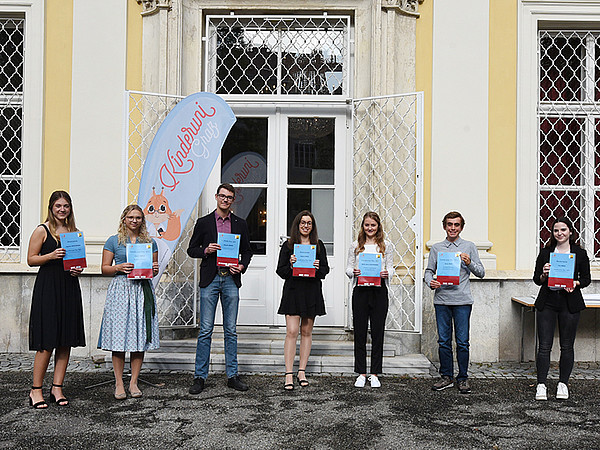
Die PreisträgerInnen der JuniorAcademic Preise sowie des SPRADI-Preises 2021. Foto: Uni Graz/Leljak.
created by Gerhild Leljak

Related news

Career Booster: How the Research Careers Campus supports researchers

They are innovative, creative and productive – researchers who have not yet been appointed to a professorship make a massive contribution to a university’s research output. To provide them with even better support on their career path, the University of Graz has established the Research Careers Campus. The official launch took place on 22 April 2026 with a ‘festival’.

Greenery on the rise: over 500 new flowers, perennials and shrubs on campus

Bright blooms and fresh greenery make our hearts beat faster in spring. But it is not just us humans who delight in this colourful growth. For many animals, this splendour provides, above all, food and habitat. There has recently been an increase in this on the University of Graz campus. More than 500 native flowers, perennials and shrubs have been planted on strips of fallow land around Universitätsplatz 2.

Around the world in eight stops: the Long Night of Research at the University of Graz

On 24 April from 5 pm, you can take a short trip around the globe at the University of Graz, discovering pecularities of foreign countries or new local features in the entrance hall of the University Library. The itinerary takes you through introduced animal species, political attitudes and the omnipotence of algorithms. There will also be a programme in the historic reading hall, as well as at the UniGraz@Museum and the University Archive.

Building biological bridges: Chemist discovers an ecological tool for the pharmaceutical industry

Building a relationship on a solid foundation is also important in chemistry. To produce medicines, disinfectants or plant protection products, stable bonds between carbon atoms must be formed. Conventional chemical methods rely on environmentally harmful reagents and solvents to carry out the desired reaction. This process also produces unusable by-products. Chemist Lilla Gal has discovered an enzyme that enables the same process to take place efficiently and sustainably. The results of her research were recently published in the prestigious journal Angewandte Chemie.

Begin of page section:
Additional information:

University of Graz
Universitaetsplatz 3
8010 Graz
Austria
  • Contact
  • Web Editors
  • Moodle
  • UNIGRAZonline
  • Imprint
  • Data Protection Declaration
  • Accessibility Declaration
Weatherstation
Uni Graz

End of this page section. Go to overview of page sections

End of this page section. Go to overview of page sections

Begin of page section:

End of this page section. Go to overview of page sections