Begin of page section:
Page sections:

  • Go to contents (Accesskey 1)
  • Go to position marker (Accesskey 2)
  • Go to main navigation (Accesskey 3)
  • Go to sub navigation (Accesskey 4)
  • Go to additional information (Accesskey 5)
  • Go to page settings (user/language) (Accesskey 8)
  • Go to search (Accesskey 9)

End of this page section. Go to overview of page sections

Begin of page section:
Page settings:

English en
Deutsch de
Search
Login

End of this page section. Go to overview of page sections

Begin of page section:
Search:

Search for details about Uni Graz
Close

End of this page section. Go to overview of page sections


Search

Begin of page section:
Main navigation:

Page navigation:

  • University

    University
    • About the University
    • Organisation
    • Faculties
    • Library
    • Working at University of Graz
    • Campus
    Developing solutions for the world of tomorrow - that is our mission. Our students and our researchers take on the great challenges of society and carry the knowledge out.
  • Research Profile

    Research Profile
    • Our Expertise
    • Research Questions
    • Research Portal
    • Promoting Research
    • Research Transfer
    • Ethics in Research
    • Commission for Scientific Integrity
    Scientific excellence and the courage to break new ground. Research at the University of Graz creates the foundations for making the future worth living.
  • Studies

    Studies
    • Prospective Students
    • Students
    • Welcome Weeks for First Year Students
  • Community

    Community
    • International
    • Location
    • Research and Business
    • Alumni
    The University of Graz is a hub for international research and brings together scientists and business experts. Moreover, it fosters the exchange and cooperation in study and teaching.
Topics
  • Sustainable University
  • Researchers answer
  • Work for us
Close menu

End of this page section. Go to overview of page sections

Begin of page section:
You are here:

University of Graz News Forschung für Gesundheit

End of this page section. Go to overview of page sections

Tuesday, 17 March 2015

Forschung für Gesundheit

Virtuelle Biopsie des Herzens als Zukunftsvision Foto: Med Uni Graz

Virtuelle Biopsie des Herzens als Zukunftsvision Foto: Med Uni Graz

BioTechMed-Graz: virtuelle Biopsie des Herzens als Zukunftsvision

Die Entwicklung der Magnetresonanztomographie (MRT) am Standort Graz kann bereits auf eine 30-jährige Erfolgsgeschichte zurückblicken und ist auch zukünftig durch Innovation gekennzeichnet. In der Forschungskooperation BioTechMed-Graz arbeiten die Universität Graz, die TU Graz und die Med Uni Graz gemeinsam an der Weiterentwicklung dieses bildgebenden Verfahrens und dessen Einsatzmöglichkeiten in verschiedenen Disziplinen. Im Rahmen des Symposiums „MRT-Forschung in Graz“ wird am 20. März 2015 die Frage geklärt, was heute bereits möglich ist und was die Zukunft an weiteren Entwicklungen bereithält.

Jubiläum: 30 Jahre Grazer MRT-Forschung
„Forschung für Gesundheit“ ist die zentrale Aufgabe der Forschungskooperation BioTechMed Graz, in der Uni Graz, TU Graz und Med Uni Graz ihre Expertise bündeln. Die Erforschung und die damit verbundene Weiterentwicklung bildgebender Verfahren bilden einen Schwerpunkt in der gemeinsamen Grazer Gesundheitsforschung. Die Forschung auf dem Gebiet der Magnetresonanztomographie ist seit 30 Jahren erfolgreich am Standort Graz implementiert und liefert vor allem im Bereich der Neurowissenschaften bemerkenswerte Ergebnisse. Aber auch in anderen Disziplinen wird die MRT angewendet und weiterentwickelt. Am 20. März 2015 veranstaltet BioTechMed-Graz an der Med Uni Graz ein Symposium zum Thema „MRT Forschung in Graz – Was ist möglich und was dürfen wir erwarten?“. Im Rahmen dieses Symposiums werden neue Einsatzmöglichkeiten und zukünftige Weiterentwicklungen der MRT von ExpertInnen der drei Universitäten präsentiert.

4D-Flow-Bildgebung: Neue MRT Biomarker für das Herz
Die Herz-Magnetresonanztomographie hat sich in den letzten Jahren zur „Untersuchungsmethode der Wahl“ zahlreicher Herzerkrankungen entwickelt. „Die konventionelle Beurteilung des Herzens erfolgt primär anhand von MRT Bildern und ihrer Kontraste“, erklärt DIin Dr.in Ursula Reiter, Univ.-Klinik für Radiologie, Med Uni Graz. Für die Diagnose, aber auch Prognose wird die Gewinnung quantitativ erfassbarer Kenngrößen – sogenannte Biomarker – allerdings immer wichtiger.
Relaxationszeitmapping als „virtuelle Myokardbiopsie“ - Probenentnahme aus der Herzinnenwand - und 4D-Flow-Bildgebung als „nicht-invasives CathLab“ sind zwei äußerst ambitionierte Visionen der Arbeitsgruppe Herz-MRT an der Univ.-Klinik für Radiologie der Med Uni Graz.

Myokardiale magnetische Relaxationszeiten konnten bereits mit diffuser myokardialer Fibrose, einem frühen Marker der fortschreitenden Herzinsuffizienz, als auch Myokardödem, dem Zeichen entzündlicher Prozesse, in Verbindung gebracht werden. Diese Relaxationszeiten hängen aber auch von vielerlei physiologischen Parametern ab, zu deren geeigneten Berücksichtigung die Universitätsklinik für Radiologie einen hochrangig publizierten Beitrag leisten konnte.

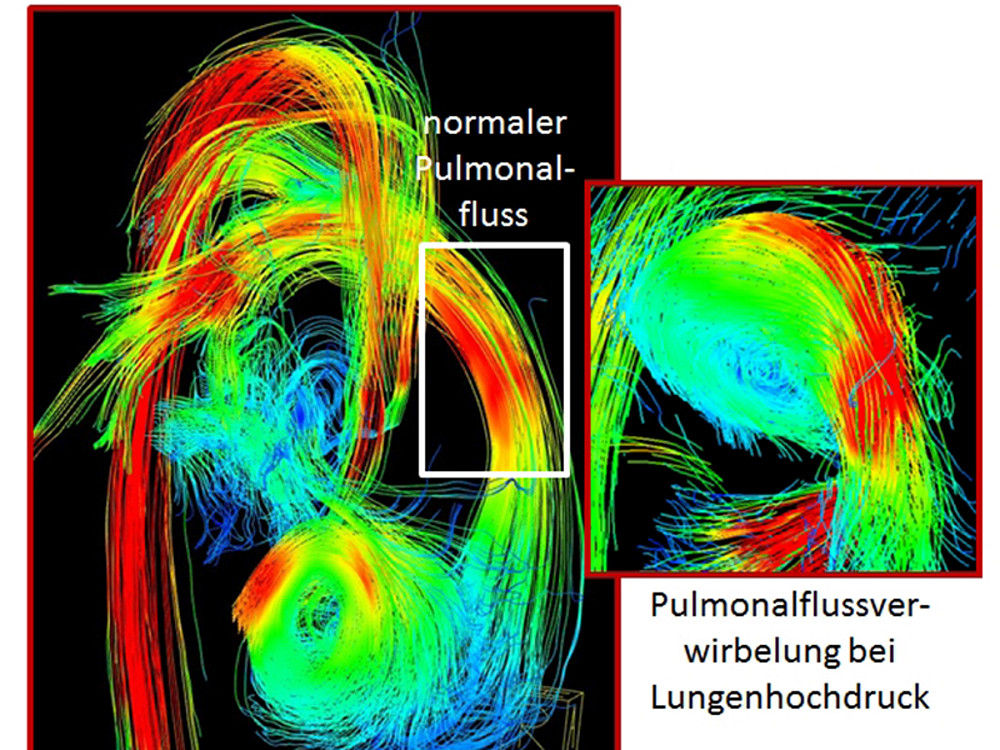
4D-Flow-Bildgebung erlaubt die vollständige Charakterisierung der kardialen Blutströmung, in welcher generisch der Blutdruck kodiert ist.
Schon 2008 wurde im Rahmen einer Forschungskooperation der Med Uni Graz mit Siemens die erste nicht-invasive Methode zur Bestimmung von Lungenhochdruck entwickelt, die mittlerweile weltweit patentiert ist.
Die nicht-invasive Erkennung der lebensbedrohlichen Krankheit Lungenhochdruck gelingt damit mit hoher Genauigkeit. Das Zusammenspiel dieser neuen, morphologischen und funktionellen kardialen MRT-Biomarker wird, unterstützt durch High-End MR-Technik, in laufenden Studien erforscht und analysiert.

Grazer Vielfalt: Innovative Entwicklung der Bildgebung im Fokus
Neben dem Einsatz neuer MRT-Biomarker für das Herz gibt es noch zahlreiche weitere Entwicklungen: So wird im Rahmen des Symposiums beispielsweise erklärt, wie Emotionen die räumliche Aufmerksamkeit leiten, welche Einsatzmöglichkeiten es für die MRT in der Rehabilitationsforschung gibt, oder welche Möglichkeiten der MRT jenseits der parallelen Bildgebung existieren.

Symposium: „MRT Forschung in Graz – Was ist möglich und was dürfen wir erwarten?“ Eine Veranstaltung der interuniversitären Forschungskooperation BioTechMed-Graz
WANN: Freitag, 20. März 2015, 09.00 bis 15.30 Uhr
WO: Med Uni Graz, Hörsaalzentrum, Auenbruggerplatz 15, 8036 Graz


http://biotechmedgraz.at

created by Gerald Auer & Andreas Schweiger

Related news

Jurassic Sounds: Biologist reconstructs insect songs from 165 million years ago

It was apparently not just the roars of the dinosaurs that made up the soundscape of the animal world during the Jurassic period. Crickets and grasshoppers communicated through a variety of songs and high-pitched sounds, as Thorin Jonsson from the Institute of Biology at the University of Graz discovered together with colleagues from the universities of Lincoln, Bristol (UK), Beijing (China) and Tempe (USA). The findings on what are so far the oldest traces of sound on Earth have just been published in the journal PNAS.

EU funding boosts international exchange between universities

The University of Graz is further expanding its international study opportunities through the European university alliance Arqus and is taking the lead in two key projects. In future, students will benefit from even more joint degree programmes and from simplified recognition of academic achievements through the Joint European Degree Label.

Rescue and risks: Researchers have surveyed public perceptions of AI

The use of artificial intelligence has had to be made transparent since 2 August 2026. The EU’s AI Act, which has been in force since then, also sets out how risky an application is and which security measures apply as a result. However, the assessment of risks by the legislation differs in some cases significantly from the perceptions of the Austrian public. This is the finding of a representative study carried out by data scientist Stefan Thalmann from the University of Graz and his team.

The Healing Sea: Researchers discover new approaches to treating chronic inflammation in sponges

Chronic inflammation plays a key role in many diseases, ranging from metabolic disorders and cardiovascular diseases to tissue damage following injuries or infections. “Normally, the body is able to resolve inflammation on its own. If this process becomes unbalanced, immune cells remain permanently active and continue to drive negative changes in the tissue,” explains Andreas Koeberle, a pharmacist at the University of Graz.

Begin of page section:
Additional information:

University of Graz
Universitaetsplatz 3
8010 Graz
Austria
  • Contact
  • Web Editors
  • Moodle
  • UNIGRAZonline
  • Imprint
  • Data Protection Declaration
  • Accessibility Declaration
Weatherstation
Uni Graz

End of this page section. Go to overview of page sections

End of this page section. Go to overview of page sections

Begin of page section:

End of this page section. Go to overview of page sections