Begin of page section:
Page sections:

  • Go to contents (Accesskey 1)
  • Go to position marker (Accesskey 2)
  • Go to main navigation (Accesskey 3)
  • Go to sub navigation (Accesskey 4)
  • Go to additional information (Accesskey 5)
  • Go to page settings (user/language) (Accesskey 8)
  • Go to search (Accesskey 9)

End of this page section. Go to overview of page sections

Begin of page section:
Page settings:

English en
Deutsch de
Search
Login

End of this page section. Go to overview of page sections

Begin of page section:
Search:

Search for details about Uni Graz
Close

End of this page section. Go to overview of page sections


Search

Begin of page section:
Main navigation:

Page navigation:

  • University

    University
    • About the University
    • Organisation
    • Faculties
    • Library
    • Working at University of Graz
    • Campus
    Developing solutions for the world of tomorrow - that is our mission. Our students and our researchers take on the great challenges of society and carry the knowledge out.
  • Research Profile

    Research Profile
    • Our Expertise
    • Research Questions
    • Research Portal
    • Promoting Research
    • Research Transfer
    • Ethics in Research
    Scientific excellence and the courage to break new ground. Research at the University of Graz creates the foundations for making the future worth living.
  • Studies

    Studies
    • Prospective Students
    • Students
  • Community

    Community
    • International
    • Location
    • Research and Business
    • Alumni
    The University of Graz is a hub for international research and brings together scientists and business experts. Moreover, it fosters the exchange and cooperation in study and teaching.
  • Spotlight
Topics
  • Our digital Advent calendar
  • Sustainable University
  • Researchers answer
  • Work for us
Close menu

End of this page section. Go to overview of page sections

Begin of page section:
You are here:

University of Graz News Stop Covid-19

End of this page section. Go to overview of page sections

Monday, 24 August 2020

Stop Covid-19

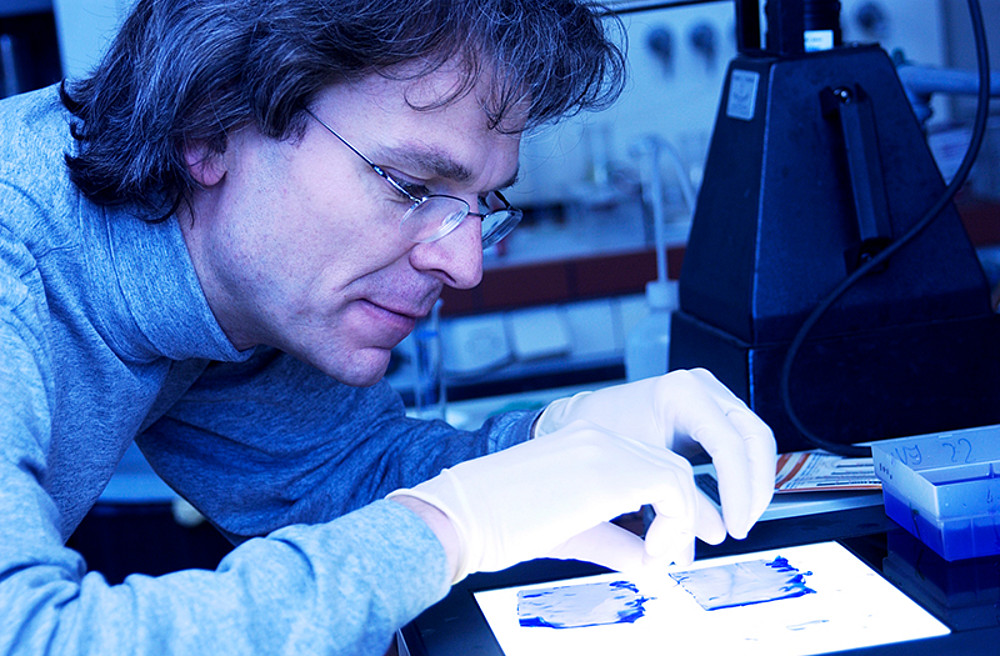
Andreas Kungl is leading a research project with the idea to find an effective way to prevent the coronavirus from entering human cells. A fundraising initiative to support the research has now been launched. Photo: Jorj Konstantinov.

Andreas Kungl is leading a research project with the idea to find an effective way to prevent the coronavirus from entering human cells. A fundraising initiative to support the research has now been launched. Photo: Jorj Konstantinov.

University of Graz launches a fundraising initiative to speed up the development of a drug against coronavirus

All over the world intensive research is under way to develop a treatment to combat SARS-CoV-2, the cause of Covid-19. The University of Graz is now launching a fundraising project to which anyone can contribute, with the aim of accelerating an unconventional therapeutic approach being pursued here. The idea is to find an effective way to prevent the virus with a novel drug from entering human cells via the surrounding extracellular matrix.


>> Click here to visit the project website, where you can make a donation: https://fundraising.uni-graz.at/de/stop-covid-19/


Project leader (principal investigator) Andreas Kungl from the Institute of Pharmaceutical Sciences explains: “Our cells are surrounded by a layer of complex sugar structures within a matrix, which form a frontline barrier to defend cells against anything trying to enter the body. However, certain intruders – tumour cells, for example, but also viruses such as SARS-CoV-2 – are able to take advantage of this barrier. For this purpose, the Covid-19 virus docks to these sugar structures in the first place, before he enters lung cells via a typical protein receptor. At exactly this first point the new drug should prevent contact and thus inhibit penetration of the target tissue.


Sugar as a game changer
Special sugar molecule receptors play a key role in this process. “Due to their complex chemical structure they have so far not been extensively studied, and they have hardly been discussed at all in the context of developing a medication against Covid-19,” says Kungl. In the future, it will be vital to have a wide range of drugs available, the researcher explains: “This means we need to identify many different suitable molecular target structures on which pharmaceutical substances can act. Focusing on the sugar molecule receptors is an entirely new and pioneering approach, which has the potential to make a crucial impact on combating future diseases caused by various viruses.”


Supporting research in Graz
Andreas Kungl and his research group have been working for a long time on identifying possible targets for their novel biopharmaceuticals which, amongst other indications, could prevent also metastases formation, for example in lung, prostate and colon cancer. Kurt Zatloukal from the Diagnostic & Research Institute of Pathology at the Medical University of Graz is also involved in the current project. Together the team hopes to make a substance available within the next 18 months to treat severely ill Covid-19 patients. “The fundraising initiative is designed to generate financial support for this important research, and thus to accelerate it,” explains Peter Riedler, Vice-Rector for Financial Affairs, Resources and Location Development.

At the same time, there are other research projects running in Graz that are also looking for ways to treat coronavirus infections. The University of Graz start-up Innophore, for example, is currently collaborating with Google and Harvard University to test around two billion potential drug candidates to combat SARS-CoV-2.

>> Andreas Kungl: Sedcard

>> More information


Related news

Fair distribution: Researchers determine just greenhouse gas budgets for all EU regions

Ten years ago, on 12 December 2015, the Paris Climate Agreement was signed at the UN Climate Conference. In order to limit global warming to well below two degrees, only a certain amount of CO2 may be emitted worldwide. While the focus was originally on national emission targets, more than 200 subnational regions and almost 300 cities have now adopted their own targets. But how many emissions are they fairly entitled to? Researchers at the University of Graz have now developed transparent criteria for fair distribution at the subnational level for the first time and determined corresponding greenhouse gas budgets for all European regions. The paper was published today in the scientific journal Nature Communications.

Chemical Christmas show at the University of Graz: An explosive evening at the Schauspielh

At the beginning of December, the University of Graz transformed the theater into a laboratory: as part of “Chemical Life,” teacher training students staged a chemical Christmas show for Styrian school classes—complete with ethanol rockets, nitrogen snow, and glowing effects. An evening designed to inspire interest in studying chemistry.

Train by train: Koralm railway accelerates exchange between the Universities

Lectures at the University of Klagenfurt in the morning, seminars at the University of Graz in the afternoon: Austria's longest tunnel and a journey time of around 45 minutes make it easy. The Koralm railway increases the speed of networking between the two university locations. The collaboration builds on existing cooperation - for example in the areas of teacher training, Slavic studies and as employers, the universities are well coordinated.

On the trail of the Big Bang: University of Graz receives 1.5 million euros for doctoral programmes

The Austrian Science Fund FWF has selected the Doctoral Programme in Theoretical Particle Physics at the University of Graz for funding from the Doc.funds. Six young scientists will be funded for 3.5 years. They will gain fundamentally new insights into the origins of the world.

Begin of page section:
Additional information:

University of Graz
Universitaetsplatz 3
8010 Graz
Austria
  • Contact
  • Web Editors
  • Moodle
  • UNIGRAZonline
  • Imprint
  • Data Protection Declaration
  • Accessibility Declaration
Weatherstation
Uni Graz

End of this page section. Go to overview of page sections

End of this page section. Go to overview of page sections

Begin of page section:

End of this page section. Go to overview of page sections