Begin of page section:
Page sections:

  • Go to contents (Accesskey 1)
  • Go to position marker (Accesskey 2)
  • Go to main navigation (Accesskey 3)
  • Go to sub navigation (Accesskey 4)
  • Go to additional information (Accesskey 5)
  • Go to page settings (user/language) (Accesskey 8)
  • Go to search (Accesskey 9)

End of this page section. Go to overview of page sections

Begin of page section:
Page settings:

English en
Deutsch de
Search
Login

End of this page section. Go to overview of page sections

Begin of page section:
Search:

Search for details about Uni Graz
Close

End of this page section. Go to overview of page sections


Search

Begin of page section:
Main navigation:

Page navigation:

  • University

    University
    • About the University
    • Organisation
    • Faculties
    • Library
    • Working at University of Graz
    • Campus
    Developing solutions for the world of tomorrow - that is our mission. Our students and our researchers take on the great challenges of society and carry the knowledge out.
  • Research Profile

    Research Profile
    • Our Expertise
    • Research Questions
    • Research Portal
    • Promoting Research
    • Research Transfer
    • Ethics in Research
    • Commission for Scientific Integrity
    Scientific excellence and the courage to break new ground. Research at the University of Graz creates the foundations for making the future worth living.
  • Studies

    Studies
    • Prospective Students
    • Students
  • Community

    Community
    • International
    • Location
    • Research and Business
    • Alumni
    The University of Graz is a hub for international research and brings together scientists and business experts. Moreover, it fosters the exchange and cooperation in study and teaching.
  • Spotlight
Topics
  • Sustainable University
  • Researchers answer
  • Work for us
Close menu

End of this page section. Go to overview of page sections

Begin of page section:
You are here:

University of Graz News Forscher:innen entdecken natürlichen Wirkstoff zum Schutz vor Lebererkrankungen

End of this page section. Go to overview of page sections

Monday, 30 March 2026

Forscher:innen entdecken natürlichen Wirkstoff zum Schutz vor Lebererkrankungen

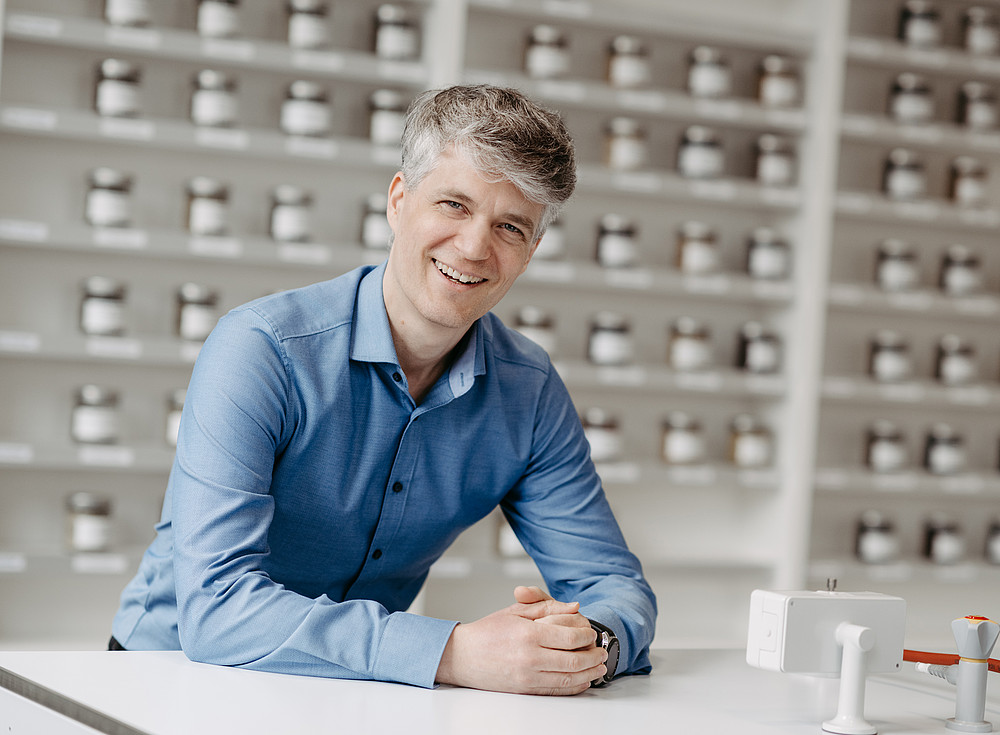
Ein Mann sitzt in einem Labor ©MICHAELA BEGSTEIGER

Andreas Koeberle hat mit seinem Team und Kolleg:innen der Uni Innsbruck den natürlichen Wirkstoff Mitrephoron B untersucht, der neue Behandlungsansätze für Lebererkrankungen ermöglicht. Foto: Uni Graz/Begsteiger.

Die Leber leidet still. „Fetteinlagerungen, strukturelle Zerstörung des Gewebes oder mutierende Tumorzellen – all das fliegt eine Weile unter dem Radar. Begleitet werden diese Veränderungen oft von leichten, jedoch chronischen Entzündungen“, erklärt Andreas Koeberle, Pharmazeut an der Universität Graz. Er hat mit seinem Team und Kolleg:innen der Universität Innsbruck den Wirkstoff Mitrephoron B untersucht, der neue Behandlungsansätze ermöglicht. Die Ergebnisse der Studie wurden kürzlich in der Open-Access-Fachzeitschrift „Theranostics“ veröffentlicht.

Mitrephoron B wird aus dem auf Borneo beheimateten Busch Mitrephora glabra gewonnen und hat mehrere positive Wirkungen auf die Leber, schildert Koeberle. „Zum einen greift der Wirkstoff in die Arbeit der Lipidtropfen ein. Das sind Organellen, die Energie für magere Zeiten speichern. Mitrephoron B verändert die Zusammensetzung der Fettsäuren in den Lipidtropfen und macht die Zellhaut dadurch widerstandsfähiger gegen oxidativen Stress.“ Zum anderen verlangsamt der Wirkstoff die Produktion von mehreren Botenstoffen, die Entzündungen fördern. „Gleichzeitig hilft Mitrephoron B dem Körper, selbst Substanzen zu bilden, die Inflammationen hemmen und so Zellen vor dem Tod schützen“, resümiert der Forscher. 

Auch in den Fettstoffwechsel greift der Wirkstoff ein: Er senkt die Spiegel von gespeichertem Cholesterol in Immunzellen. „Das Überangebot an Lipiden ist einer der Faktoren, die häufig eine niedrig-gradige Dauerentzündung auslösen, die wiederum zu Leberzirrhose, Fettleber oder Krebs führen kann“, beschreibt der Forscher. Wird der Cholesterol-Spiegel in Immunzellen gesenkt, kann das dazu beitragen, dass Krankheiten langsamer voranschreiten. 

Mitrephoron B ist also ein vielversprechender Kandidat für die Entwicklung neuer Medikamente. „Weitere Untersuchungen sind allerdings notwendig, um die Wirksamkeit und Sicherheit des Wirkstoffs zu bestätigen“, betont Koeberle. 


Publikationsdaten: Waltl, L., Wein, L.A., Bereuter, L., Su, F., Barta, H., Le Xuan, L., Holubek, D., Mahmoudi, Z., Puskac, K., Siller, A., Schlenke, P., Schennach, H., Pferschy-Wenzig, E.M., Schött, H., Racedo, S., Koeberle, S.C., Magauer, T., Koeberle, A. (2026) Context-dependent activities of mitrephorone link lipid redirection, anti-inflammatory action, and ferroptosis control to hepatocyte protection (2026). Theranostics. https://doi.org/10.7150/thno.127100. 

created by Gerhild Leljak

Related news

Climate at the cliffs: Researchers unravel the evolution of the Greenland ice margin

Vertical ice walls, up to 40 metres high: in "Game of Thrones" they were dramatised as fortifications; during the Cold War, they were studied with great interest. How these imposing walls along Greenland’s 80,000-kilometre-long ice margin formed, how they are evolving, and what impact they have on the climate is not yet fully understood. Researchers from the Universities of Graz and Innsbruck have come one step closer to solving the mystery. The results of their latest study have been published in the journal The Cryosphere.

Achieving climate goals: Researchers highlight need for fair country shares in CO2

As the war in the Middle East is currently reminding us once again, many countries around the world are heavily reliant on oil and gas. Lax climate policy and limited options for removing CO₂ from the atmosphere could cement this dependence for future generations. Scientists at the University of Graz highlight this danger in a new study published in the journal Global Environmental Change. They find that rights to carbon dioxide removal should be distributed across countries just as fairly as emission budgets in order to halt global warming.

Electrons and AI: New approaches to the search for new medicines

Researchers at the University of Graz are revolutionising the development of new medicines by combining electrochemistry and artificial intelligence. Thanks to smart optimisation, the search for new active ingredients will in future be faster, more sustainable and safer.

Universities call for sustained investment in the Southern Education Region

University rectors are calling for an adequately funded budget for the Southern Education Region

Begin of page section:
Additional information:

University of Graz
Universitaetsplatz 3
8010 Graz
Austria
  • Contact
  • Web Editors
  • Moodle
  • UNIGRAZonline
  • Imprint
  • Data Protection Declaration
  • Accessibility Declaration
Weatherstation
Uni Graz

End of this page section. Go to overview of page sections

End of this page section. Go to overview of page sections

Begin of page section:

End of this page section. Go to overview of page sections