Begin of page section:
Page sections:

  • Go to contents (Accesskey 1)
  • Go to position marker (Accesskey 2)
  • Go to main navigation (Accesskey 3)
  • Go to sub navigation (Accesskey 4)
  • Go to additional information (Accesskey 5)
  • Go to page settings (user/language) (Accesskey 8)
  • Go to search (Accesskey 9)

End of this page section. Go to overview of page sections

Begin of page section:
Page settings:

English en
Deutsch de
Search
Login

End of this page section. Go to overview of page sections

Begin of page section:
Search:

Search for details about Uni Graz
Close

End of this page section. Go to overview of page sections


Search

Begin of page section:
Main navigation:

Page navigation:

  • University

    University
    • About the University
    • Organisation
    • Faculties
    • Library
    • Working at University of Graz
    • Campus
    Developing solutions for the world of tomorrow - that is our mission. Our students and our researchers take on the great challenges of society and carry the knowledge out.
  • Research Profile

    Research Profile
    • Our Expertise
    • Research Questions
    • Research Portal
    • Promoting Research
    • Research Transfer
    • Ethics in Research
    • Commission for Scientific Integrity
    Scientific excellence and the courage to break new ground. Research at the University of Graz creates the foundations for making the future worth living.
  • Studies

    Studies
    • Prospective Students
    • Students
    • Registration for Study Programme (Winter semester 2026/27)
  • Community

    Community
    • International
    • Location
    • Research and Business
    • Alumni
    The University of Graz is a hub for international research and brings together scientists and business experts. Moreover, it fosters the exchange and cooperation in study and teaching.
Topics
  • Sustainable University
  • Researchers answer
  • Work for us
Close menu

End of this page section. Go to overview of page sections

Begin of page section:
You are here:

University of Graz News Festival der Forschung

End of this page section. Go to overview of page sections

Tuesday, 28 August 2018

Festival der Forschung

Der FWF präsentiert Spitzenforschung zum Entdecken, Mitmachen und Mitreden: ForscherInnen der Uni Graz sind beim Festival in Wien mit dabei.

Der FWF präsentiert Spitzenforschung zum Entdecken, Mitmachen und Mitreden: ForscherInnen der Uni Graz sind beim Festival in Wien mit dabei.

50 Jahre FWF: WissenschafterInnen der Universität Graz präsentieren Projekte in Wien

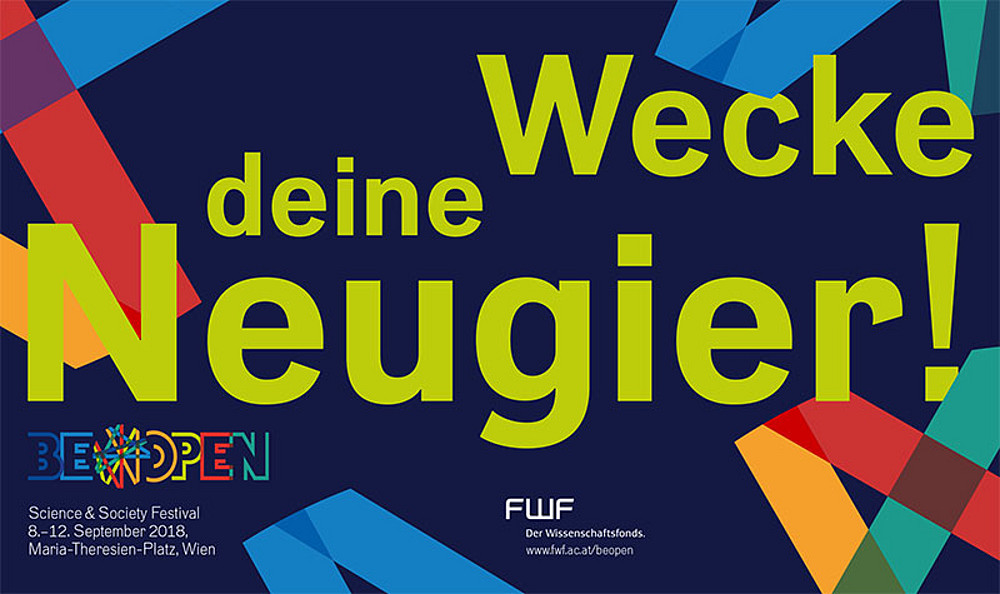
Mit einem mehrtätigen Science & Society Festival feiert der Österreichische Wissenschaftsfonds FWF von 8. bis 12. September 2018 sein 50-jähriges Bestehen. Unter dem Motto „BE OPEN“ wird der Maria-Theresien-Platz in Wien – zwischen Naturhistorischem und Kunsthistorischem Museum – zur Bühne für Spitzenforschung. Auch WissenschafterInnen der Universität Graz präsentieren vor großem Publikum ausgewählte Projekte.

Molekülrennen, Weltraumwetter, Deutsch in Österreich
In einem interaktiven Pop-up-Pavillon zum Thema Materialforschung demonstriert Leonhard Grill mit seinem Team vom Institut für Chemie, wie sich einzelne Moleküle manipulieren lassen. Die BesucherInnen erfahren, was es mit diesem „Autorennen“ auf sich hat und können außerdem via Live-Schaltung in ein Labor an der Universität Graz in Echtzeit Moleküle und Atome in Bewegung bringen.

Im Pavillon zum Thema Astronomie zeigen Forscher vom Institutsbereich Geophysik, Astronomie und Meteorologie sowie vom Observatorium Kanzelhöhe Live-Bilder von der Sonne. Bei Werner Pötzi und Desmond Helmut Grossmann können sich die BesucherInnen aus erster Hand über neueste Erkenntnisse zu Sonnenaktivität und Weltraumwetter informieren.

Ein Team von SprachwissenschafterInnen unter der Leitung von Arne Ziegler wird zusammen mit KollegInnen aus ganz Österreich Einblicke in den Spezialforschungsbereich „Deutsch in Österreich“ geben. Dieser beschäftigt sich mit Aspekten wie regionalen Besonderheiten, Wahrnehmung von Sprache, Sprachkontakt, Veränderungen in der Zeit oder sozialen und situationsbezogenen Zusammenhängen.

Open Science und Citizen Science
Darüber hinaus ist die Universität Graz Kooperationspartnerin des UNIVERSITÄTSDISKURS AUSTRIA: WISSENSCHAFT | KUNST | GESELLSCHAFT IM GESPRÄCH am 11. September 2018 – eine Veranstaltung der uniko (Universitätenkonferenz), die in das FWF-Festival eingebettet ist.

Die Veranstaltung widmet sich dem Thema „Inklusive Wissenschaft: zum Für und Wider von Open Science und Citizen Science“ und setzt sich auf künstlerischer, wissenschaftlicher und diskursiver Ebene damit auseinander. Nach einer Begrüßung durch Wissenschaftsminister Heinz Faßmann und uniko-Präsidentin Eva Blimlinger interpretiert das AUREUM Saxophon Quartett das Thema Neugier mit Hilfe verschiedener Komponisten aus verschiedenen Epochen.

Nach einer Keynote von Sabine Brunswicker (Purdue University, USA) werden Brunswicker selbst, Ron Dekker (CESSDA, Bergen), Benedikt Fecher (Humboldt Institut für Internet und Gesellschaft, Berlin) und Eunike Grahofer (Citizen Scientist) unter der Moderation von Ina Zwerger (Ö1) am Podium diskutieren.

>> Mehr erfahren


Der FWF präsentiert Spitzenforschung zum Entdecken, Mitmachen und Mitreden


Alle Infos zu BE OPEN – Science & Society Festival
created by Gudrun Pichler & Andreas Schweiger

Related news

Save, invest or guarantee: What Austrians expect from the state

Austria needs to make savings. But where? And what should the Republic actually be spending its money on? The answers are provided by the initial findings of a major study involving the University of Graz. 99 per cent of those surveyed are in favour of the state ensuring healthcare provision. Almost three-quarters would like to see more public funding for education, whilst only around three per cent are in favour of cuts in this sector.

Complying with the norm: Why Do Standards Shape Our Lives, Elisabeth Staudegger?

Standards determine whether a sheet of paper fits in a printer or whether a charging plug can power multiple devices. These standards shape our everyday lives. But who actually sets these standards? Where are the weaknesses, and how could science help to improve them? Elisabeth Staudegger, Head of the ‘Law and IT’ Department at the Institute for Legal Foundations at the University of Graz, host the Academic Standards Day on 16 June. Here she relays how sciences can contribute to the topic of standardisation and reveals her personal favourite standard.

More body awareness than a culture war

In Italy, sex education lessons will in future only be permitted with parental consent, and will be banned entirely in nurseries and primary schools. At the same time, Pride Month highlights why knowledge about the body, relationships, boundaries and diversity is important for young people. A study by the University of Graz shows how important knowledge about the body, contraception, relationship skills and protection against violence is

Will Austria win the World Cup? Mathematician reveals calculation method

Michael Fischer uses the football tournament as a practical example for highschool lessons.

Begin of page section:
Additional information:

University of Graz
Universitaetsplatz 3
8010 Graz
Austria
  • Contact
  • Web Editors
  • Moodle
  • UNIGRAZonline
  • Imprint
  • Data Protection Declaration
  • Accessibility Declaration
Weatherstation
Uni Graz

End of this page section. Go to overview of page sections

End of this page section. Go to overview of page sections

Begin of page section:

End of this page section. Go to overview of page sections