Begin of page section:
Page sections:

  • Go to contents (Accesskey 1)
  • Go to position marker (Accesskey 2)
  • Go to main navigation (Accesskey 3)
  • Go to sub navigation (Accesskey 4)
  • Go to additional information (Accesskey 5)
  • Go to page settings (user/language) (Accesskey 8)
  • Go to search (Accesskey 9)

End of this page section. Go to overview of page sections

Begin of page section:
Page settings:

English en
Deutsch de
Search
Login

End of this page section. Go to overview of page sections

Begin of page section:
Search:

Search for details about Uni Graz
Close

End of this page section. Go to overview of page sections


Search

Begin of page section:
Main navigation:

Page navigation:

  • University

    University
    • About the University
    • Organisation
    • Faculties
    • Library
    • Working at University of Graz
    • Campus
    Developing solutions for the world of tomorrow - that is our mission. Our students and our researchers take on the great challenges of society and carry the knowledge out.
  • Research Profile

    Research Profile
    • Our Expertise
    • Research Questions
    • Research Portal
    • Promoting Research
    • Research Transfer
    • Ethics in Research
    • Commission for Scientific Integrity
    Scientific excellence and the courage to break new ground. Research at the University of Graz creates the foundations for making the future worth living.
  • Studies

    Studies
    • Prospective Students
    • Students
    • Welcome Weeks for First Year Students
  • Community

    Community
    • International
    • Location
    • Research and Business
    • Alumni
    The University of Graz is a hub for international research and brings together scientists and business experts. Moreover, it fosters the exchange and cooperation in study and teaching.
Topics
  • Sustainable University
  • Researchers answer
  • Work for us
Close menu

End of this page section. Go to overview of page sections

Begin of page section:
You are here:

University of Graz News Fesches Format

End of this page section. Go to overview of page sections

Thursday, 12 February 2015

Fesches Format

Update für die Uni-Graz-Homepage, 36.000 Seiten bekommen ein neues Gesicht

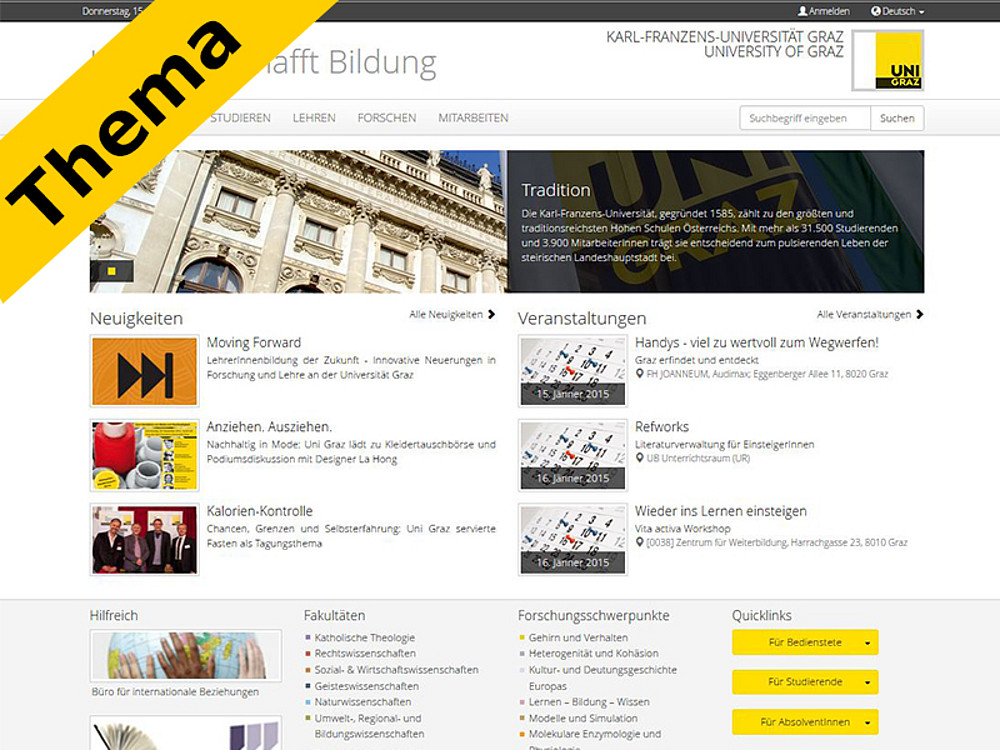
Die Homepage der Uni Graz wird am kommenden Montag, den 16. Februar 2015, auf den neuesten Sicherheits-Stand gebracht; im Zuge dieses Updates wird auch das Layout, das derzeit noch dem Userbility-Standard von 2012 entspricht, ein wenig modernisiert. Die rund 36.000 Seiten werden tagsüber automatisiert in das neue Design überführt. Danach erfolgen noch manuelle Anpassungen durch die MitarbeiterInnen der UNI-IT. Gegen Abend werden alle Webseiten in der neuen Version online sein. Neben einem Sicherheitsupdate wird die Webseite der Uni Graz im verbesserten Layout vor allem auf mobilen Endgeräten, wie Tablets und Smartphones fortan bequem lesbar sein – responsive Layout. Neu sind auch vereinheitlichte Informationsteaser sowie größere Kontaktboxen, die in einer weiteren Stufe auch mit dem Campusplan gekoppelt werden sollen. Das Update wird automatisch im Hintergrund eingespielt, die Informationen auf den Webseiten bleiben selbstverständlich uneingeschränkt verfügbar.


Vor der Umstellung

Sie können schon jetzt sehen, wie Ihre Website im neuen Kleid aussehen wird.

  • Loggen Sie sich im Backend (http://webadmin.uni-graz.at) ein. Wählen Sie die anzusehende Seite im Seitenbaum links [1].
  • Über die rechte Maustaste erhalten Sie die Option „Ansehen“. Wählen Sie diese aus. Es öffnet sich in der Regel ein neuer Tab im Browser mit der anzuzeigenden Seite [2].
  • Ersetzen Sie Ihre Subdomain (hier “ict”) durch “dev2www” sowie das “https://” durch “http://”. Lassen Sie den Rest des URLs so stehen, wie er ist. [3]
  • Bei dringenden Fragen wenden Sie sich bitte an den Servicedesk. Nutzen Sie bitte unser Angebot an offenen Arbeitsrunden ab dem 17.2. Die Termine finden Sie hier.
  • Sie können schon jetzt die Qualität der Bilddarstellung auf Ihren Seiten überprüfen. Sollte diese nicht entsprechen, können Sie die Bilder schon vor der Umstellung mit den neuen Bildformaten hochladen. Details zu den neuen Formaten hier.


Während der Umstellung am 16.2.2015

  • Sie können tagsüber nicht im Backend arbeiten, alle Seiten sind schreibgeschützt.
  • Die bestehenden Seiten werden während der Umstellung zum Großteil weiterhin ins Internet ausgeliefert.
  • Alle Standard-Elemente der Seiten werden automatisch ans neue System angepasst.
  • Darstellungsprobleme könnte es bei eigenen, nicht-standardisierten Elementen oder falsch verwendeten Elementen geben. Diese sollten in den darauffolgenden Tagen in den Arbeitsgruppen besprochen und behoben werden.
  • Die Bildformate werden geändert. Infos unter: http://typo3support.uni-graz.at/de/designmoeglichkeiten/bilder-dokumente-und-andere-medien/ 


Nach der Umstellung

Um den Umstieg zu erleichtern, bieten wir Ihnen

  • eine Vielzahl von Terminen für offene Arbeitsgruppen ein Handout mit allen wesentlichen Änderungen
  • einen überarbeiteten FAQ-Bereich unter typo3support.uni-graz.at
  • Das Login im Backend bleibt natürlich unverändert!
  • Das modernisierte, übersichtliche Design der Uni-Graz-Homepage passt sich automatisch den Endgeräten Tablets und Smartphones an

created by Konstantinos Tzivanopoulos

Related news

Jurassic Sounds: Biologist reconstructs insect songs from 165 million years ago

It was apparently not just the roars of the dinosaurs that made up the soundscape of the animal world during the Jurassic period. Crickets and grasshoppers communicated through a variety of songs and high-pitched sounds, as Thorin Jonsson from the Institute of Biology at the University of Graz discovered together with colleagues from the universities of Lincoln, Bristol (UK), Beijing (China) and Tempe (USA). The findings on what are so far the oldest traces of sound on Earth have just been published in the journal PNAS.

EU funding boosts international exchange between universities

The University of Graz is further expanding its international study opportunities through the European university alliance Arqus and is taking the lead in two key projects. In future, students will benefit from even more joint degree programmes and from simplified recognition of academic achievements through the Joint European Degree Label.

Rescue and risks: Researchers have surveyed public perceptions of AI

The use of artificial intelligence has had to be made transparent since 2 August 2026. The EU’s AI Act, which has been in force since then, also sets out how risky an application is and which security measures apply as a result. However, the assessment of risks by the legislation differs in some cases significantly from the perceptions of the Austrian public. This is the finding of a representative study carried out by data scientist Stefan Thalmann from the University of Graz and his team.

The Healing Sea: Researchers discover new approaches to treating chronic inflammation in sponges

Chronic inflammation plays a key role in many diseases, ranging from metabolic disorders and cardiovascular diseases to tissue damage following injuries or infections. “Normally, the body is able to resolve inflammation on its own. If this process becomes unbalanced, immune cells remain permanently active and continue to drive negative changes in the tissue,” explains Andreas Koeberle, a pharmacist at the University of Graz.

Begin of page section:
Additional information:

University of Graz
Universitaetsplatz 3
8010 Graz
Austria
  • Contact
  • Web Editors
  • Moodle
  • UNIGRAZonline
  • Imprint
  • Data Protection Declaration
  • Accessibility Declaration
Weatherstation
Uni Graz

End of this page section. Go to overview of page sections

End of this page section. Go to overview of page sections

Begin of page section:

End of this page section. Go to overview of page sections