



Begin of page section:
Page sections:

  • Go to contents (Accesskey 1)
  • Go to position marker (Accesskey 2)
  • Go to main navigation (Accesskey 3)
  • Go to sub navigation (Accesskey 4)
  • Go to additional information (Accesskey 5)
  • Go to page settings (user/language) (Accesskey 8)
  • Go to search (Accesskey 9)

End of this page section. Go to overview of page sections

Begin of page section:
Page settings:

English en
Deutsch de
Search
Login

End of this page section. Go to overview of page sections

Begin of page section:
Search:

Search for details about Uni Graz
Close

End of this page section. Go to overview of page sections


Search

Begin of page section:
Main navigation:

Page navigation:

  • University

    University
    • About the University
    • Organisation
    • Faculties
    • Library
    • Working at University of Graz
    • Campus
    Developing solutions for the world of tomorrow - that is our mission. Our students and our researchers take on the great challenges of society and carry the knowledge out.
  • Research Profile

    Research Profile
    • Our Expertise
    • Research Questions
    • Research Portal
    • Promoting Research
    • Research Transfer
    • Ethics in Research
    • Commission for Scientific Integrity
    Scientific excellence and the courage to break new ground. Research at the University of Graz creates the foundations for making the future worth living.
  • Studies

    Studies
    • Prospective Students
    • Students
    • Registration for Study Programme (Winter semester 2026/27)
    • Study Days 22-26 June 2026
  • Community

    Community
    • International
    • Location
    • Research and Business
    • Alumni
    The University of Graz is a hub for international research and brings together scientists and business experts. Moreover, it fosters the exchange and cooperation in study and teaching.
Topics
  • Sustainable University
  • Researchers answer
  • Work for us
Close menu

End of this page section. Go to overview of page sections

Begin of page section:
You are here:

University of Graz News Fehler macht flexibel

End of this page section. Go to overview of page sections

Wednesday, 25 July 2018

Fehler macht flexibel
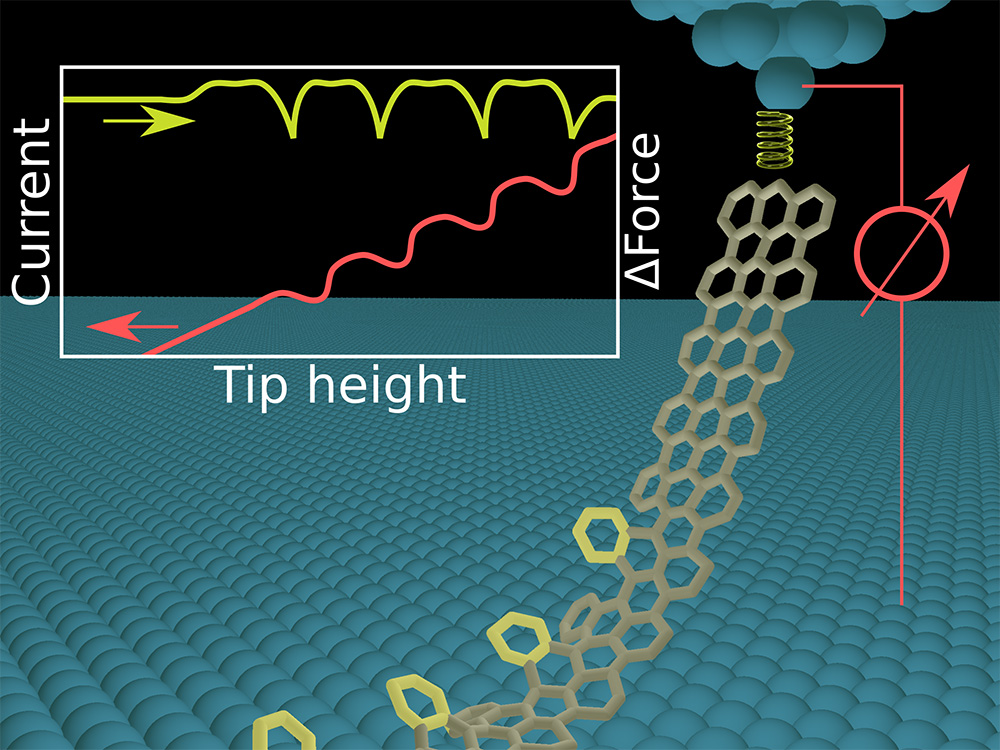
Strukturelle Defekte machen Nanodrähte biegsamer: Das zeigten Forscher der Universität Graz in einer aktuelle Publikation. Grafik: Uni Graz
Strukturelle Defekte machen Nanodrähte biegsamer: Das zeigten Forscher der Universität Graz in einer aktuelle Publikation. Grafik: Uni Graz

Nano-Forscher der Universität Graz charakterisieren den Einfluss von Defekten auf Graphendrähte

Elektronische Bauteile wie Schalter oder Transistoren, die aus einem einzigen Molekül bestehen, könnten in Zukunft die Technik revolutionieren. Die Grundlagen dafür erforscht die Arbeitsgruppe Single-Molecule Chemistry an der Universität Graz unter der Leitung von Leonhard Grill. Das Team hat nun herausgefunden, dass Graphendrähte - ein vielversprechender Typ der für die zukünftigen Anwendungen nötigen molekularen „Kabel“ - durch strukturelle Fehler biegsamer werden. Die Ergebnisse sind soeben im Fachmagazin Physical Review Letters erschienen und wurden dort als „Editors’ Suggestion“ ausgezeichnet.

„Graphendrähte sind interessante Kandidaten als Miniatur-‚Kabel‘ für Schaltungen, weil sich ihre elektronischen Eigenschaften über ihre Breite von wenigen Nanometer einstellen lassen“, berichtet Grill. Bei der Herstellung können Defekte entstehen – also Stellen, an denen sich der Kristall nicht ordentlich ausbildet. „Bisher hat noch niemand untersucht, wie sich diese Fehler auf die Funktionalität auswirken“, so der Forscher. Seine Arbeitsgruppe konnte nun zeigen, dass diese Defekte die Flexibilität der Drähte erhöhen, die elektrischen Eigenschaften aber unverändert lassen.

Um die Messungen durchführen zu können, setzten die Physiker durch den Einsatz der richtigen Molekülbausteine die Drähte auf einer Goldoberfläche zusammen. Durch gezielte Veränderung der Probentemperatur können sie die Defektdichte in der Kette einstellen. „Wir beobachteten, dass strukturelle Fehler in Gruppen auftreten, ein Zeichen für kooperatives Verhalten“, schildert Grill. Anschließend hoben die Forscher mit der extrem feinen Spitze eines Rastersondenmikroskops ein freies Ende eines Graphendrahtes hoch, um sowohl das elektrische Verhalten als auch die mechanischen Eigenschaften eines einzelnen Drahtes simultan und in Echtzeit zu studieren. Je mehr Defekte ein Graphendraht hatte, umso mehr konnte er gebogen werden – ein Beweis für erhöhte Flexibilität.
„Interessanterweise stellte sich heraus, dass die Anzahl der Defekte kaum Einfluss auf die elektronischen Eigenschaften und die elektrische Leitfähigkeit hat“, so der Physiker. Die Ergebnisse könnten daher für zukünftige Anwendungen der Nanotechnologie von Interesse sein, bei denen mechanische Flexibilität erforderlich ist, die elektronischen Eigenschaften jedoch erhalten bleiben sollen.

created by Dagmar Eklaude

Related news

Save, invest or guarantee: What Austrians expect from the state

Austria needs to make savings. But where? And what should the Republic actually be spending its money on? The answers are provided by the initial findings of a major study involving the University of Graz. 99 per cent of those surveyed are in favour of the state ensuring healthcare provision. Almost three-quarters would like to see more public funding for education, whilst only around three per cent are in favour of cuts in this sector.

Complying with the norm: Why Do Standards Shape Our Lives, Elisabeth Staudegger?

Standards determine whether a sheet of paper fits in a printer or whether a charging plug can power multiple devices. These standards shape our everyday lives. But who actually sets these standards? Where are the weaknesses, and how could science help to improve them? Elisabeth Staudegger, Head of the ‘Law and IT’ Department at the Institute for Legal Foundations at the University of Graz, host the Academic Standards Day on 16 June. Here she relays how sciences can contribute to the topic of standardisation and reveals her personal favourite standard.

More body awareness than a culture war

In Italy, sex education lessons will in future only be permitted with parental consent, and will be banned entirely in nurseries and primary schools. At the same time, Pride Month highlights why knowledge about the body, relationships, boundaries and diversity is important for young people. A study by the University of Graz shows how important knowledge about the body, contraception, relationship skills and protection against violence is

Will Austria win the World Cup? Mathematician reveals calculation method

Michael Fischer uses the football tournament as a practical example for highschool lessons.

Begin of page section:
Additional information:

University of Graz
Universitaetsplatz 3
8010 Graz
Austria
  • Contact
  • Web Editors
  • Moodle
  • UNIGRAZonline
  • Imprint
  • Data Protection Declaration
  • Accessibility Declaration
Weatherstation
Uni Graz

End of this page section. Go to overview of page sections

End of this page section. Go to overview of page sections

Begin of page section:

End of this page section. Go to overview of page sections


