Begin of page section:
Page sections:

  • Go to contents (Accesskey 1)
  • Go to position marker (Accesskey 2)
  • Go to main navigation (Accesskey 3)
  • Go to sub navigation (Accesskey 4)
  • Go to additional information (Accesskey 5)
  • Go to page settings (user/language) (Accesskey 8)
  • Go to search (Accesskey 9)

End of this page section. Go to overview of page sections

Begin of page section:
Page settings:

English en
Deutsch de
Search
Login

End of this page section. Go to overview of page sections

Begin of page section:
Search:

Search for details about Uni Graz
Close

End of this page section. Go to overview of page sections


Search

Begin of page section:
Main navigation:

Page navigation:

  • University

    University
    • About the University
    • Organisation
    • Faculties
    • Library
    • Working at University of Graz
    • Campus
    Developing solutions for the world of tomorrow - that is our mission. Our students and our researchers take on the great challenges of society and carry the knowledge out.
  • Research Profile

    Research Profile
    • Our Expertise
    • Research Questions
    • Research Portal
    • Promoting Research
    • Research Transfer
    • Ethics in Research
    Scientific excellence and the courage to break new ground. Research at the University of Graz creates the foundations for making the future worth living.
  • Studies

    Studies
    • Prospective Students
    • Students
  • Community

    Community
    • International
    • Location
    • Research and Business
    • Alumni
    The University of Graz is a hub for international research and brings together scientists and business experts. Moreover, it fosters the exchange and cooperation in study and teaching.
  • Spotlight
Topics
  • Our digital Advent calendar
  • Sustainable University
  • Researchers answer
  • Work for us
Close menu

End of this page section. Go to overview of page sections

Begin of page section:
You are here:

University of Graz News Fall der Mauer

End of this page section. Go to overview of page sections

Wednesday, 03 April 2019

Fall der Mauer

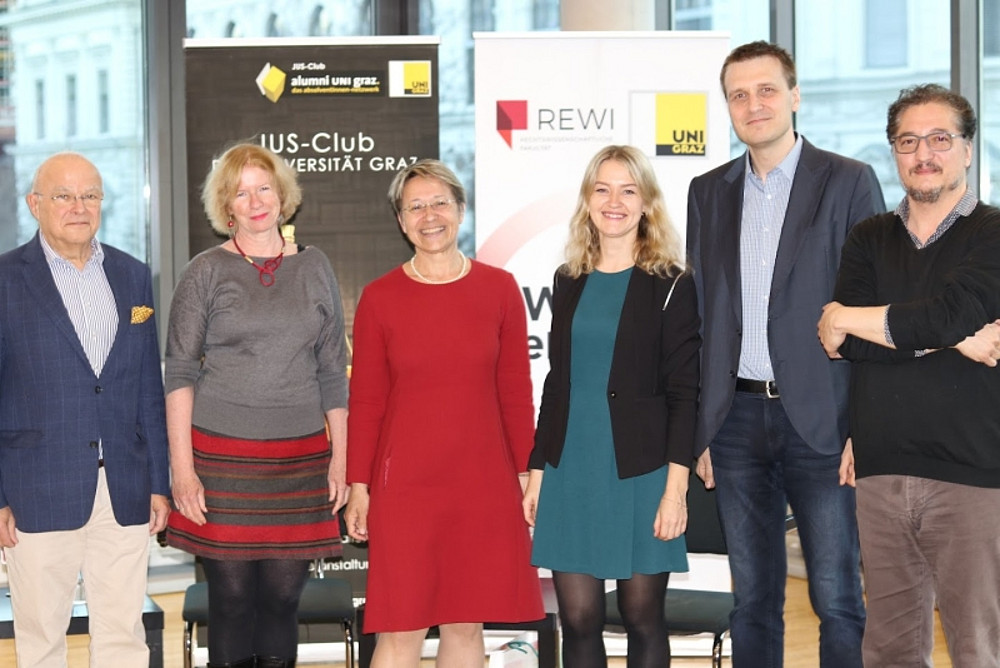
Das Jahr 1989 im Fokus: Joseph Marko, Claudia Gigler, Anita Ziegerhofer, Aiste Mickonyte, Benedikt Harzl und Kerem Öktem (v. l.) Foto: Uni Graz/Mayer-Krauss ©alumni UNI Graz/Mayer-Krauss

Das Jahr 1989 im Fokus: Joseph Marko, Claudia Gigler, Anita Ziegerhofer, Aiste Mickonyte, Benedikt Harzl und Kerem Öktem (v. l.) Foto: Uni Graz/Mayer-Krauss

Als der Eiserne Vorhang fiel: rechtshistorischer Blick auf das Jahr 1989 und seine Folgen

Es war eine weltpolitische Sensation, als vor genau 30 Jahren der Eiserne Vorhang fiel und die Welt neu geordnet wurde. Der 4. Rechtshistorische Dialog am 26. März 2019 warf daher einen Blick auf dieses Ereignis der jüngeren Zeitgeschichte. 
Mit eindrucksvollen Bildern zeichnete zunächst Joseph Marko, Professor am Institut für Öffentliches Recht, in seinem Vortrag die Geschehnisse rund um das Jahr 1989 nach, beleuchtete das weltweite Geschehen bis ins Heute und zeigte Gegenpole, Trennlinien, aber auch gemeinsame Entwicklungen auf.
In der anschließenden Podiumsdiskussion berichteten unter der Moderation von Anita Ziegerhofer, Professorin am Institut für Rechtswissenschaftliche Grundlagen, drei WissenschafterInnen der Universität Graz und eine Journalistin von ihren persönlichen Erfahrungen und Beobachtungen zum und nach dem Jahr 1989. 

Claudia Gigler, Redakteurin der Kleine Zeitung, erzählte von der Begeisterung der Menschen in Berlin direkt nach dem Mauerfall, den sie vor Ort als Journalistin miterlebte. Zwei Jahre später, als sie neuerlich das Land besuchte, war die Stimmung umgeschlagen, die Bevölkerung ernüchtert. Aiste Mickonyte vom Russian East European Eurasian Studies Centre – in Litauen aufgewachsen – schilderte, wie ihre Familie den Umbruch als Zeit der Hoffnung empfand, eine Hoffnung auf die Wiedererlangung der Eigenstaatlichkeit Litauens. 
Benedikt Harzl, ebenfalls Wissenschafter am Russian East European Eurasian Studies Centre, erläuterte, wie auch im Russland der 1990er-Jahre ein Zeitenbruch stattfand und Tendenzen, sich dem Westen anzunähern, zu verzeichnen waren. Kerem Öktem, Professor am Zentrum für Südosteuropastudien, beleuchtete Entwicklungen in der Türkei und zeigte den interessanten Aspekt auf, dass die Türkei im Kalten Krieg eher zum Westen gehörte, danach eher in den Osten rückte. 

Fortsetzung folgt: Der nächste Rechtshistorische Dialog findet am 15. Oktober 2019 statt. Thema: 100 Jahre Staatsvertrag 

>> Fotogalerie 

created by Wolfgang Schleifer

Related news

Semester abroad without barriers: University of Graz wins award for promoting inclusion

The University of Graz has been awarded the Internationalization Award for its new inclusion initiative. Students with fewer opportunities now also receive financial support for their semester abroad outside Europe.

Fair distribution: Researchers determine just greenhouse gas budgets for all EU regions

Ten years ago, on 12 December 2015, the Paris Climate Agreement was signed at the UN Climate Conference. In order to limit global warming to well below two degrees, only a certain amount of CO2 may be emitted worldwide. While the focus was originally on national emission targets, more than 200 subnational regions and almost 300 cities have now adopted their own targets. But how many emissions are they fairly entitled to? Researchers at the University of Graz have now developed transparent criteria for fair distribution at the subnational level for the first time and determined corresponding greenhouse gas budgets for all European regions. The paper was published today in the scientific journal Nature Communications.

Chemical Christmas show at the University of Graz: An explosive evening at the Schauspielh

At the beginning of December, the University of Graz transformed the theater into a laboratory: as part of “Chemical Life,” teacher training students staged a chemical Christmas show for Styrian school classes—complete with ethanol rockets, nitrogen snow, and glowing effects. An evening designed to inspire interest in studying chemistry.

Train by train: Koralm railway accelerates exchange between the Universities

Lectures at the University of Klagenfurt in the morning, seminars at the University of Graz in the afternoon: Austria's longest tunnel and a journey time of around 45 minutes make it easy. The Koralm railway increases the speed of networking between the two university locations. The collaboration builds on existing cooperation - for example in the areas of teacher training, Slavic studies and as employers, the universities are well coordinated.

Begin of page section:
Additional information:

University of Graz
Universitaetsplatz 3
8010 Graz
Austria
  • Contact
  • Web Editors
  • Moodle
  • UNIGRAZonline
  • Imprint
  • Data Protection Declaration
  • Accessibility Declaration
Weatherstation
Uni Graz

End of this page section. Go to overview of page sections

End of this page section. Go to overview of page sections

Begin of page section:

End of this page section. Go to overview of page sections