



Begin of page section:
Page sections:

  • Go to contents (Accesskey 1)
  • Go to position marker (Accesskey 2)
  • Go to main navigation (Accesskey 3)
  • Go to sub navigation (Accesskey 4)
  • Go to additional information (Accesskey 5)
  • Go to page settings (user/language) (Accesskey 8)
  • Go to search (Accesskey 9)

End of this page section. Go to overview of page sections

Begin of page section:
Page settings:

English en
Deutsch de
Search
Login

End of this page section. Go to overview of page sections

Begin of page section:
Search:

Search for details about Uni Graz
Close

End of this page section. Go to overview of page sections


Search

Begin of page section:
Main navigation:

Page navigation:

  • University

    University
    • About the University
    • Organisation
    • Faculties
    • Library
    • Working at University of Graz
    • Campus
    Developing solutions for the world of tomorrow - that is our mission. Our students and our researchers take on the great challenges of society and carry the knowledge out.
  • Research Profile

    Research Profile
    • Our Expertise
    • Research Questions
    • Research Portal
    • Promoting Research
    • Research Transfer
    • Ethics in Research
    • Commission for Scientific Integrity
    Scientific excellence and the courage to break new ground. Research at the University of Graz creates the foundations for making the future worth living.
  • Studies

    Studies
    • Prospective Students
    • Students
  • Community

    Community
    • International
    • Location
    • Research and Business
    • Alumni
    The University of Graz is a hub for international research and brings together scientists and business experts. Moreover, it fosters the exchange and cooperation in study and teaching.
  • Spotlight
Topics
  • Sustainable University
  • Researchers answer
  • Work for us
Close menu

End of this page section. Go to overview of page sections

Begin of page section:
You are here:

University of Graz News Eyewitnesses

End of this page section. Go to overview of page sections

Tuesday, 28 June 2022

Eyewitnesses

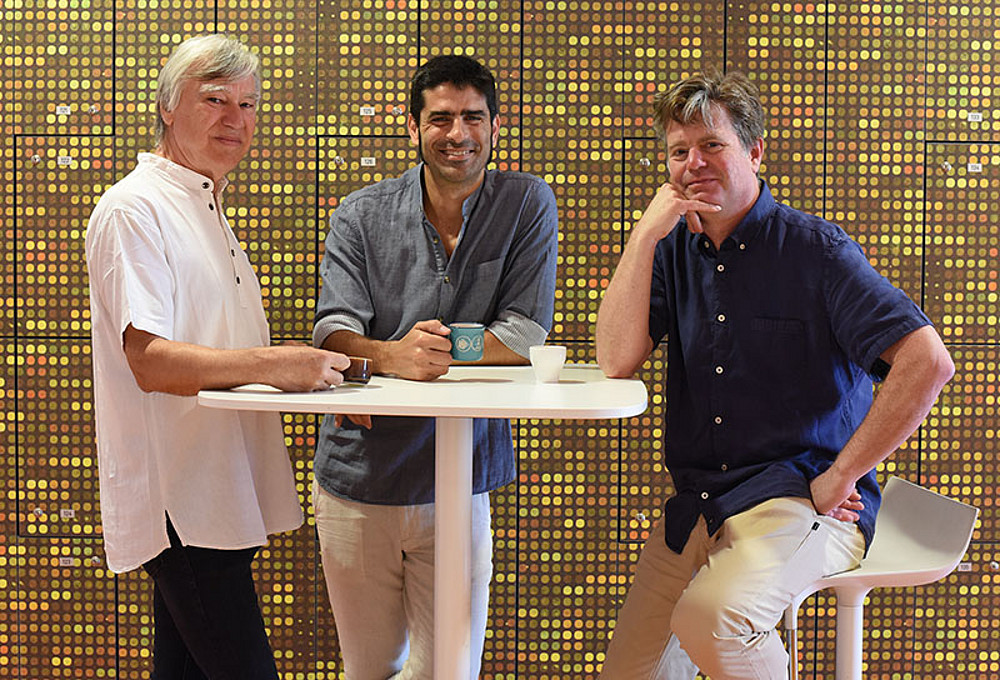
The most creative solutions to many a problem often emerge over coffee. This was the experience of biophysicists Karl Lohner, Enrico Semeraro and Georg Pabst (from left). A chance encounter seven years ago in Germany inspired the researchers to break out of tried-and-true thought patterns. Photo: Uni Graz/Leljak.

The most creative solutions to many a problem often emerge over coffee. This was the experience of biophysicists Karl Lohner, Enrico Semeraro and Georg Pabst (from left). A chance encounter seven years ago in Germany inspired the researchers to break out of tried-and-true thought patterns. Photo: Uni Graz/Leljak.

Researchers observe how small protein molecules destroy E. coli bacteria at lightning speed

Peptides are small protein molecules that control many processes in the human body. Some of them fight invaders such as bacteria and viruses as part of the innate immune system. Lactoferrin is also part of this defense force. Researchers at the University of Graz have now shown how powerful antimicrobial peptides - so-called AMPs - derived from lactoferrin are. And they did so using the E. coli bacterium, which can go from being a harmless intestinal inhabitant to the most common cause of diarrhea and inflammation. Spoiler alert: There is a murder at the end of this story!

On the trail of the killers

In fact, the AMPs made short work of the E. coli bacteria. "Within a few seconds, they had overcome the bacterium's outermost protective envelope and penetrated the cell interior," says Enrico Semeraro, describing the lightning-like assault in which there were no survivors. "What exactly the AMPs do inside the cell, i.e. how they kill the bacteria, remains a mystery for now. Our publication has, like a thriller, a real cliffhanger ending," admits Georg Pabst, "and of course there are the usual suspects."

In fact, what is special about the paper, published in the online journal eLife, is not the comprehensive elucidation of the "E. coli murder." Rather, it's the approach the team took to observe AMPs as they attacked - in real time and simultaneously on length scales that describe bacterial size (micrometers) and molecular structures (nanometers). "Our technique can be applied to other questions about molecular processes in cells. It allows us to find new solutions to certain problems that are otherwise inaccessible," Karl Lohner emphasizes.

Old tried and tested rethought

The "highlight" of the biophysicists' approach: they have used a time-honored method for the structural investigation of non-crystalline materials - known as small-angle scattering - for the first time to accurately "screen" bacteria. "Small-angle scattering gives us an incredible amount of data on the nature of molecular structures in these organisms. This was both an opportunity and a challenge.  We had to painstakingly filter out what was relevant to us by combining mathematics, physics, chemistry and molecular biology," explains Enrico Semeraro.

The effort was doubly worthwhile: On the one hand, the scientists have thus brought a new application of small-angle scattering onto the scene. On the other hand, the findings about the rapid demise of E. coli bacteria could also improve the design of novel antibiotics in the future.

The end of the key and lock

At the moment, these work according to a "lock and key" principle, i.e. they are "set" precisely to the bacterium to be combated. As researchers discover more about how AMPs work, they could be equipped with specific instructions as "hit men" and thus play tricks on bacteria that are becoming increasingly resistant to conventional methods. "This is still a dream of the future, but we still believe that our approach is right and important for such considerations," Semeraro is convinced.

Think outside the box

Breaking out of tried-and-tested thought patterns - that, by the way, is also what brought the native Italian to Graz. Chance brought Enrico Semeraro and Georg Pabst together at a conference in Dresden. Small-angle scattering and E. coli quickly became a topic. "And then it 'clicked,'" Pabst smiles. Seven years later, the two colleagues are at the Institute of Molecular Biosciences at the University of Graz and have successfully implemented the idea by means of an interdisciplinary collaboration within the Field of Excellence BioHealth. Their current publication shows how important creativity, unconventional ideas and cross-border approaches are also in natural science research.


Publication: Semeraro et al. "Lactoferricins impair the cytosolic membrane of Escherichia coli within a few seconds and accumulate inside the cell." eLife. DOI: https://doi.org/10.7554/eLife.72850


created by Gerhild Leljak

Related news

Greenery on the rise: over 500 new flowers, perennials and shrubs on campus

Bright blooms and fresh greenery make our hearts beat faster in spring. But it is not just us humans who delight in this colourful growth. For many animals, this splendour provides, above all, food and habitat. There has recently been an increase in this on the University of Graz campus. More than 500 native flowers, perennials and shrubs have been planted on strips of fallow land around Universitätsplatz 2.

Around the world in eight stops: the Long Night of Research at the University of Graz

On 24 April from 5 pm, you can take a short trip around the globe at the University of Graz, discovering pecularities of foreign countries or new local features in the entrance hall of the University Library. The itinerary takes you through introduced animal species, political attitudes and the omnipotence of algorithms. There will also be a programme in the historic reading hall, as well as at the UniGraz@Museum and the University Archive.

Building biological bridges: Chemist discovers an ecological tool for the pharmaceutical industry

Building a relationship on a solid foundation is also important in chemistry. To produce medicines, disinfectants or plant protection products, stable bonds between carbon atoms must be formed. Conventional chemical methods rely on environmentally harmful reagents and solvents to carry out the desired reaction. This process also produces unusable by-products. Chemist Lilla Gal has discovered an enzyme that enables the same process to take place efficiently and sustainably. The results of her research were recently published in the prestigious journal Angewandte Chemie.

Higher Education Strategy 2040: Austria’s universities on course for the future

Austria has 77 higher education institutions, which is above the EU average – but does this really make sense? The new Higher Education Strategy 2040 focuses on cooperation rather than mergers. As one of the six largest universities in Austria, the University of Graz plays a central role in this.

Begin of page section:
Additional information:

University of Graz
Universitaetsplatz 3
8010 Graz
Austria
  • Contact
  • Web Editors
  • Moodle
  • UNIGRAZonline
  • Imprint
  • Data Protection Declaration
  • Accessibility Declaration
Weatherstation
Uni Graz

End of this page section. Go to overview of page sections

End of this page section. Go to overview of page sections

Begin of page section:

End of this page section. Go to overview of page sections