Begin of page section:
Page sections:

  • Go to contents (Accesskey 1)
  • Go to position marker (Accesskey 2)
  • Go to main navigation (Accesskey 3)
  • Go to sub navigation (Accesskey 4)
  • Go to additional information (Accesskey 5)
  • Go to page settings (user/language) (Accesskey 8)
  • Go to search (Accesskey 9)

End of this page section. Go to overview of page sections

Begin of page section:
Page settings:

English en
Deutsch de
Search
Login

End of this page section. Go to overview of page sections

Begin of page section:
Search:

Search for details about Uni Graz
Close

End of this page section. Go to overview of page sections


Search

Begin of page section:
Main navigation:

Page navigation:

  • University

    University
    • About the University
    • Organisation
    • Faculties
    • Library
    • Working at University of Graz
    • Campus
    Developing solutions for the world of tomorrow - that is our mission. Our students and our researchers take on the great challenges of society and carry the knowledge out.
  • Research Profile

    Research Profile
    • Our Expertise
    • Research Questions
    • Research Portal
    • Promoting Research
    • Research Transfer
    • Ethics in Research
    Scientific excellence and the courage to break new ground. Research at the University of Graz creates the foundations for making the future worth living.
  • Studies

    Studies
    • Prospective Students
    • Students
  • Community

    Community
    • International
    • Location
    • Research and Business
    • Alumni
    The University of Graz is a hub for international research and brings together scientists and business experts. Moreover, it fosters the exchange and cooperation in study and teaching.
  • Spotlight
Topics
  • Our digital Advent calendar
  • Sustainable University
  • Researchers answer
  • Work for us
Close menu

End of this page section. Go to overview of page sections

Begin of page section:
You are here:

University of Graz News Europas 20. Jahrhundert

End of this page section. Go to overview of page sections

Friday, 07 November 2014

Europas 20. Jahrhundert

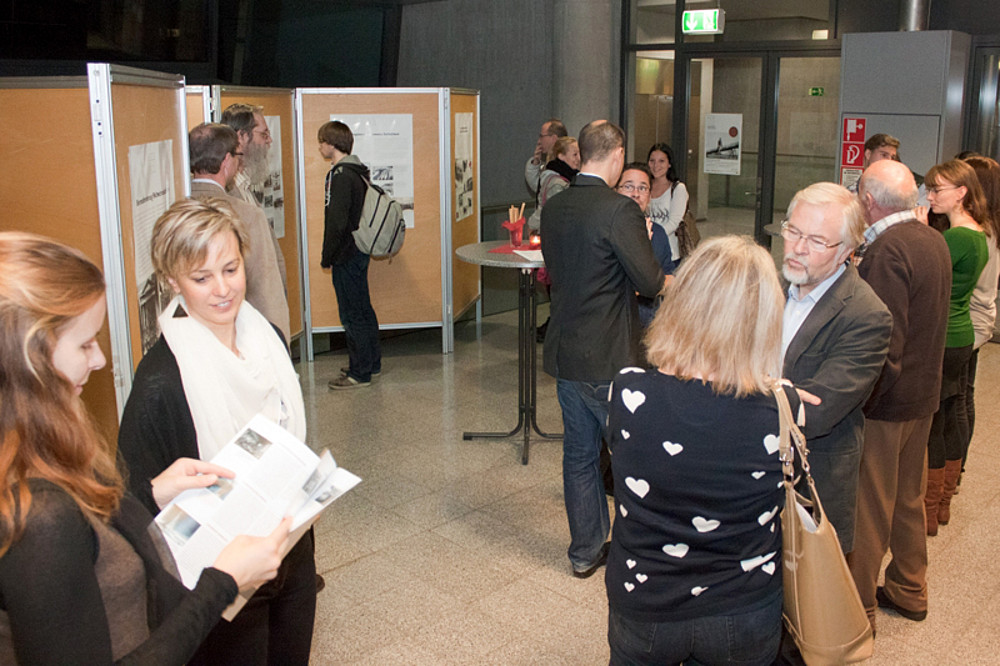
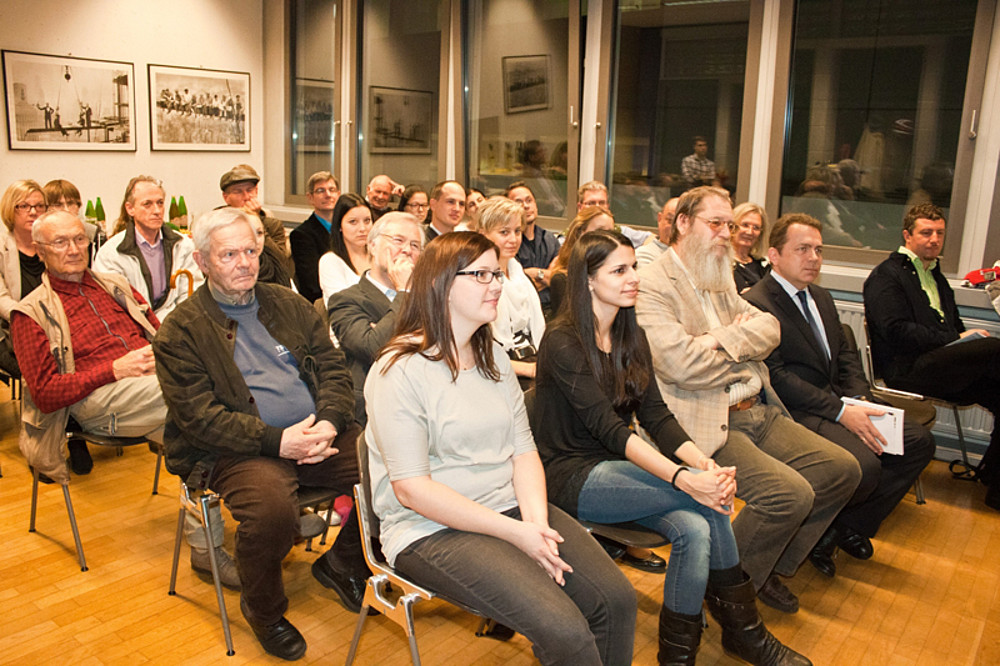
Gut besuchte Ausstellungseröffnung am 6. November im Resowi-Zentrum.

Gut besuchte Ausstellungseröffnung am 6. November im Resowi-Zentrum.

Die Schau ist noch bis 4. Dezember zu sehen.

Die Schau ist noch bis 4. Dezember zu sehen.

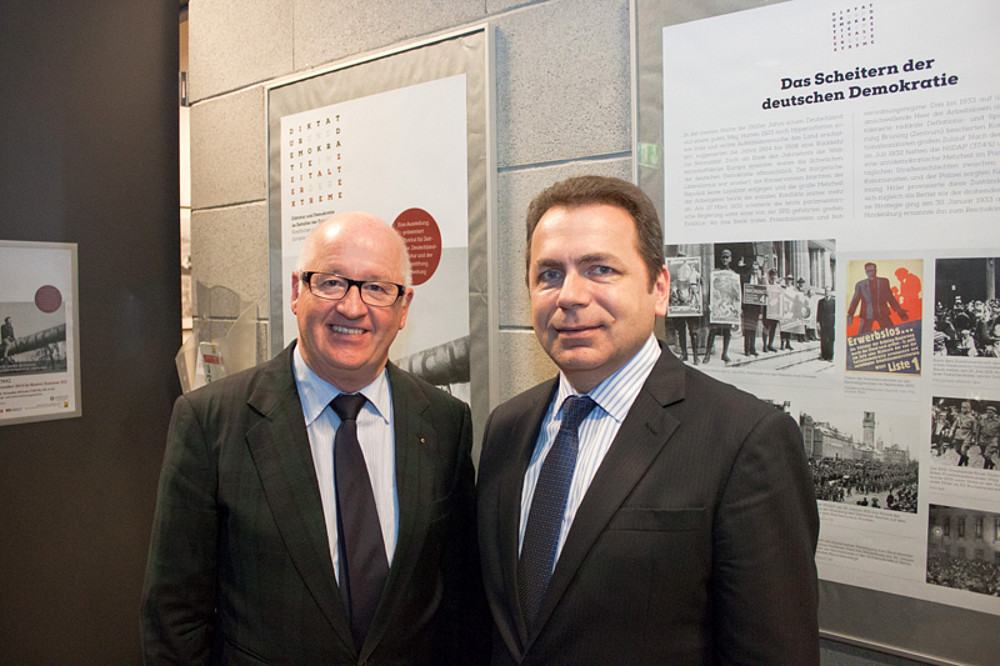
Stefan Karner (links) und SOWI-Dekan Thomas Foscht eröffneten die Ausstellung. Fotos: Kleinberger.

Stefan Karner (links) und SOWI-Dekan Thomas Foscht eröffneten die Ausstellung. Fotos: Kleinberger.

Ausstellung zu Diktatur und Demokratie im Zeitalter der Extreme eröffnet

Europas 20. Jahrhundert als dramatische Geschichte zwischen Freiheit und Tyrannei, zwischen Demokratie und Diktatur ist Thema einer aktuellen Ausstellung im RESOWI-Zentrum. Gestern, 6. November 2014, wurde die Schau "Diktatur und Demokratie im Zeitalter der Extreme. Streiflichter auf die Geschichte Europas im 20. Jahrhundert" von Univ.-Prof. Dr. Stefan Karner und SOWI-Dekan Univ.-Prof. Dr. Thomas Foscht eröffnet.


Die Ausstellung greift alle zentralen Themen des Erinnerungsjahrs 2014 auf und wird international in mehr als 3.000 Exemplaren und zehn Sprachfassungen gezeigt. Nach Graz brachten die Schau das Institut für Wirtschafts-, Sozial- und Unternehmensgeschichte der Karl-Franzens-Universität und das Ludwig Boltzmann Institut für Kriegsfolgenforschung.


"Diktatur und Demokratie im Zeitalter der Extreme" lädt zu einer historischen Ortsbestimmung ein, zu der das Jahr 2014 herausfordert: 2014 jährt sich der Ausbruch des Ersten Weltkriegs zum 100. Mal, 75 Jahre sind seit Beginn des Zweiten Weltkriegs vergangen, 25 Jahre seit den friedlichen Revolutionen und zehn Jahre seit der EU-Osterweiterung. Dazu Stefan Karner: „Die Ausstellung zeigt sehr eindringlich, wie tief totalitäre Systeme in das Alltagsleben der Menschen einwirken und wie schwer sich gerade junge Menschen dem entziehen konnten. Außerdem wird dargestellt, wie oft demokratisch legitimierte Systeme in diktatorische kippen konnten."


Auf 26 Tafeln präsentiert die Ausstellung rund 190 zeithistorische Fotos sowie 24 historische Tondokumente, die mit internetfähigen Mobiltelefonen via QR-Codes abgerufen werden können. AutorInnen der Ausstellung sind der Direktor des Instituts für Zeitgeschichte, Prof. Dr. Andreas Wirsching, und Dr. Petra Weber. Die vom Leipziger Grafiker Dr. Thomas Klemm gestaltete Ausstellung wird von der Bundesstiftung zur Aufarbeitung der SED-Diktatur, dem Institut für Zeitgeschichte und Deutschlandradio Kultur herausgegeben.


Die Schau ist von 6. November bis 4. Dezember 2014 im Resowi-Zentrum  der Karl-Franzens-Universität Graz (Universitätsstraße 15, Bauteil E, 2. Stock) öffentlich zugänglich.

created by Klaus Kleinberger & Gerhild Kastrun

Related news

Chemical Christmas show at the University of Graz: An explosive evening at the Schauspielh

At the beginning of December, the University of Graz transformed the theater into a laboratory: as part of “Chemical Life,” teacher training students staged a chemical Christmas show for Styrian school classes—complete with ethanol rockets, nitrogen snow, and glowing effects. An evening designed to inspire interest in studying chemistry.

Train by train: Koralm railway accelerates exchange between the Universities

Lectures at the University of Klagenfurt in the morning, seminars at the University of Graz in the afternoon: Austria's longest tunnel and a journey time of around 45 minutes make it easy. The Koralm railway increases the speed of networking between the two university locations. The collaboration builds on existing cooperation - for example in the areas of teacher training, Slavic studies and as employers, the universities are well coordinated.

On the trail of the Big Bang: University of Graz receives 1.5 million euros for doctoral programmes

The Austrian Science Fund FWF has selected the Doctoral Programme in Theoretical Particle Physics at the University of Graz for funding from the Doc.funds. Six young scientists will be funded for 3.5 years. They will gain fundamentally new insights into the origins of the world.

From trans women and knee prostheses: sports science prizes awarded

Walking better with a prosthesis, successfully getting rid of excess weight, training more effectively, more fairness for trans people in sport: these were the topics addressed by the students at the University of Graz who were awarded the sports science prizes for their Master's theses on 3 December 2025.

Begin of page section:
Additional information:

University of Graz
Universitaetsplatz 3
8010 Graz
Austria
  • Contact
  • Web Editors
  • Moodle
  • UNIGRAZonline
  • Imprint
  • Data Protection Declaration
  • Accessibility Declaration
Weatherstation
Uni Graz

End of this page section. Go to overview of page sections

End of this page section. Go to overview of page sections

Begin of page section:

End of this page section. Go to overview of page sections