Begin of page section:
Page sections:

  • Go to contents (Accesskey 1)
  • Go to position marker (Accesskey 2)
  • Go to main navigation (Accesskey 3)
  • Go to sub navigation (Accesskey 4)
  • Go to additional information (Accesskey 5)
  • Go to page settings (user/language) (Accesskey 8)
  • Go to search (Accesskey 9)

End of this page section. Go to overview of page sections

Begin of page section:
Page settings:

English en
Deutsch de
Search
Login

End of this page section. Go to overview of page sections

Begin of page section:
Search:

Search for details about Uni Graz
Close

End of this page section. Go to overview of page sections


Search

Begin of page section:
Main navigation:

Page navigation:

  • University

    University
    • About the University
    • Organisation
    • Faculties
    • Library
    • Working at University of Graz
    • Campus
    Developing solutions for the world of tomorrow - that is our mission. Our students and our researchers take on the great challenges of society and carry the knowledge out.
  • Research Profile

    Research Profile
    • Our Expertise
    • Research Questions
    • Research Portal
    • Promoting Research
    • Research Transfer
    • Ethics in Research
    • Commission for Scientific Integrity
    Scientific excellence and the courage to break new ground. Research at the University of Graz creates the foundations for making the future worth living.
  • Studies

    Studies
    • Prospective Students
    • Students
  • Community

    Community
    • International
    • Location
    • Research and Business
    • Alumni
    The University of Graz is a hub for international research and brings together scientists and business experts. Moreover, it fosters the exchange and cooperation in study and teaching.
  • Spotlight
Topics
  • Sustainable University
  • Researchers answer
  • Work for us
Close menu

End of this page section. Go to overview of page sections

Begin of page section:
You are here:

University of Graz News Es werde Licht ...

End of this page section. Go to overview of page sections

Tuesday, 11 November 2014

Es werde Licht ...
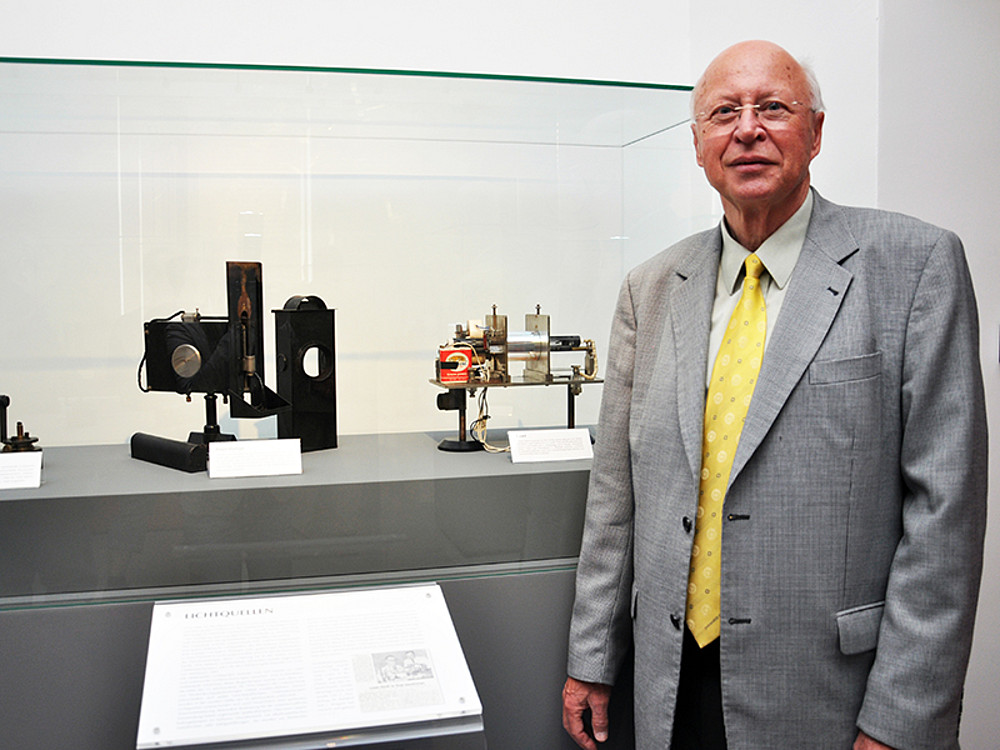
Physiker Franz Aussenegg baute 1964 den ersten Laser in der Steiermark. Die Pionierleistung ist UniGraz@Museum zu bestaunen. im Foto: Uni Graz/Schweiger


Physiker Franz Aussenegg baute 1964 den ersten Laser in der Steiermark. Die Pionierleistung ist UniGraz@Museum zu bestaunen. im Foto: Uni Graz/Schweiger
Pionierleistung der Physik an der Uni Graz: Der erste steirische Laser feiert 50. Geburtstag

DVD, Drucker sowie die Behandlung beim Augen- oder Hautarzt – die Laser-Technologie gehört längst zum Alltag. Im Herbst 1964 war es jedoch eine Sensation: Der erste steirische Laser erblickte das Rampenlicht. 50 Jahre später erinnert sich der Erbauer, Univ.-Prof.i.R. Dr. Franz Aussenegg, an die bahnbrechende Leistung, die als mittlerweile ältester österreichischer Laser im UniGraz@Museum zu bestaunen ist.

„Die Entwicklung und heutigen Anwendungen waren nicht vorhersehbar“, denkt Franz Aussenegg an die Präsentation des ersten steirischen Lasers vor genau fünf Jahrzehnten zurück.
Die Maschine zur Erzeugung von gebündeltem Licht hatte kurz davor in den USA für Furore gesorgt, aber nur langsam den Weg über den Atlantik genommen. Als damals 26-jähriger Assistent am Institut für Physik der Karl-Franzens-Universität Graz hatte Aussenegg die Spur aufgenommen und als Erster in der Steiermark diesen Apparat gebaut. „Der wissenschaftliche Austausch war aufgrund fehlender Kommunikationsinstrumente nicht so stark ausgeprägt. Der Bau des Lasers war vielfach eine Bastelei“, schmunzelt der Physiker. „Ich habe mit einer einfachen Batterie und Isolierband gearbeitet, aber auch mit Rubinstäben mit besonderer optischer Qualität.“
Das Gerät, das zugleich den Ausgangspunkt für moderne Forschung etwa im Bereich der Nanooptik an der Uni Graz bildet, existiert noch immer und ist in Österreich eine echte Rarität.

Anlässlich des Geburtstages wird am 19. November 2014, um 17 Uhr im UniGraz@Museum im Hauptgebäude, wo die Maschine ausgestellt ist, an die steirische Pionierleistung erinnert.
Ein Zwiegespräch zwischen Franz Aussenegg und Museumskustos Mag. Franz Stangl erklärt das Phänomen Laser für LaiInnen. Das historische Original kann natürlich besichtigt werden, Experimente mit modernen CO2- und Luftlasern zeigen den technologischen Fortschritt.

WANN: Mittwoch, 19. November 2014, 17 Uhr
WO: UniGraz@Museum, Universitätsplatz 3, Tiefparterre, 8010 Graz

Der Eintritt ist kostenlos, um Anmeldung wird gebeten:
Mag. Franz Stangl
Tel. 0316 380-7444
E-Mail: franz.stangl(at)uni-graz.at

created by Andreas Schweiger

Related news

Climate research in Greenland: Old data provides new insights

The polar explorer and University of Graz professor Alfred Wegener left behind a unique collection of climate data from Greenland. A research team from the University of Graz is now analysing this 100-year-old treasure trove of data and comparing it with current measurements.

Diversity in nature and science: How we talk about plants and each other

Ginkgo, kiwi, hemp: they exist as male and female plants. Anyone who paid attention in biology class will confirm this. But is this categorisation, established by Carl von Linné almost 300 years ago, still valid today? An interdisciplinary team at the University of Graz is questioning these attributions and using this as a starting point to provide food for thought for gender-sensitive interaction between students, scientific and teaching staff.

Around the world in eight stops: the Long Night of Research at the University of Graz

On 24 April from 5 pm, you can take a short trip around the globe at the University of Graz, discovering pecularities of foreign countries or new local features in the entrance hall of the University Library. The itinerary takes you through introduced animal species, political attitudes and the omnipotence of algorithms. There will also be a programme in the historic reading hall, as well as at the UniGraz@Museum and the University Archive.

Eine runde Sache: Uni-Jubiläen im Jahr 2024

Vor 20 Jahren trat das Universitätsgesetz 2004 in Kraft. Die darin verankerte Autonomie nützte die Universität Graz, um zum Beispiel NAWI Graz zu gründen. Heuer feiert die Universität zahlreiche Jubiläen: Vor 30 Jahren siedelte die Universität Graz ins „Wall“. Und vor sechs Jahrzehnten erblickte der erste steirische Laser das Licht der Welt.

Begin of page section:
Additional information:

University of Graz
Universitaetsplatz 3
8010 Graz
Austria
  • Contact
  • Web Editors
  • Moodle
  • UNIGRAZonline
  • Imprint
  • Data Protection Declaration
  • Accessibility Declaration
Weatherstation
Uni Graz

End of this page section. Go to overview of page sections

End of this page section. Go to overview of page sections

Begin of page section:

End of this page section. Go to overview of page sections