Begin of page section:
Page sections:

  • Go to contents (Accesskey 1)
  • Go to position marker (Accesskey 2)
  • Go to main navigation (Accesskey 3)
  • Go to sub navigation (Accesskey 4)
  • Go to additional information (Accesskey 5)
  • Go to page settings (user/language) (Accesskey 8)
  • Go to search (Accesskey 9)

End of this page section. Go to overview of page sections

Begin of page section:
Page settings:

English en
Deutsch de
Search
Login

End of this page section. Go to overview of page sections

Begin of page section:
Search:

Search for details about Uni Graz
Close

End of this page section. Go to overview of page sections


Search

Begin of page section:
Main navigation:

Page navigation:

  • University

    University
    • About the University
    • Organisation
    • Faculties
    • Library
    • Working at University of Graz
    • Campus
    Developing solutions for the world of tomorrow - that is our mission. Our students and our researchers take on the great challenges of society and carry the knowledge out.
  • Research Profile

    Research Profile
    • Our Expertise
    • Research Questions
    • Research Portal
    • Promoting Research
    • Research Transfer
    • Ethics in Research
    • Commission for Scientific Integrity
    Scientific excellence and the courage to break new ground. Research at the University of Graz creates the foundations for making the future worth living.
  • Studies

    Studies
    • Prospective Students
    • Students
  • Community

    Community
    • International
    • Location
    • Research and Business
    • Alumni
    The University of Graz is a hub for international research and brings together scientists and business experts. Moreover, it fosters the exchange and cooperation in study and teaching.
  • Spotlight
Topics
  • Sustainable University
  • Researchers answer
  • Work for us
Close menu

End of this page section. Go to overview of page sections

Begin of page section:
You are here:

University of Graz News Erstmals erklärt

End of this page section. Go to overview of page sections

Monday, 28 January 2019

Erstmals erklärt

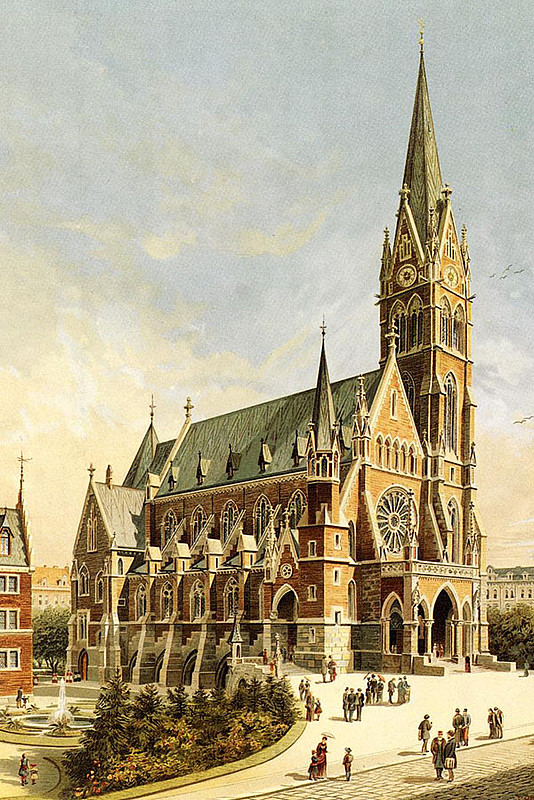
 Chromolithographie von der Herz-Jesu-Kirche nach einem Aquarell von Josef Oberbauer, 1896. Quelle: Grazer Privatbesitz.

Chromolithographie von der Herz-Jesu-Kirche nach einem Aquarell von Josef Oberbauer, 1896. Quelle: Grazer Privatbesitz.

Studierende werfen in einer Ausstellung Licht auf die Herz-Jesu-Kirche

Mit dem Bau der Herz-Jesu-Kirche erreichte die sakrale Baukunst Ende des 19. Jahrhunderts in der Steiermark ihren Höhepunkt. Auch dem Bauherrn, Fürstbischof Johannes Baptist Zwerger, erwuchs „aus diesem Bau ein fortdauernder Ruhm“ – so beschrieb es ein unbekannter Autor im Jahr 1891 im Grazer Volksblatt. Eine gleichnamige Ausstellung wirft jetzt Licht auf seine Person und den Bau. Zwergers 125. Todestag im vergangenen Jahr nahmen Kunsthistorikerin Dagmar Probst und Studierende der Kunstgeschichte an der Universität Graz zum Anlass, um die Schau zu konzipieren. Sie wurde vergangene Woche eröffnet und ist noch bis zum 24. April 2019 in der Arkadengalerie sowie im Pfarrmuseum der Pfarre Herz Jesu zu sehen.

Die Ausstellung thematisiert drei Schwerpunkte: Die Person des Bischofs Johannes Baptist Zwerger, die Baugeschichte der Kirche – die von Zwergers Hartnäckigkeit geprägt war – sowie die Künstler, die am Bau und an der Ausgestaltung beteiligt waren. „Die Studierenden arbeiteten dabei mit teilweise noch nie gezeigten und bearbeiteten Werken und veröffentlichten ihre Objektforschungen im Ausstellungsleitfaden, der nun die BesucherInnen begleitet“, weiß Dagmar Probst. „Der Leitfaden erklärt den Großteil der gezeigten Exponate, wie zum Beispiel originale Entwurfszeichnungen des Architekten Hauberrissers oder die originalen Vorzeichungen für die Wandgemälde in der Kirche“, führt Friedrich Bouvier von der Pfarre Herz-Jesu weiter aus. Er leitete gemeinsam mit Dagmar Probst die der Ausstellung zugrundeliegende Lehrveranstaltung am Institut für Kunstgeschichte.

Die Studierenden forschten nicht nur inhaltlich, sondern organisierten die Ausstellung praktisch mit, indem sie sich an der Konzeption, Planung und an der Umsetzung beteiligten. Sie beschäftigten sich in Kleingruppen mit Aufgaben wie Ausstellungs- und Textgestaltung, Medien-, PR- und Öffentlichkeitsarbeit sowie Layoutdesign für den Leitfaden und unterstützten den Ausstellungsaufbau. So erhielten sie umfassende Einblicke in die kuratorische Tätigkeit und nahmen am Prozess des Ausstellungsmachens aktiv teil.
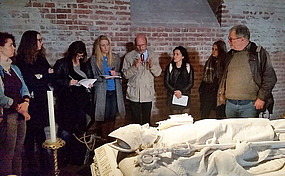
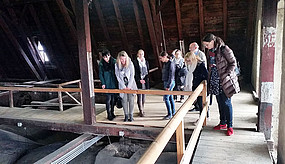
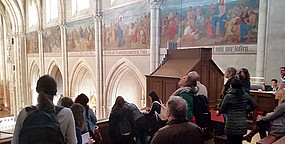
Zur Eröffnung der Ausstellung am 24. Jänner konnten sich Dagmar Probst, Friedrich Bouvier und die Studierenden der Uni Graz über ein volles Haus freuen. Alle Fotos: Dagmar Probst.
created by Gerhild Leljak

Related news

Studying at the University of Graz: How to enrol

Ready for a new chapter in your life with the start of your studies at the University of Graz in the winter semester 2026/27? Here you will find information on deadlines, admission procedures, registration, and everything else you need to successfully start your studies in the fall.

Interpreting data: Why studies sometimes get it wrong

Hilmar Brohmer and Ziva Korda from the Institute of Psychology, together with 500 international colleagues, have re-evaluated a hundred scientific publications and have often come to different conclusions.

Crystal-clear: AI method revolutionises solar observation

The Sun makes life on Earth possible. However, its magnetic fields can also cause massive disruption. This makes it all the more important to gain a better understanding of the processes taking place on our nearest star. A research team from the University of Graz and the High Altitude Observatory in Boulder (USA) has succeeded in doing just that. The astrophysicists have developed an AI-supported method that makes even the smallest structures on the Sun visible. The scientists are convinced that this will bring about a lasting change in solar observation and that the new method can be used for the planned European Solar Telescope.

Long Night of Research: How many languages are there in the world?

From a linguistic perspective, there are worlds of difference between Bern, Berlin and Vienna. A dialect impersonator will demonstrate live just how varied German can sound. How many languages are there in the world? What are their distinctive features? Which of these are spoken in Austria? These and other questions will be answered during the Long Night of Research at the University of Graz: on Friday, 24 April 2025, from 5 pm to 11 pm, in the University Library. Visitors can immerse themselves in the diversity of languages without travelling far by taking part in a quiz at the station.

Begin of page section:
Additional information:

University of Graz
Universitaetsplatz 3
8010 Graz
Austria
  • Contact
  • Web Editors
  • Moodle
  • UNIGRAZonline
  • Imprint
  • Data Protection Declaration
  • Accessibility Declaration
Weatherstation
Uni Graz

End of this page section. Go to overview of page sections

End of this page section. Go to overview of page sections

Begin of page section:

End of this page section. Go to overview of page sections