Begin of page section:
Page sections:

  • Go to contents (Accesskey 1)
  • Go to position marker (Accesskey 2)
  • Go to main navigation (Accesskey 3)
  • Go to sub navigation (Accesskey 4)
  • Go to additional information (Accesskey 5)
  • Go to page settings (user/language) (Accesskey 8)
  • Go to search (Accesskey 9)

End of this page section. Go to overview of page sections

Begin of page section:
Page settings:

English en
Deutsch de
Search
Login

End of this page section. Go to overview of page sections

Begin of page section:
Search:

Search for details about Uni Graz
Close

End of this page section. Go to overview of page sections


Search

Begin of page section:
Main navigation:

Page navigation:

  • University

    University
    • About the University
    • Organisation
    • Faculties
    • Library
    • Working at University of Graz
    • Campus
    Developing solutions for the world of tomorrow - that is our mission. Our students and our researchers take on the great challenges of society and carry the knowledge out.
  • Research Profile

    Research Profile
    • Our Expertise
    • Research Questions
    • Research Portal
    • Promoting Research
    • Research Transfer
    • Ethics in Research
    • Commission for Scientific Integrity
    Scientific excellence and the courage to break new ground. Research at the University of Graz creates the foundations for making the future worth living.
  • Studies

    Studies
    • Prospective Students
    • Students
    • Registration for Study Programme (Winter semester 2026/27)
  • Community

    Community
    • International
    • Location
    • Research and Business
    • Alumni
    The University of Graz is a hub for international research and brings together scientists and business experts. Moreover, it fosters the exchange and cooperation in study and teaching.
Topics
  • Sustainable University
  • Researchers answer
  • Work for us
Close menu

End of this page section. Go to overview of page sections

Begin of page section:
You are here:

University of Graz News Erfolgsgeschichte

End of this page section. Go to overview of page sections

Wednesday, 03 July 2019

Erfolgsgeschichte

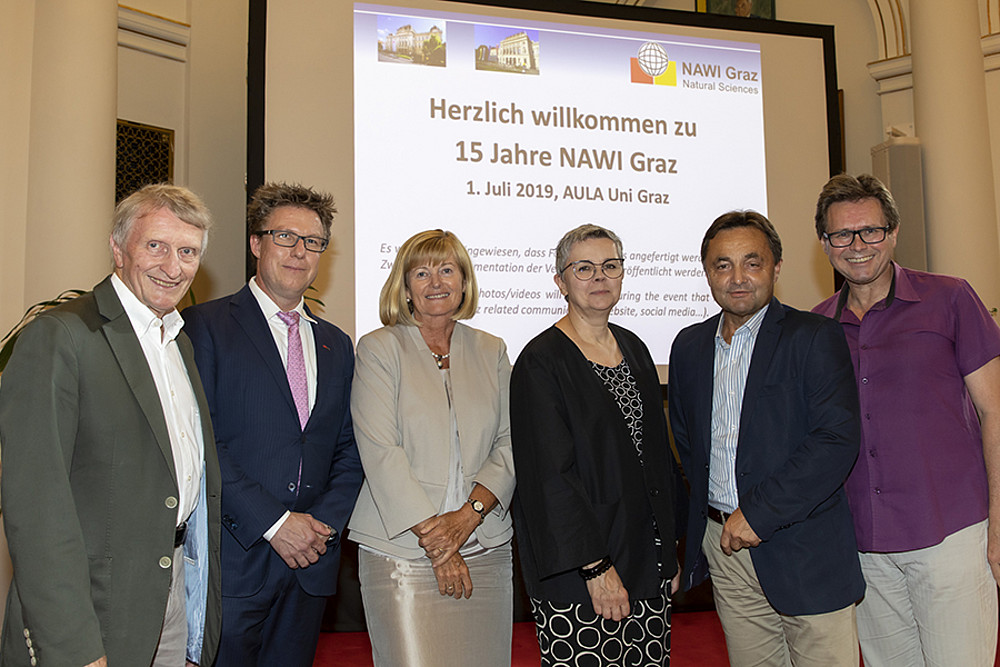
15 Jahre NAWI Graz: TU-Graz-Rektor a.D. Hans Sünkel, TU-Graz-Vizerektor Detlef Heck, Rektorin Christa Neuper, Vizerekotrin Renate Dworczak, Uni-Graz-Rektor a.D. Alfred Gutschelhofer und designierter Rektor Martin Polaschek (v. l.) Fotos: NAWI Graz/Lunghammer  ©© Helmut Lunghammer

15 Jahre NAWI Graz: TU-Graz-Rektor a.D. Hans Sünkel, TU-Graz-Vizerektor Detlef Heck, Rektorin Christa Neuper, Vizerekotrin Renate Dworczak, Uni-Graz-Rektor a.D. Alfred Gutschelhofer und designierter Rektor Martin Polaschek (v. l.) Fotos: NAWI Graz/Lunghammer 

Universität Graz und TU Graz starteten NAWI Graz vor 15 Jahren

Es war einmal, als Universität Graz und die Technische Universität Graz jeweils eigene Studien in Physik, Molekularbiologie, Mathematik, Erdwissenschaften und Chemie anboten… Und dann begann eine Erfolgsgeschichte: NAWI Graz wurde gegründet, eine nach wie vor einzigartige Kooperation in den Naturwissenschaften. 15 Jahre später werden 21 Studien in Union betrieben, wurden mehr als 19 Millionen Euro in moderne Infrastruktur investiert und 20 Professuren gemeinsam berufen. Eine erfolgreiche Bilanz, die am 1. Juli 2019 in der Aula der Universität Graz gefeiert wurde. 

Vizerektorin Renate Dworczak erinnerte an die Gründung durch die damaligen Rektoren Alfred Gutschelhofer und Hans Sünkel: „Am Anfang standen zwei Personen, die sich sagten, geht nicht, gibt’s nicht.“ Mittlerweile arbeiten 36 Institute beider Universitäten in den Fachbereichen Bioscience, Chemistry, Mathematics, Physics sowie Earth, Space and Environmental Science zusammen. 
Im Zeitraffer ließ Dworczak dann die ersten zehn Jahre des Schulterschlusses Revue passieren: von der Einrichtung des strategischen Dekanats 2004 über den Start der ersten Studien 2006, der ersten NAWI Graz Fulbright-Professur 2010 bis hin zum Start des gemeinsamen Alumni-Netzwerks 2013. Den Rückblick setzte TU Graz-Vizerektor Detlef Heck fort: „Wir haben einen Paradigmen-Wechsel eingeleitet. Mittlerweile haben die 5.300 Studierenden NAWI Graz längst verinnerlicht.“ Ebenso die ForscherInnen, wie Vizerektorin Dworczak ergänzte. So haben sich unter anderem die Drittmittel-Einnahmen in den Kooperationsbereichen zwischen 2006 und 2018 auf 32 Millionen Euro verdoppelt. 
In 14 Central Labs und Core Facilities wird nach internationalen Maßstäben geforscht. Deutliche Synergien bringt es, dass 150 Geräte partnerschaftlich genutzt werden. Darüber hinaus entstehen dank der gemeinsam berufenen Professuren neue, oft interdisziplinäre Kooperationen. 
Die Nachwuchsförderung genießt mit den DocSchools einen überaus hohen Stellenwert, derzeit werden mehr als 530 Doktoratsstudierende ausgebildet.
Inzwischen ist man im Rahmen der Zusammenarbeit große Schritte weiter und plant etwa in den Geowissenschaften und Geotechnik sowie in der Physik gemeinsame Department-Strukturen. Bis zum 20-Jahr-Jubiläum wird sich hier weiteres tun…

Den anschließenden Festvortrag hielt Christoph Lampert, Professor am Institute of Science and Technology (IST) Austria, „Machine Learning for Science: Hype or Hallelujah“. 
www.nawigraz.at

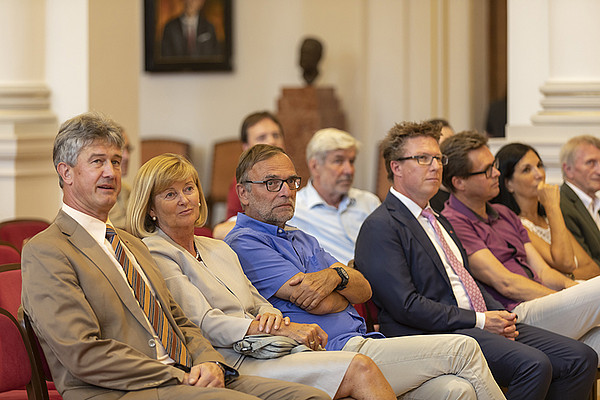
Blickten auf einen erfolgreichen Ausbau der Zusammenarbeit (v. l.): Die beiden RektorInnen Harald Kainz und Christa Neuper sowie der ehemalige NAWI-Graz-Dekan Martin Mittelbach. ©© Helmut Lunghammer
© Helmut Lunghammer
Blickten auf einen erfolgreichen Ausbau der Zusammenarbeit (v. l.): Die beiden RektorInnen Harald Kainz und Christa Neuper sowie der ehemalige NAWI-Graz-Dekan Martin Mittelbach.
created by Andreas Schweiger

Related news

Staying fit during the holidays: summer sports on the University of Graz campus

The Kleeblattlauf is not the end of the fitness term. Following last year’s successful launch, the University of Graz is once again offering summer sports on campus this year. From 30 June to 16 July 2026, there will be a free exercise programme in the open air. On the shady Südwiese (between the main building and Universitätsplatz 2), anyone interested can get in shape in the afternoons with body workouts, fascia training and yoga.

Getting even hotter: Researchers predict global warming of 1.7 degrees by 2027

While Europe is currently sweltering in the heat, global temperatures are also rising towards concerning record levels. In 2026, Earth’s surface air temperature is expected to reach 1.62 degrees, and in 2027 even 1.71 degrees Celsius above pre-industrial levels. The long-term temperature rise – an average over a 20-year period – is predicted to exceed the 1.5-degree threshold of the Paris Agreement as of 2026 already. For the first time, researchers at the University of Graz have been able to make such a forecast so far in advance. The intensifying El Niño climate event favors forecast skill and thereby facilitates a reliable computation.

Forest fire at Rosenhain: Volunteer fire brigade carried out an evacuation drill at the Jesuit refectory

Thick smoke in the stairwell, flames at the edge of the forest, people missing in the Jesuit refectory at the University of Graz: at Rosenhain, the Graz Volunteer Fire Brigade carried out a drill simulating a scenario that is becoming increasingly realistic given the heat and drought

Full effort in the heat: the Sports Centre was in full swing at the Kleeblattlauf

On 19 June 2026, 2,000 runners and hundreds of supporters made their way to the Rosenhain for a sporting end-of-term event.

Begin of page section:
Additional information:

University of Graz
Universitaetsplatz 3
8010 Graz
Austria
  • Contact
  • Web Editors
  • Moodle
  • UNIGRAZonline
  • Imprint
  • Data Protection Declaration
  • Accessibility Declaration
Weatherstation
Uni Graz

End of this page section. Go to overview of page sections

End of this page section. Go to overview of page sections

Begin of page section:

End of this page section. Go to overview of page sections