Begin of page section:
Page sections:

  • Go to contents (Accesskey 1)
  • Go to position marker (Accesskey 2)
  • Go to main navigation (Accesskey 3)
  • Go to sub navigation (Accesskey 4)
  • Go to additional information (Accesskey 5)
  • Go to page settings (user/language) (Accesskey 8)
  • Go to search (Accesskey 9)

End of this page section. Go to overview of page sections

Begin of page section:
Page settings:

English en
Deutsch de
Search
Login

End of this page section. Go to overview of page sections

Begin of page section:
Search:

Search for details about Uni Graz
Close

End of this page section. Go to overview of page sections


Search

Begin of page section:
Main navigation:

Page navigation:

  • University

    University
    • About the University
    • Organisation
    • Faculties
    • Library
    • Working at University of Graz
    • Campus
    Developing solutions for the world of tomorrow - that is our mission. Our students and our researchers take on the great challenges of society and carry the knowledge out.
  • Research Profile

    Research Profile
    • Our Expertise
    • Research Questions
    • Research Portal
    • Promoting Research
    • Research Transfer
    • Ethics in Research
    Scientific excellence and the courage to break new ground. Research at the University of Graz creates the foundations for making the future worth living.
  • Studies

    Studies
    • Prospective Students
    • Students
  • Community

    Community
    • International
    • Location
    • Research and Business
    • Alumni
    The University of Graz is a hub for international research and brings together scientists and business experts. Moreover, it fosters the exchange and cooperation in study and teaching.
  • Spotlight
Topics
  • Our digital Advent calendar
  • Sustainable University
  • Researchers answer
  • Work for us
Close menu

End of this page section. Go to overview of page sections

Begin of page section:
You are here:

University of Graz News Erfolgsgeschichte

End of this page section. Go to overview of page sections

Wednesday, 03 July 2019

Erfolgsgeschichte

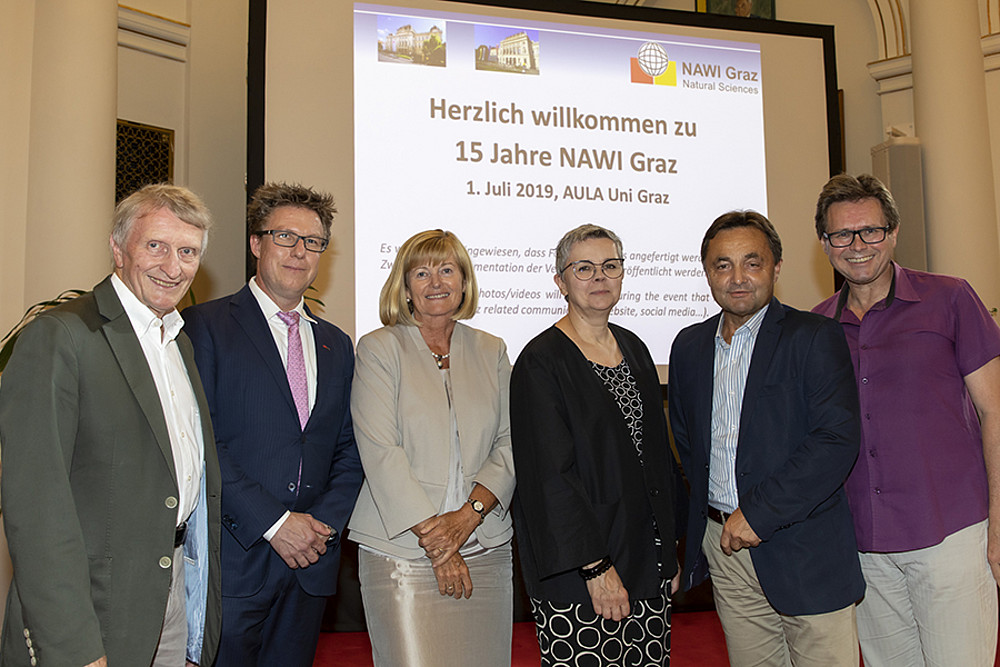
15 Jahre NAWI Graz: TU-Graz-Rektor a.D. Hans Sünkel, TU-Graz-Vizerektor Detlef Heck, Rektorin Christa Neuper, Vizerekotrin Renate Dworczak, Uni-Graz-Rektor a.D. Alfred Gutschelhofer und designierter Rektor Martin Polaschek (v. l.) Fotos: NAWI Graz/Lunghammer  ©© Helmut Lunghammer

15 Jahre NAWI Graz: TU-Graz-Rektor a.D. Hans Sünkel, TU-Graz-Vizerektor Detlef Heck, Rektorin Christa Neuper, Vizerekotrin Renate Dworczak, Uni-Graz-Rektor a.D. Alfred Gutschelhofer und designierter Rektor Martin Polaschek (v. l.) Fotos: NAWI Graz/Lunghammer 

Universität Graz und TU Graz starteten NAWI Graz vor 15 Jahren

Es war einmal, als Universität Graz und die Technische Universität Graz jeweils eigene Studien in Physik, Molekularbiologie, Mathematik, Erdwissenschaften und Chemie anboten… Und dann begann eine Erfolgsgeschichte: NAWI Graz wurde gegründet, eine nach wie vor einzigartige Kooperation in den Naturwissenschaften. 15 Jahre später werden 21 Studien in Union betrieben, wurden mehr als 19 Millionen Euro in moderne Infrastruktur investiert und 20 Professuren gemeinsam berufen. Eine erfolgreiche Bilanz, die am 1. Juli 2019 in der Aula der Universität Graz gefeiert wurde. 

Vizerektorin Renate Dworczak erinnerte an die Gründung durch die damaligen Rektoren Alfred Gutschelhofer und Hans Sünkel: „Am Anfang standen zwei Personen, die sich sagten, geht nicht, gibt’s nicht.“ Mittlerweile arbeiten 36 Institute beider Universitäten in den Fachbereichen Bioscience, Chemistry, Mathematics, Physics sowie Earth, Space and Environmental Science zusammen. 
Im Zeitraffer ließ Dworczak dann die ersten zehn Jahre des Schulterschlusses Revue passieren: von der Einrichtung des strategischen Dekanats 2004 über den Start der ersten Studien 2006, der ersten NAWI Graz Fulbright-Professur 2010 bis hin zum Start des gemeinsamen Alumni-Netzwerks 2013. Den Rückblick setzte TU Graz-Vizerektor Detlef Heck fort: „Wir haben einen Paradigmen-Wechsel eingeleitet. Mittlerweile haben die 5.300 Studierenden NAWI Graz längst verinnerlicht.“ Ebenso die ForscherInnen, wie Vizerektorin Dworczak ergänzte. So haben sich unter anderem die Drittmittel-Einnahmen in den Kooperationsbereichen zwischen 2006 und 2018 auf 32 Millionen Euro verdoppelt. 
In 14 Central Labs und Core Facilities wird nach internationalen Maßstäben geforscht. Deutliche Synergien bringt es, dass 150 Geräte partnerschaftlich genutzt werden. Darüber hinaus entstehen dank der gemeinsam berufenen Professuren neue, oft interdisziplinäre Kooperationen. 
Die Nachwuchsförderung genießt mit den DocSchools einen überaus hohen Stellenwert, derzeit werden mehr als 530 Doktoratsstudierende ausgebildet.
Inzwischen ist man im Rahmen der Zusammenarbeit große Schritte weiter und plant etwa in den Geowissenschaften und Geotechnik sowie in der Physik gemeinsame Department-Strukturen. Bis zum 20-Jahr-Jubiläum wird sich hier weiteres tun…

Den anschließenden Festvortrag hielt Christoph Lampert, Professor am Institute of Science and Technology (IST) Austria, „Machine Learning for Science: Hype or Hallelujah“. 
www.nawigraz.at

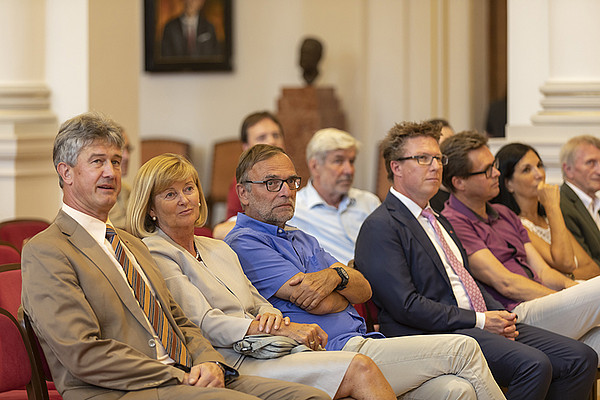
Blickten auf einen erfolgreichen Ausbau der Zusammenarbeit (v. l.): Die beiden RektorInnen Harald Kainz und Christa Neuper sowie der ehemalige NAWI-Graz-Dekan Martin Mittelbach. ©© Helmut Lunghammer
© Helmut Lunghammer
Blickten auf einen erfolgreichen Ausbau der Zusammenarbeit (v. l.): Die beiden RektorInnen Harald Kainz und Christa Neuper sowie der ehemalige NAWI-Graz-Dekan Martin Mittelbach.
created by Andreas Schweiger

Related news

Semester abroad without barriers: University of Graz wins award for promoting inclusion

The University of Graz has been awarded the Internationalization Award for its new inclusion initiative. Students with fewer opportunities now also receive financial support for their semester abroad outside Europe.

Fair distribution: Researchers determine just greenhouse gas budgets for all EU regions

Ten years ago, on 12 December 2015, the Paris Climate Agreement was signed at the UN Climate Conference. In order to limit global warming to well below two degrees, only a certain amount of CO2 may be emitted worldwide. While the focus was originally on national emission targets, more than 200 subnational regions and almost 300 cities have now adopted their own targets. But how many emissions are they fairly entitled to? Researchers at the University of Graz have now developed transparent criteria for fair distribution at the subnational level for the first time and determined corresponding greenhouse gas budgets for all European regions. The paper was published today in the scientific journal Nature Communications.

Chemical Christmas show at the University of Graz: An explosive evening at the Schauspielh

At the beginning of December, the University of Graz transformed the theater into a laboratory: as part of “Chemical Life,” teacher training students staged a chemical Christmas show for Styrian school classes—complete with ethanol rockets, nitrogen snow, and glowing effects. An evening designed to inspire interest in studying chemistry.

Train by train: Koralm railway accelerates exchange between the Universities

Lectures at the University of Klagenfurt in the morning, seminars at the University of Graz in the afternoon: Austria's longest tunnel and a journey time of around 45 minutes make it easy. The Koralm railway increases the speed of networking between the two university locations. The collaboration builds on existing cooperation - for example in the areas of teacher training, Slavic studies and as employers, the universities are well coordinated.

Begin of page section:
Additional information:

University of Graz
Universitaetsplatz 3
8010 Graz
Austria
  • Contact
  • Web Editors
  • Moodle
  • UNIGRAZonline
  • Imprint
  • Data Protection Declaration
  • Accessibility Declaration
Weatherstation
Uni Graz

End of this page section. Go to overview of page sections

End of this page section. Go to overview of page sections

Begin of page section:

End of this page section. Go to overview of page sections