Begin of page section:
Page sections:

  • Go to contents (Accesskey 1)
  • Go to position marker (Accesskey 2)
  • Go to main navigation (Accesskey 3)
  • Go to sub navigation (Accesskey 4)
  • Go to additional information (Accesskey 5)
  • Go to page settings (user/language) (Accesskey 8)
  • Go to search (Accesskey 9)

End of this page section. Go to overview of page sections

Begin of page section:
Page settings:

English en
Deutsch de
Search
Login

End of this page section. Go to overview of page sections

Begin of page section:
Search:

Search for details about Uni Graz
Close

End of this page section. Go to overview of page sections


Search

Begin of page section:
Main navigation:

Page navigation:

  • University

    University
    • About the University
    • Organisation
    • Faculties
    • Library
    • Working at University of Graz
    • Campus
    Developing solutions for the world of tomorrow - that is our mission. Our students and our researchers take on the great challenges of society and carry the knowledge out.
  • Research Profile

    Research Profile
    • Our Expertise
    • Research Questions
    • Research Portal
    • Promoting Research
    • Research Transfer
    • Ethics in Research
    • Commission for Scientific Integrity
    Scientific excellence and the courage to break new ground. Research at the University of Graz creates the foundations for making the future worth living.
  • Studies

    Studies
    • Prospective Students
    • Students
    • Registration for Study Programme (Winter semester 2026/27)
  • Community

    Community
    • International
    • Location
    • Research and Business
    • Alumni
    The University of Graz is a hub for international research and brings together scientists and business experts. Moreover, it fosters the exchange and cooperation in study and teaching.
Topics
  • Sustainable University
  • Researchers answer
  • Work for us
Close menu

End of this page section. Go to overview of page sections

Begin of page section:
You are here:

University of Graz News Entzogenes Buchgut

End of this page section. Go to overview of page sections

Tuesday, 06 June 2017

Entzogenes Buchgut

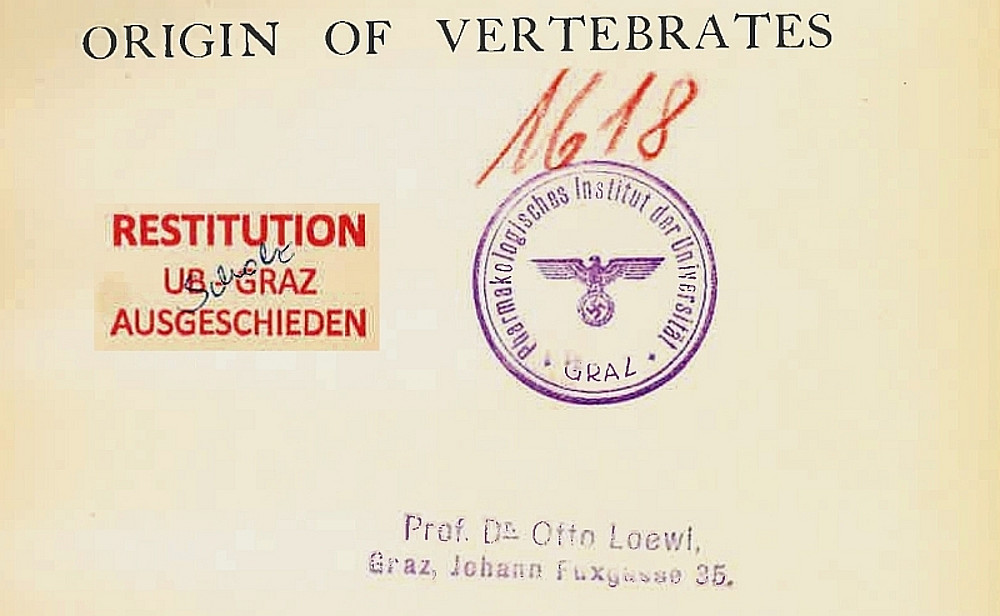
Illegal beschaffte Bücher: Die Grazer Universitätsbibliothek restituierte unter anderem Bände aus dem Besitz Otto Loewis. Foto: Uni Graz

Illegal beschaffte Bücher: Die Grazer Universitätsbibliothek restituierte unter anderem Bände aus dem Besitz Otto Loewis. Foto: Uni Graz

Uni-Graz-Tagung zeigt Umgang mit Ergebnissen aus NS-Provenienzforschung

Im Jahr 2013 sorgte der „Fall Gurlitt“ weltweit für Aufsehen: In der Münchner Wohnung des Cornelius Gurlitt, Sohn von Adolf Hitlers Kunsthändler Hildebrand Gurlitt, kam eine millionenschwere Kunstsammlung mit verschollenen Werken und nationalsozialistischer Vergangenheit ans Tageslicht. Der Fall beschäftigte jahrelang KunstexpertInnen und Justiz. „Während des Nationalsozialismus wurden politisch und ,rassisch‘ verfolgte Menschen und Institutionen ihrer Besitztümer beraubt“, erklären die beiden Grazer ForscherInnen Dr. Birgit Scholz und Dr. Markus Helmut Lenhart. „Darunter befanden sich nicht nur wertvolle Kunstobjekte, sondern auch Bücher und ganze Bibliotheken, die entweder direkt beschlagnahmt wurden oder fluchtbedingt zurückgelassen werden mussten.“

Über Gestapo, Oberfinanzprokuratur, „Judenauktionen“ oder Tausch, Geschenke und Antiquariate gelangte das „NS-verfolgungsbedingt entzogene Buchgut“ auch an öffentliche Bibliotheken wie etwa die Universitätsbibliothek Graz. Dort beschäftigt man sich seit 2011 in Kooperation mit der Zentralen österreichischen Forschungsstelle Nachkriegsjustiz Wien-Graz in einem eigenen Projekt mit dem Thema und versucht augenscheinlich betroffene Bücher den BesitzerInnen oder ihren Nachfahren zurückzugeben. Insgesamt 127 Bücher konnten bereits restituiert werden, darunter auch 21 an die Enkelinnen des Nobelpreisträgers Otto Loewi. „Der Karl-Franzens-Universität geht es darum, im Nationalsozialismus begangenes Unrecht wieder gut zu machen“, betont Rektorin Univ.-Prof. Dr. Christa Neuper. Bei der Tagung „Was bleibt? Bibliothekarische NS-Provenienzforschung und der Umgang mit ihren Ergebnissen“ am 12. und 13. Juni 2017 an der Uni Graz wird öffentlich darüber diskutiert, wie mit den Resultaten der Provenienzforschung weiter verfahren werden soll. „Durch die Provenienzforschung und mit der Tagung leistet die Universität Graz einen wertvollen Beitrag zur Vergangenheitsbewältigung“, so Univ.-Prof. Dr. Peter Scherrer, Vizerektor für Forschung und Nachwuchsförderung.

Rund 33.000 Erwerbungen der Jahre 1938 bis 1945 an der Hauptbibliothek und 55.000 bis 1945 erschienene Bücher, die im Bestand von Fach- und Institutsbibliotheken sind, wurden von Birgit Scholz und Markus Helmut Lenhart in den vergangenen sechs Jahren durchgesehen. Die Bücher gelangten auf ganz unterschiedlichen Wegen an die Uni Graz und wurden auf Vermerke von VorbesitzerInnen hin analysiert. Mithilfe von Matrikelbüchern, Personenregistern und historischen Meldekarten sowie genealogischen Datenbanken und anderem mehr konnten die Nachfahren der Beraubten bis nach Australien zurückverfolgt werden. Die bestmögliche Verwertung der Erkenntnisse dieser aufwändigen Recherche ist auch Thema der Grazer Tagung: Der Bogen spannt sich von der Rekonstruktion ehemaliger Bibliotheken über den Mehrwert von Provenienzforschung bis hin zu Möglichkeiten einer effizienten Dokumentation von Arbeitsergebnissen und Öffentlichkeitsarbeit. ExpertInnen aus dem deutschsprachigen Raum berichten über ihre Forschungen. Rob Tausk, der Enkel von Martha Tausk – sie war die erste weibliche Abgeordnete des steirischen Landtags – wird über das persönliche Erinnern, das durch die Rückgabe des Buches erweckt wird, erzählen.

„Was bleibt? Bibliothekarische NS-Provenienzforschung und der Umgang mit ihren Ergebnissen“
Wann? Montag und Dienstag, 12. und 13. Juni 2017, ab 14 Uhr
Wo?
Zentrum für Weiterbildung, Harrachgasse 23/II, 8010 Graz
Die Teilnahme ist kostenlos, eine Anmeldung nicht erforderlich

Infos unter http://www.nachkriegsjustiz.at/aktuelles/termine_index.php
created by Konstantinos Tzivanopoulos

Related news

In hot water: New Report reveals record losses in glaciers, permafrost and snow cover

Climate change is driving up temperatures not only in summer. Winters are also getting warmer – with dramatic consequences for glaciers, permafrost, snow cover and the freezing of lakes. The recently published cryosphere report provides specific figures for Austria. “Our monitoring shows a clear trend with record losses of ice and snow,” says project leader Wolfgang Schöner from the University of Graz.

Theologian at the University of Graz: What the excommunication of the Society of St Pius X

Following the schism involving the Society of St Pius X, there is a need for discussion. Bernd Hillebrand from the University of Graz explains why the Vatican took this step, what role anti-democratic tendencies play, and why the Society’s sacraments are no longer recognised as valid under canon law for Catholics with immediate effect.

“HeinrichBiCool”: University of Graz demonstrates the effects of green facades and roofs

The University of Graz has launched a pioneering project at the University Centre for Theology. Its name, “HeinrichBiCool”, says it all: a comprehensive system of green facades and roof will cool the building at Heinrichstraße 80 during the summer. At the same time, this will create a new habitat for plants and animals, helping to increase biodiversity. The accompanying monitoring programme will provide detailed data on the impact of the measures on indoor climate, energy consumption and biodiversity. The findings will lay a scientifically sound foundation for further projects aimed at making cities sustainable, climate-resilient and liveable. The partners in this project, funded by the Austrian Research Promotion Agency (FFG), are AEE INTEC – Institute for Sustainable Technologies, Technisches Büro Siegfried Stark, the landscape architecture and urban planning firm “studio boden”, and Ökoteam Graz.

When stress melts away in your mouth: nicotine pouches are widespread among Styrian students

Sociologists at the University of Graz, in collaboration with VIVID – the Centre for Addiction Prevention, have carried out a survey involving more than 600 participants. Around a quarter of them use these products. The ability to use them discreetly and flexibly is a key motivation.

Begin of page section:
Additional information:

University of Graz
Universitaetsplatz 3
8010 Graz
Austria
  • Contact
  • Web Editors
  • Moodle
  • UNIGRAZonline
  • Imprint
  • Data Protection Declaration
  • Accessibility Declaration
Weatherstation
Uni Graz

End of this page section. Go to overview of page sections

End of this page section. Go to overview of page sections

Begin of page section:

End of this page section. Go to overview of page sections