Begin of page section:
Page sections:

  • Go to contents (Accesskey 1)
  • Go to position marker (Accesskey 2)
  • Go to main navigation (Accesskey 3)
  • Go to sub navigation (Accesskey 4)
  • Go to additional information (Accesskey 5)
  • Go to page settings (user/language) (Accesskey 8)
  • Go to search (Accesskey 9)

End of this page section. Go to overview of page sections

Begin of page section:
Page settings:

English en
Deutsch de
Search
Login

End of this page section. Go to overview of page sections

Begin of page section:
Search:

Search for details about Uni Graz
Close

End of this page section. Go to overview of page sections


Search

Begin of page section:
Main navigation:

Page navigation:

  • University

    University
    • About the University
    • Organisation
    • Faculties
    • Library
    • Working at University of Graz
    • Campus
    Developing solutions for the world of tomorrow - that is our mission. Our students and our researchers take on the great challenges of society and carry the knowledge out.
  • Research Profile

    Research Profile
    • Our Expertise
    • Research Questions
    • Research Portal
    • Promoting Research
    • Research Transfer
    • Ethics in Research
    • Commission for Scientific Integrity
    Scientific excellence and the courage to break new ground. Research at the University of Graz creates the foundations for making the future worth living.
  • Studies

    Studies
    • Prospective Students
    • Students
  • Community

    Community
    • International
    • Location
    • Research and Business
    • Alumni
    The University of Graz is a hub for international research and brings together scientists and business experts. Moreover, it fosters the exchange and cooperation in study and teaching.
  • Spotlight
Topics
  • Sustainable University
  • Researchers answer
  • Work for us
Close menu

End of this page section. Go to overview of page sections

Begin of page section:
You are here:

University of Graz News English scholar from the University of Graz wins international doctoral competition

End of this page section. Go to overview of page sections

Monday, 10 June 2024

English scholar from the University of Graz wins international doctoral competition

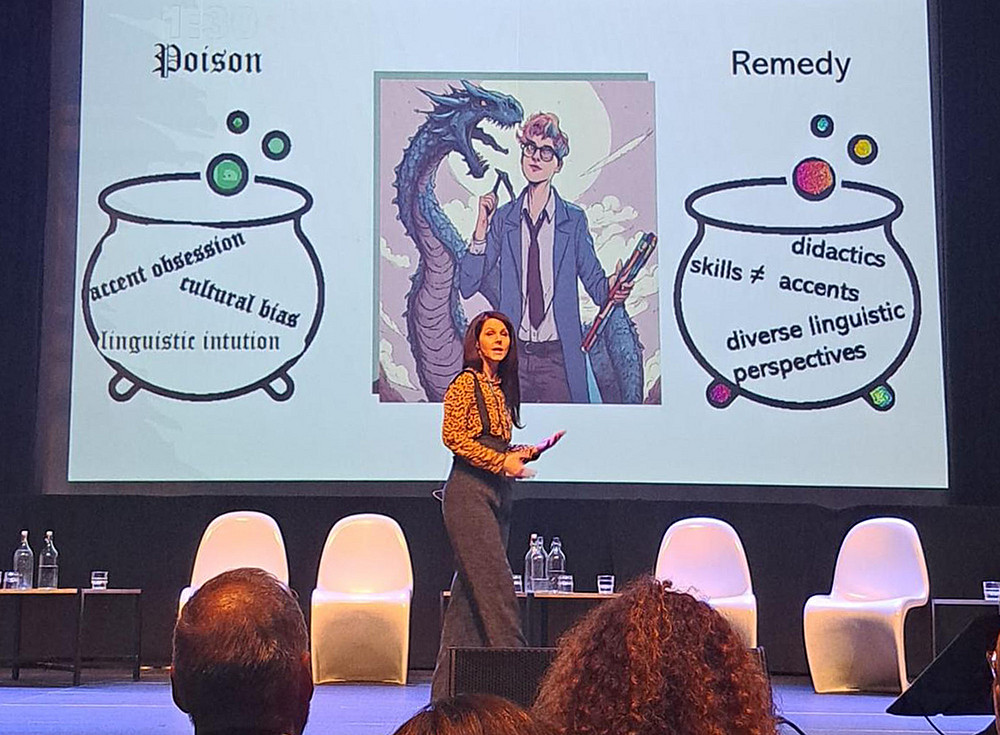
Silvia Lasnik on stage ©University of Graz

Silvia Lasnik won the final of the international Three Minute Thesis Competition in Finland with her presentation on the dragon of native speakerism. Photo: University of Graz

Why is "native speakerism" a dangerous dragon? Excuse me? What's that all about? Silvia Lasnik, an English scholar at the University of Graz, knows because she is researching the topic in her doctoral thesis. She explained her research in three minutes with wit and esprit at the final of the Three Minute Thesis Competition (3MT) on 6 June 2024 in Turku, Finland. The jury learnt something new and was very impressed by the presentation. They chose Silvia Lasnik as the winner.

The 3MT task is a real challenge: presenting your own research in three minutes in an understandable and exciting way to an audience from outside the field, in English, with just one PowerPoint slide, but with a lot of creativity. Silvia Lasnik chose the vivid image of a dragon to explain her research. That was convincing.

The Dragon of Native Speakerism
Who better to teach English than a person who learnt it as first language? Probably no one, according to many in the school system. Therefore, native speakers are often favoured when applying for a job as a teacher. That's not good, says Silvia Lasnik. "Because pedagogical and didactic skills are as important as language skills," emphasises the English specialist. In her doctoral thesis, supervised by Hermine Penz, she is investigating how the "dragon of native speakerism" paralyses teachers. "If they are afraid to speak in a foreign language because they don't think they know it well enough, then this has a negative impact on teaching," says Lasnik. Especially with English, which is used worldwide as a bridge language, communicative competence should come first, before grammar and accent. "That's why we need to slay the dragon of native speakerism," the doctoral student emphasises with her picture. This is already important in the teacher training programme so that future teachers can promote speaking more than reading and writing at school.

The 3MT is organised annually by the Coimbra Group, an association of particularly renowned and traditional European universities. After Silvia Lasnik had won the main prize at the 3MT of the University of Graz on 15 March 2024, ahead of ten other candidates, she also impressed the international jury of the competition and was invited to the final in Turku. She has now won this too.
created by Gudrun Pichler

Related news

Around the world in eight stops: the Long Night of Research at the University of Graz

On 24 April from 5 pm, you can take a short trip around the globe at the University of Graz, discovering pecularities of foreign countries or new local features in the entrance hall of the University Library. The itinerary takes you through introduced animal species, political attitudes and the omnipotence of algorithms. There will also be a programme in the historic reading hall, as well as at the UniGraz@Museum and the University Archive.

Studying at the University of Graz: How to enrol

Ready for a new chapter in your life with the start of your studies at the University of Graz in the winter semester 2026/27? Here you will find information on deadlines, admission procedures, registration, and everything else you need to successfully start your studies in the fall.

Interpreting data: Why studies sometimes get it wrong

Hilmar Brohmer and Ziva Korda from the Institute of Psychology, together with 500 international colleagues, have re-evaluated a hundred scientific publications and have often come to different conclusions.

Crystal-clear: AI method revolutionises solar observation

The Sun makes life on Earth possible. However, its magnetic fields can also cause massive disruption. This makes it all the more important to gain a better understanding of the processes taking place on our nearest star. A research team from the University of Graz and the High Altitude Observatory in Boulder (USA) has succeeded in doing just that. The astrophysicists have developed an AI-supported method that makes even the smallest structures on the Sun visible. The scientists are convinced that this will bring about a lasting change in solar observation and that the new method can be used for the planned European Solar Telescope.

Begin of page section:
Additional information:

University of Graz
Universitaetsplatz 3
8010 Graz
Austria
  • Contact
  • Web Editors
  • Moodle
  • UNIGRAZonline
  • Imprint
  • Data Protection Declaration
  • Accessibility Declaration
Weatherstation
Uni Graz

End of this page section. Go to overview of page sections

End of this page section. Go to overview of page sections

Begin of page section:

End of this page section. Go to overview of page sections