



Begin of page section:
Page sections:

  • Go to contents (Accesskey 1)
  • Go to position marker (Accesskey 2)
  • Go to main navigation (Accesskey 3)
  • Go to sub navigation (Accesskey 4)
  • Go to additional information (Accesskey 5)
  • Go to page settings (user/language) (Accesskey 8)
  • Go to search (Accesskey 9)

End of this page section. Go to overview of page sections

Begin of page section:
Page settings:

English en
Deutsch de
Search
Login

End of this page section. Go to overview of page sections

Begin of page section:
Search:

Search for details about Uni Graz
Close

End of this page section. Go to overview of page sections


Search

Begin of page section:
Main navigation:

Page navigation:

  • University

    University
    • About the University
    • Organisation
    • Faculties
    • Library
    • Working at University of Graz
    • Campus
    Developing solutions for the world of tomorrow - that is our mission. Our students and our researchers take on the great challenges of society and carry the knowledge out.
  • Research Profile

    Research Profile
    • Our Expertise
    • Research Questions
    • Research Portal
    • Promoting Research
    • Research Transfer
    • Ethics in Research
    • Commission for Scientific Integrity
    Scientific excellence and the courage to break new ground. Research at the University of Graz creates the foundations for making the future worth living.
  • Studies

    Studies
    • Prospective Students
    • Students
    • Welcome Weeks for First Year Students
  • Community

    Community
    • International
    • Location
    • Research and Business
    • Alumni
    The University of Graz is a hub for international research and brings together scientists and business experts. Moreover, it fosters the exchange and cooperation in study and teaching.
Topics
  • Sustainable University
  • Researchers answer
  • Work for us
Close menu

End of this page section. Go to overview of page sections

Begin of page section:
You are here:

University of Graz News Energiekick

End of this page section. Go to overview of page sections

Wednesday, 02 June 2021

Energiekick

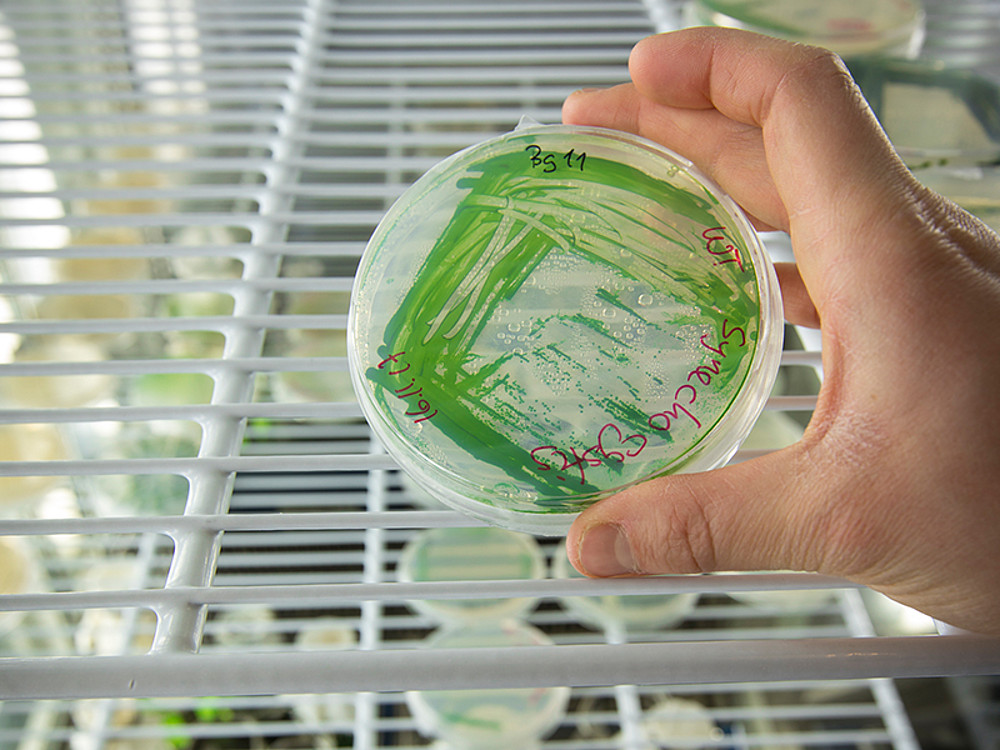
Blaugrünbakterien sind umweltfreundliche und gut verfügbare Biokatalysatoren zur Herstellung von Chemikalien. In Zukunft könnten sie bei großtechnologischen Anwendungen einen zusätzlichen "Energiekick" liefern. Foto: Lunghammer.

Blaugrünbakterien sind umweltfreundliche und gut verfügbare Biokatalysatoren zur Herstellung von Chemikalien. In Zukunft könnten sie bei großtechnologischen Anwendungen einen zusätzlichen "Energiekick" liefern. Foto: Lunghammer.

ForscherInnen beschleunigen chemische Reaktionen mit Licht 

Dass Pflanzen den lebensnotwendigen Sauerstoff im Rahmen der Photosynthese produzieren, ist Schulwissen. Dass dieser biochemische Prozess auch in einigen Bakterien abläuft, ist weniger bekannt. Und dass die so genannten Blaugrünbakterien in ihrem Inneren Licht in chemische Energie umwandeln, ist ein Fall für die Forschung. 

Genau diese Photosynthese-Fähigkeit dieser Bakterien macht sich jetzt ein Team rund um Wolfgang Kroutil vom Institut für Chemie der Universität Graz zunutze. „Die Blaugrünbakterien liefern uns quasi einen kostenlosen Energiekick. Dadurch können wir chemische Produktionsprozesse, zum Beispiel für Medikamente, maßgeblich vereinfachen und günstiger gestalten“, erklärt Kroutil. Das Verfahren wurde zum Patent angemeldet. Es entstand in einem Teilbereich des EU-Projekts PhotoBioCat, das Robert Kourist, Institut für Molekulare Biotechnologie der TU Graz, koordiniert. 


Blaugrünbakterien: Lichtenergie im Inneren 
Blaugrünbakterien sind an vielen Orten zu finden: in Süß- und Meereswasser, aber auch in Feuchtböden, auf Baumrinden oder Gesteinsoberflächen. Ihre Fähigkeit zur Photosynthese macht sie zu idealen Energielieferanten – sie arbeiten schnell, einfach und gratis. Dennoch hat man sie bislang in der chemischen Produktion kaum eingesetzt. Hauptsächlich deshalb, weil sie ungern Störenfriede in ihrem Inneren dulden, erklärt Kroutil. Er hat deshalb einen neuen Zugang gewählt. 


Chemische Reaktions-Systeme: einsatzbereit innerhalb weniger Tage 
Mit folgendem „Trick“ waren die ForscherInnen erfolgreich: Sie verwendeten ein bestimmtes Molekül für den Transport der Lichtenergie aus dem Inneren der Bakterien zu einem Enzym außerhalb der Zellen. Das Transport-Molekül gibt die gebundene Energie außerhalb der Zelle wieder ab, wo sie für jede passende chemische Reaktion nutzbar ist. „Normalerweise dauert es sechs Monate oder länger, bis man ein Setting gebaut hat, in dem Blaugrünbakterien auf die Fähigkeit, Stoffe umzusetzen, getestet werden können. In Zukunft können wir diese Tests binnen weniger Tage schaffen. Und das bedeutet wiederum, dass weitere Produktionsprozesse schneller gestartet werden können“, unterstreicht Christoph Winkler, gemeinsam mit Valentina Jurkas Teil von Kroutils Forschungsteam. Vor allem in der industriellen Großproduktion, etwa im Pharmabereich, bedeutet eine effizientere Handhabe der Herstellungsprozesse auch eine enorme Kostenersparnis. Gleichzeitig fällt durch die Verwendung von Licht als Reagenz weniger Abfall an. 


Weitere Infos zum Projekt „PhotoBioCat“
Im EU-Projekt „PhotoBioCat. Light-driven sustainable biocatalysis training network“ nutzen internationale DoktorandInnen unter Anleitung von ExpertInnen den „Treibstoff“ Licht, um enzymatische Reaktionen – etwa mittels der Blaugrünbakterien – zu beschleunigen. Damit soll die biokatalytische Herstellung von Chemikalien erheblich nachhaltiger werden. Das Projekt wird im Rahmen des EU-Programmes Horizon2020 Marie Sklodowksa-Curie Actions – European Joint Doctorates mit rund drei Millionen Euro gefördert. Neben der TU Graz (Lead, für den Verbund NAWI Graz) und der Universität Graz sind sieben weitere Universitäten an Bord, dazu acht Industriepartner. 

created by Gerhild Leljak

Related news

Electrifying: Researchers film the first moments on the way from light to electricity

Physicists at the University of Graz (Austria), in collaboration with colleagues from Marburg University and Forschungszentrum Jülich (Germany), have achieved a scientific breakthrough. For the first time, the generation of electrical energy from light has been filmed and described theoretically. This work is of far-reaching significance, not least for optimising sustainable energy production from photovoltaics. This is because it provides fundamental building blocks for understanding the physical processes that take place, for example, in organic solar cells. The paper was published in the journal Physical Review X, one of the world’s most prestigious physics journals.

University of Graz: Working together to make Styria a sustainable centre of learning

Round table calls for sustainable funding for the 2028–2030 performance agreement period between the five Styrian universities and the federal government.

How can we teach using YouTube and AI? The University of Graz is strengthening media education in schools

A journey through the blood vessels using VR headsets brings biology lessons to life. An interactive quiz brings physics to life. The YouTube video explains the First World War. Whilst mobile phones are increasingly being banned from the classroom, social media platforms, apps and AI are playing an ever-greater role in knowledge transfer at school. But how can teaching with media be made even more effective? What are the challenges in media-based teaching? At the University of Graz, researchers are discussing these issues at a conference being held in Austria for the first time.

Jurassic Sounds: Biologist reconstructs insect songs from 165 million years ago

It was apparently not just the roars of the dinosaurs that made up the soundscape of the animal world during the Jurassic period. Crickets and grasshoppers communicated through a variety of songs and high-pitched sounds, as Thorin Jonsson from the Institute of Biology at the University of Graz discovered together with colleagues from the universities of Lincoln, Bristol (UK), Beijing (China) and Tempe (USA). The findings on what are so far the oldest traces of sound on Earth have just been published in the journal PNAS.

Begin of page section:
Additional information:

University of Graz
Universitaetsplatz 3
8010 Graz
Austria
  • Contact
  • Web Editors
  • Moodle
  • UNIGRAZonline
  • Imprint
  • Data Protection Declaration
  • Accessibility Declaration
Weatherstation
Uni Graz

End of this page section. Go to overview of page sections

End of this page section. Go to overview of page sections

Begin of page section:

End of this page section. Go to overview of page sections


