Begin of page section:
Page sections:

  • Go to contents (Accesskey 1)
  • Go to position marker (Accesskey 2)
  • Go to main navigation (Accesskey 3)
  • Go to sub navigation (Accesskey 4)
  • Go to additional information (Accesskey 5)
  • Go to page settings (user/language) (Accesskey 8)
  • Go to search (Accesskey 9)

End of this page section. Go to overview of page sections

Begin of page section:
Page settings:

English en
Deutsch de
Search
Login

End of this page section. Go to overview of page sections

Begin of page section:
Search:

Search for details about Uni Graz
Close

End of this page section. Go to overview of page sections


Search

Begin of page section:
Main navigation:

Page navigation:

  • University

    University
    • About the University
    • Organisation
    • Faculties
    • Library
    • Working at University of Graz
    • Campus
    Developing solutions for the world of tomorrow - that is our mission. Our students and our researchers take on the great challenges of society and carry the knowledge out.
  • Research Profile

    Research Profile
    • Our Expertise
    • Research Questions
    • Research Portal
    • Promoting Research
    • Research Transfer
    • Ethics in Research
    Scientific excellence and the courage to break new ground. Research at the University of Graz creates the foundations for making the future worth living.
  • Studies

    Studies
    • Prospective Students
    • Students
  • Community

    Community
    • International
    • Location
    • Research and Business
    • Alumni
    The University of Graz is a hub for international research and brings together scientists and business experts. Moreover, it fosters the exchange and cooperation in study and teaching.
  • Spotlight
Topics
  • Sustainable University
  • Researchers answer
  • Work for us
Close menu

End of this page section. Go to overview of page sections

Begin of page section:
You are here:

University of Graz News Einschließend

End of this page section. Go to overview of page sections

Tuesday, 01 December 2020

Einschließend

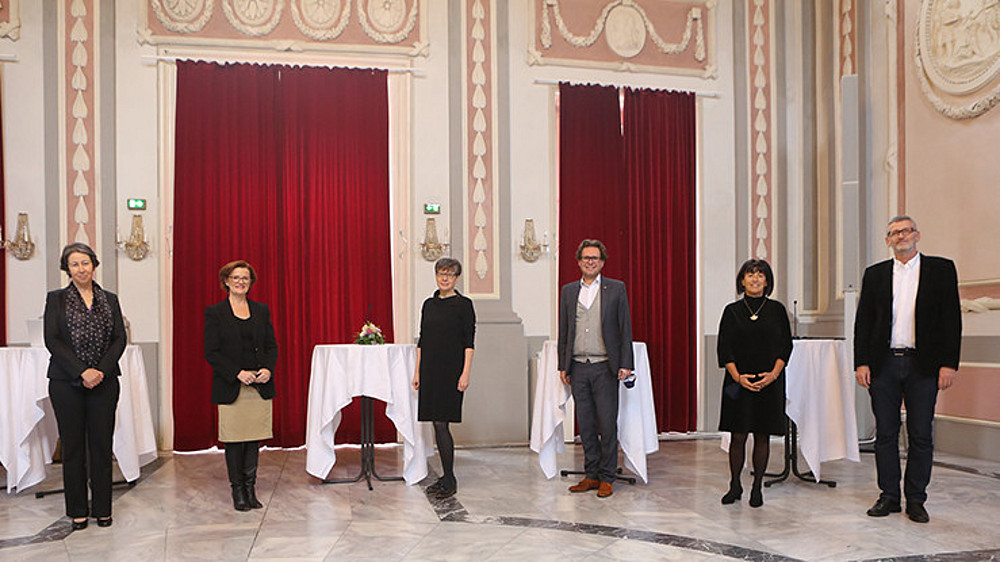
Die ZentrumsleiterInnen Barbara Gasteiger-Klicpera (l.), Andrea Holzinger und David Wohlhart (1. u. 2. v.r.) mit den RektorInnen Elgrid Messner (PH, 2.v.l.), Andrea Seel (KPH, 3. v.l.) und Martin Polaschek (Uni Graz). Foto: Martin Grössler/PH Steiermark

Die ZentrumsleiterInnen Barbara Gasteiger-Klicpera (l.), Andrea Holzinger und David Wohlhart (1. u. 2. v.r.) mit den RektorInnen Elgrid Messner (PH, 2.v.l.), Andrea Seel (KPH, 3. v.l.) und Martin Polaschek (Uni Graz). Foto: Martin Grössler/PH Steiermark

Das Forschungszentrum für Inklusive Bildung (FZIB) wurde mit einer Schwerpunktwoche eröffnet

Das Forschungszentrum für Inklusive Bildung (FZIB) ist ein Kooperationsprojekt der Universität Graz, der Pädagogischen Hochschule Steiermark und der Kirchlichen Pädagogischen Hochschule Graz und hat zum Ziel, die Forschungsexpertise der drei Institutionen zur inklusiven Bildung zu bündeln. Mitte November 2020 wurde das FZIB offiziell der Öffentlichkeit präsentiert mit einer Eröffnungswoche, an deren Veranstaltungen insgesamt rund 600 Personen aus dem In- und Ausland teilnahmen.

 
Wochenthema: inklusive Bildung 

Die Eröffnungswoche startete am 9. November 2020 mit Online-Präsentationen zum aktuellen Stand der Forschung zu inklusiver Bildung, die sich über zwei Tage erstreckten. Im 20-Minuten-Takt konnten die TeilnehmerInnen zwischen Präsentationen wechseln, an aktuellen Erkenntnissen teilhaben, Anknüpfungspunkte zur eigenen Forschung herstellen und dadurch das Netzwerk der Inklusionsforschung national und international erweitern. 

Der Mittwoch, 11. November, stand im Zeichen der Corona-Pandemie und ihrer Auswirkungen auf Bildung, Forschung und Inklusion. Mit dem Format des World Cafés wurden die TeilnehmerInnen eingeladen, im Anschluss an zwei Key-Notes ihre Perspektiven aus Praxis und Forschung einzubringen, die in eine Ergebniszusammenfassung und Diskussion im Plenum mündeten. 

Der Donnerstag, 12. November, verfolgte die Perspektive „Alle Kinder im Unterricht erreichen“ und stellte das Projekt „Reaching the ‚Hard to reach‘“ in den Mittelpunkt. Ein besonderer Höhepunkt war die Verleihung der Forschungspreise der Lebenshilfe sowie die Verleihung des diesjährigen Poster-Awards an die Teams aus dem Masterstudium Inclusive Education. Nach diesen vier Tagen stand der Freitag, 13. November, ganz im Zeichen des Eröffnungs-Festaktes. 

Festakt im Meerscheinschloss

Das Leitungsteam Barbara Gasteiger-Klicpera (Universität Graz), Andrea Holzinger (PH Steiermark) und David Wohlhart (KPH Graz) begrüßte die Ehren- und Festgäste herzlich. Die RektorInnen der drei kooperierenden Hochschulen skizzierten ihre Erwartungen an die neue Einrichtung. Rektor Martin Polaschek verglich das Projekt beispielsweise mit der großen Kooperationsidee, die der Entwicklungsverbund Südost bereits in der Umsetzung der PädagogInnenbildung Neu verwirklicht hat: „Wir möchten auch hier Innovatives fördern sowie unsere Forschungskapazitäten bündeln und damit vom Standort Graz ausgehend neue, übergreifende Impulse setzen.“ 

Bundesminister Heinz Fassmann hob in seiner Grußbotschaft per Video das geplante „Digital Lab for Inclusion“ hervor, das die Kompetenzentwicklung von Lehrpersonen fördern soll: „Menschen mit Behinderung dürfen nicht vom allgemeinen Bildungssystem ausgeschlossen werden, sondern sollen gleichberechtigt mit anderen in der Gemeinschaft, in der sie leben, lernen können. So lautet auch eines der Systemziele im aktuellen gesamtösterreichischen Universitätsentwicklungsplan. Es ist klar, dass Inklusion grundlegende Veränderungen im Bildungssystem notwendig macht. Sie ermöglicht aber auch eine deutliche Steigerung der Qualität von Lehre und Unterricht“. 

Im Anschluss präsentierten internationale ExpertInnen ihre Key Notes. Mel Ainscow, University of Manchester, zeigte seine Vision einer inklusiven Gesellschaft auf; Ingo Bosse, TU München, stellte unter anderem die Herausforderungen für Schul-Pädagogik und (digitale) Bildungsarbeit zur Diskussion; und Vera Moser, Zentrum für Inklusionsforschung an der Humboldt Universität zu Berlin, warf in ihrem Beitrag einen international vergleichenden Blick auf die Inklusionsforschung und ihre möglichen Zukunftsszenarien.  

created by FZIB & Gerhild Leljak

Related news

Cosmetics in the environment: University of Graz proves danger to ants

Titanium dioxide, which is found in cosmetics, for example, is increasingly entering the environment in the form of nanoparticles. This could also put insects at risk. If ants ingest the substance in combination with the pesticide glyphosate, it disturbs the development of their offspring. Scientists at the University of Graz are drawing attention to the negative consequences of this toxic cocktail.

How are tech companies changing democracy? Uni Graz designs exhibition for schools

Filtered information, conspiracy theories, fake news – certain groups and corporations are using social media and algorithms to try to influence public opinion in their favour. Their goal: to weaken fundamental rights and diversity of opinion and seize power. In a new exhibition, researchers at the University of Graz are working with pupils to explore the impact of social media and AI on democracy. In accompanying workshops, the scientists want to encourage young people to develop their own ideas for a socially and ecologically viable future and to actively help shape it. The exhibition, designed as a travelling exhibition for schools, will open on 9 March 2026 at the Dreihackengasse Gymnasium in Graz.

Step by step: What motivates Mireille van Poppel as a scientist and vice-rector

Improving people's health and eliminating inequalities: Mireille van Poppel pursues these goals both as a public health researcher and as vice-rector for Internationalisation and Equality. In both roles, she pays particular attention to individual needs.

Master's degree in psychotherapy in Graz: registration opens in March

Graz is becoming a hotspot for psychotherapy: from 2026, the University of Graz and the Medical University of Graz will jointly offer the new master's programme. Registration for the admission procedure for the 140 study places will start in March.

Begin of page section:
Additional information:

University of Graz
Universitaetsplatz 3
8010 Graz
Austria
  • Contact
  • Web Editors
  • Moodle
  • UNIGRAZonline
  • Imprint
  • Data Protection Declaration
  • Accessibility Declaration
Weatherstation
Uni Graz

End of this page section. Go to overview of page sections

End of this page section. Go to overview of page sections

Begin of page section:

End of this page section. Go to overview of page sections