



Begin of page section:
Page sections:

  • Go to contents (Accesskey 1)
  • Go to position marker (Accesskey 2)
  • Go to main navigation (Accesskey 3)
  • Go to sub navigation (Accesskey 4)
  • Go to additional information (Accesskey 5)
  • Go to page settings (user/language) (Accesskey 8)
  • Go to search (Accesskey 9)

End of this page section. Go to overview of page sections

Begin of page section:
Page settings:

English en
Deutsch de
Search
Login

End of this page section. Go to overview of page sections

Begin of page section:
Search:

Search for details about Uni Graz
Close

End of this page section. Go to overview of page sections


Search

Begin of page section:
Main navigation:

Page navigation:

  • University

    University
    • About the University
    • Organisation
    • Faculties
    • Library
    • Working at University of Graz
    • Campus
    Developing solutions for the world of tomorrow - that is our mission. Our students and our researchers take on the great challenges of society and carry the knowledge out.
  • Research Profile

    Research Profile
    • Our Expertise
    • Research Questions
    • Research Portal
    • Promoting Research
    • Research Transfer
    • Ethics in Research
    • Commission for Scientific Integrity
    Scientific excellence and the courage to break new ground. Research at the University of Graz creates the foundations for making the future worth living.
  • Studies

    Studies
    • Prospective Students
    • Students
  • Community

    Community
    • International
    • Location
    • Research and Business
    • Alumni
    The University of Graz is a hub for international research and brings together scientists and business experts. Moreover, it fosters the exchange and cooperation in study and teaching.
  • Spotlight
Topics
  • Sustainable University
  • Researchers answer
  • Work for us
Close menu

End of this page section. Go to overview of page sections

Begin of page section:
You are here:

University of Graz News A weed shows how plants can become climate-fit

End of this page section. Go to overview of page sections

Tuesday, 25 February 2025

A weed shows how plants can become climate-fit

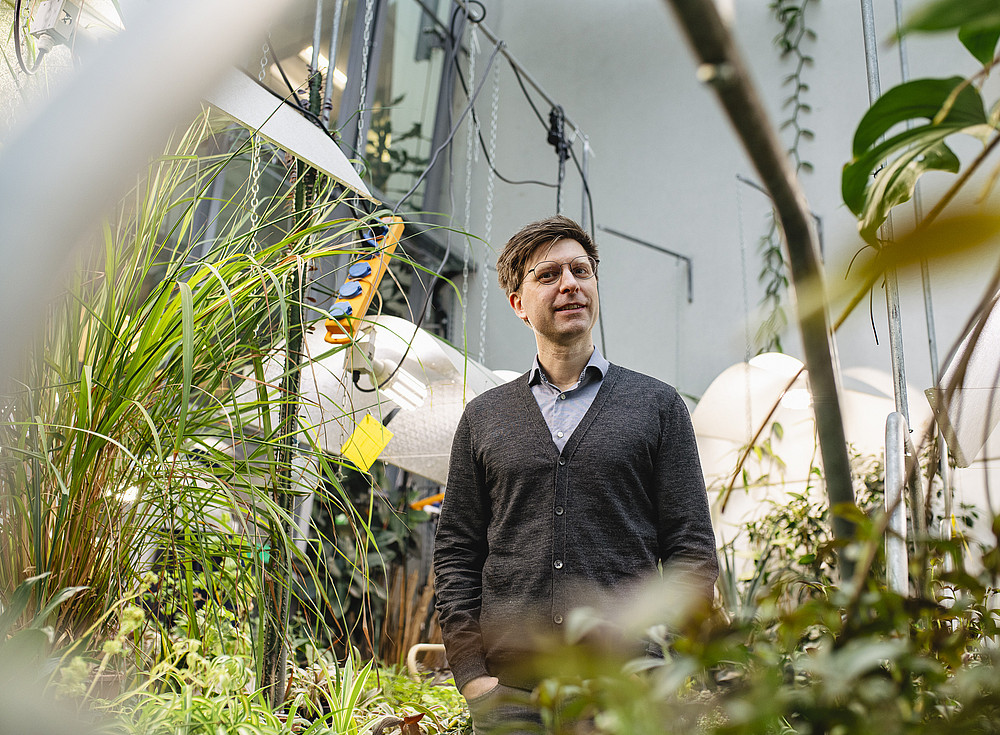
A portrait of an adult male scientist standing in the center, surrounded by plants and white walls with large glass windows. He is wearing glasses and has short brown hair. The background features various plant life including grasses, leaves, flowers, vines, mushrooms, and small birds. ©Uni Graz/Tzivanopoulos

Johannes Liesche is investigating how plants react to drought stress. Photo: Uni Graz/Tzivanopoulos

Researchers at the University of Graz are using thale cress to decipher the water distribution within plants. Their discoveries regarding water transport and sugar storage could provide new approaches for drought-resistant plants and prepare agriculture for climate change.

Climate change, drought and crop failures are major challenges for agriculture. However, a weed, thale cress, provides valuable insights into the internal processes of plants and thus offers a scientific basis for climate-adapted crops. Researchers at the University of Graz are using this inconspicuous cruciferous plant as a laboratory organism to understand how plants can withstand periods of drought.

"We are particularly interested in the transport of sugars in plants," explains Johannes Liesche from the Institute of Biology at the University of Graz. “The more sugar the plant cells store, the more water they can hold – a natural water reservoir. In times of heat and drought, this can make the difference between life and death for a plant.”

Until now, it was unclear how water moves between cells. The research group at the University of Graz has gained new insights here. Plants apparently have a kind of water tap that they can open and close as needed. Liesche: "Just like a valve, they can make the cell connections thicker and thinner, thus increasing or decreasing the flow."

Search for triggers

Three specific proteins play a central role in this process. "If one of these protein molecules is genetically deactivated, the plants look as if they are constantly suffering from drought stress, regardless of how much water they receive," says the biologist. "The next step is to gain a better understanding of the exact function of these proteins." It is still unclear what triggers this valve to open and close.

"We are also interested in what a diversion of water within the plant means for the transport of nutrients or phytohormones," asks Liesche. This valve would be of great importance for processes such as plant growth. “We are still at the very beginning here,” says the biologist. "We want to use thale cress to gain a better understanding of these processes. With this knowledge, field crops can then be adapted to the new climate conditions." If this succeeds, this weed could actually contribute to a climate-friendly future for agriculture.

Publication

Drought-dependent regulation of cell coupling in Arabidopsis leaf epidermis requires plasmodesmal protein NHL12, Journal of Experimenatal Botany → https://doi.org/10.1093/jxb/erae370

⇒ If you are interested in how nature deals with the many challenges in this world, you may find the answers in the Bachelor's programme in Biology.

created by Roman Vilgut

Related news

Around the world in eight stops: the Long Night of Research at the University of Graz

On 24 April from 5 pm, you can take a short trip around the globe at the University of Graz, discovering pecularities of foreign countries or new local features in the entrance hall of the University Library. The itinerary takes you through introduced animal species, political attitudes and the omnipotence of algorithms. There will also be a programme in the historic reading hall, as well as at the UniGraz@Museum and the University Archive.

Studying at the University of Graz: How to enrol

Ready for a new chapter in your life with the start of your studies at the University of Graz in the winter semester 2026/27? Here you will find information on deadlines, admission procedures, registration, and everything else you need to successfully start your studies in the fall.

Interpreting data: Why studies sometimes get it wrong

Hilmar Brohmer and Ziva Korda from the Institute of Psychology, together with 500 international colleagues, have re-evaluated a hundred scientific publications and have often come to different conclusions.

Crystal-clear: AI method revolutionises solar observation

The Sun makes life on Earth possible. However, its magnetic fields can also cause massive disruption. This makes it all the more important to gain a better understanding of the processes taking place on our nearest star. A research team from the University of Graz and the High Altitude Observatory in Boulder (USA) has succeeded in doing just that. The astrophysicists have developed an AI-supported method that makes even the smallest structures on the Sun visible. The scientists are convinced that this will bring about a lasting change in solar observation and that the new method can be used for the planned European Solar Telescope.

Begin of page section:
Additional information:

University of Graz
Universitaetsplatz 3
8010 Graz
Austria
  • Contact
  • Web Editors
  • Moodle
  • UNIGRAZonline
  • Imprint
  • Data Protection Declaration
  • Accessibility Declaration
Weatherstation
Uni Graz

End of this page section. Go to overview of page sections

End of this page section. Go to overview of page sections

Begin of page section:

End of this page section. Go to overview of page sections