Begin of page section:
Page sections:

  • Go to contents (Accesskey 1)
  • Go to position marker (Accesskey 2)
  • Go to main navigation (Accesskey 3)
  • Go to sub navigation (Accesskey 4)
  • Go to additional information (Accesskey 5)
  • Go to page settings (user/language) (Accesskey 8)
  • Go to search (Accesskey 9)

End of this page section. Go to overview of page sections

Begin of page section:
Page settings:

English en
Deutsch de
Search
Login

End of this page section. Go to overview of page sections

Begin of page section:
Search:

Search for details about Uni Graz
Close

End of this page section. Go to overview of page sections


Search

Begin of page section:
Main navigation:

Page navigation:

  • University

    University
    • About the University
    • Organisation
    • Faculties
    • Library
    • Working at University of Graz
    • Campus
    Developing solutions for the world of tomorrow - that is our mission. Our students and our researchers take on the great challenges of society and carry the knowledge out.
  • Research Profile

    Research Profile
    • Our Expertise
    • Research Questions
    • Research Portal
    • Promoting Research
    • Research Transfer
    • Ethics in Research
    • Commission for Scientific Integrity
    Scientific excellence and the courage to break new ground. Research at the University of Graz creates the foundations for making the future worth living.
  • Studies

    Studies
    • Prospective Students
    • Students
    • Registration for Study Programme (Winter semester 2026/27)
  • Community

    Community
    • International
    • Location
    • Research and Business
    • Alumni
    The University of Graz is a hub for international research and brings together scientists and business experts. Moreover, it fosters the exchange and cooperation in study and teaching.
Topics
  • Sustainable University
  • Researchers answer
  • Work for us
Close menu

End of this page section. Go to overview of page sections

Begin of page section:
You are here:

University of Graz News Ein System feiert

End of this page section. Go to overview of page sections

Thursday, 31 January 2019

Ein System feiert

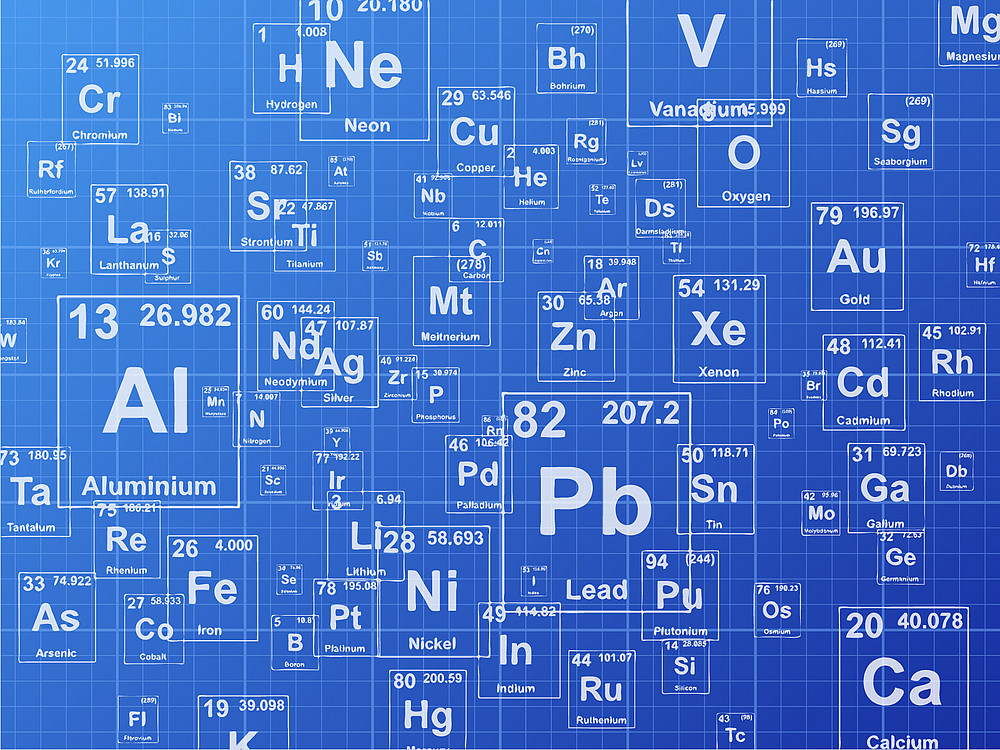
118 Elemente sind derzeit im Periodensystem. Foto: shutterstock.com/Jason Winter

118 Elemente sind derzeit im Periodensystem. Foto: shutterstock.com/Jason Winter

Heuer feiert das Periodensystem seinen 150. Geburtstag. Doch wie lässt es sich erklären?

Der russische Chemiker Dmitri Mendelejew hat seinerzeit, 1869, einen systematischen Zusammenhang zwischen Atommasse und chemischen Eigenschaften der Elemente entdeckt und damit das Periodensystem geschaffen. Insgesamt umfasst das Periodensystem 118 Elemente - von Wasserstoff (1) bis Oganesson (118). Die Elemente sind nach der Anzahl ihrer positiven Teilchen (Protonen) im Atomkern durchnummeriert. Sie  sind in Gruppen (senkrechte Spalten) und Perioden (waagrechte Zeilen) angeordnet. Die Mitglieder einer Gruppe haben alle gleich viele negativ geladene Teilchen (Elektronen) in ihrer äußersten Elektronenschale und somit ähnliche chemische Eigenschaften. Die Elemente einer Periode haben alle gleich viele Elektronenschalen. Uni-Graz-Chemiker Wolfgang Kroutil erklärt

„Bis es zu der für uns heute vertrauten bekannten zeilen- und spaltenweisen Anordnung der Elemente im Periodensystem kam, dauerte es mindestens 80 Jahre und zahlreiche Diskussion vieler Chemiker. Angefangen hat die Diskussion mit einer einfachen Liste von 33 vermutlichen Substanzen durch Antoine Lavoisier wobei im Jahre 1789 er auch noch Licht und Wärme als Elemente klassifizierte. Die Genialität des veröffentlichten Periodensystems vor 150 Jahren war, dass in dieser Darstellung Positionen frei gelassen wurden für Elemente die noch nicht entdeckt worden waren und deren Eigenschaften man aufgrund der Position voraussagen konnte. Waren vor 150 Jahren noch alle beschriebenen Elemente (ca. 50) natürlich auf der Erde nachgewiesen, so werden heute in etwa 90 der heute bekannten Elemente als natürlich vorkommend eingestuft. Von diesen haben auch zwei Österreicher einige entdeckt. So hat der Chemiker und Mineralogen Franz Joseph Müller von Reichenstein das Element Tellur (1782) entdeckt, und Carl Auer von Welsbach die chemischen Elemente Neodym (1885), Praseodym (1885) und Lutetium (1907). Circa 30 Elemente werden für den Zusammenbau eines Smartphones benötigt. Da die natürliche Häufigkeit einiger davon sehr gering ist, wird ein Engpass erwartet, was Forschung für Alternativen antreibt.“


Zum Artikel von der APA - Austrian Presse Agentur.
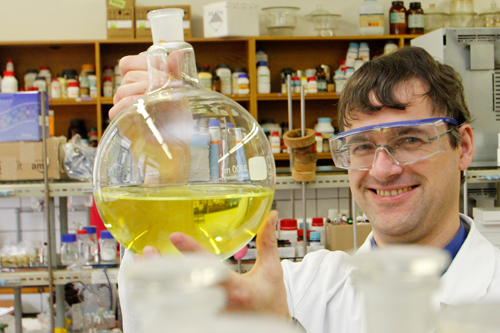
Der Chemiker Wolfgang Kroutil forscht zum Thema Biokatalyse. Er erklärte für die Austrian Presse Agentur APA das Periodensystem der Elemente, das heuer seinen 150. Geburtstag feiert. Foto: Uni Graz/Tzivanopoulos
created by Konstantin Tzivanopoulos

Related news

Complying with the norm: Why Do Standards Shape Our Lives, Elisabeth Staudegger?

Standards determine whether a sheet of paper fits in a printer or whether a charging plug can power multiple devices. These standards shape our everyday lives. But who actually sets these standards? Where are the weaknesses, and how could science help to improve them? Elisabeth Staudegger, Head of the ‘Law and IT’ Department at the Institute for Legal Foundations at the University of Graz, host the Academic Standards Day on 16 June. Here she relays how sciences can contribute to the topic of standardisation and reveals her personal favourite standard.

More body awareness than a culture war

In Italy, sex education lessons will in future only be permitted with parental consent, and will be banned entirely in nurseries and primary schools. At the same time, Pride Month highlights why knowledge about the body, relationships, boundaries and diversity is important for young people. A study by the University of Graz shows how important knowledge about the body, contraception, relationship skills and protection against violence is

Will Austria win the World Cup? Mathematician reveals calculation method

Michael Fischer uses the football tournament as a practical example for highschool lessons.

Survival strategies: How plants respond to drought

According to Geosphere Austria, this spring was the driest in Austria since records began around 170 years ago. The low rainfall put particular pressure on the agricultural sector. And climate change is set to make the situation even worse in the coming decades. We asked Johannes Liesche, a professor at the Department of Biology at the University of Graz, how plants react to water shortages and how they survive periods of drought.

Begin of page section:
Additional information:

University of Graz
Universitaetsplatz 3
8010 Graz
Austria
  • Contact
  • Web Editors
  • Moodle
  • UNIGRAZonline
  • Imprint
  • Data Protection Declaration
  • Accessibility Declaration
Weatherstation
Uni Graz

End of this page section. Go to overview of page sections

End of this page section. Go to overview of page sections

Begin of page section:

End of this page section. Go to overview of page sections