Begin of page section:
Page sections:

  • Go to contents (Accesskey 1)
  • Go to position marker (Accesskey 2)
  • Go to main navigation (Accesskey 3)
  • Go to sub navigation (Accesskey 4)
  • Go to additional information (Accesskey 5)
  • Go to page settings (user/language) (Accesskey 8)
  • Go to search (Accesskey 9)

End of this page section. Go to overview of page sections

Begin of page section:
Page settings:

English en
Deutsch de
Search
Login

End of this page section. Go to overview of page sections

Begin of page section:
Search:

Search for details about Uni Graz
Close

End of this page section. Go to overview of page sections


Search

Begin of page section:
Main navigation:

Page navigation:

  • University

    University
    • About the University
    • Organisation
    • Faculties
    • Library
    • Working at University of Graz
    • Campus
    Developing solutions for the world of tomorrow - that is our mission. Our students and our researchers take on the great challenges of society and carry the knowledge out.
  • Research Profile

    Research Profile
    • Our Expertise
    • Research Questions
    • Research Portal
    • Promoting Research
    • Research Transfer
    • Ethics in Research
    Scientific excellence and the courage to break new ground. Research at the University of Graz creates the foundations for making the future worth living.
  • Studies

    Studies
    • Prospective Students
    • Students
  • Community

    Community
    • International
    • Location
    • Research and Business
    • Alumni
    The University of Graz is a hub for international research and brings together scientists and business experts. Moreover, it fosters the exchange and cooperation in study and teaching.
  • Spotlight
Topics
  • Sustainable University
  • Researchers answer
  • Work for us
Close menu

End of this page section. Go to overview of page sections

Begin of page section:
You are here:

University of Graz News Doppelrolle

End of this page section. Go to overview of page sections

Wednesday, 12 October 2022

Doppelrolle

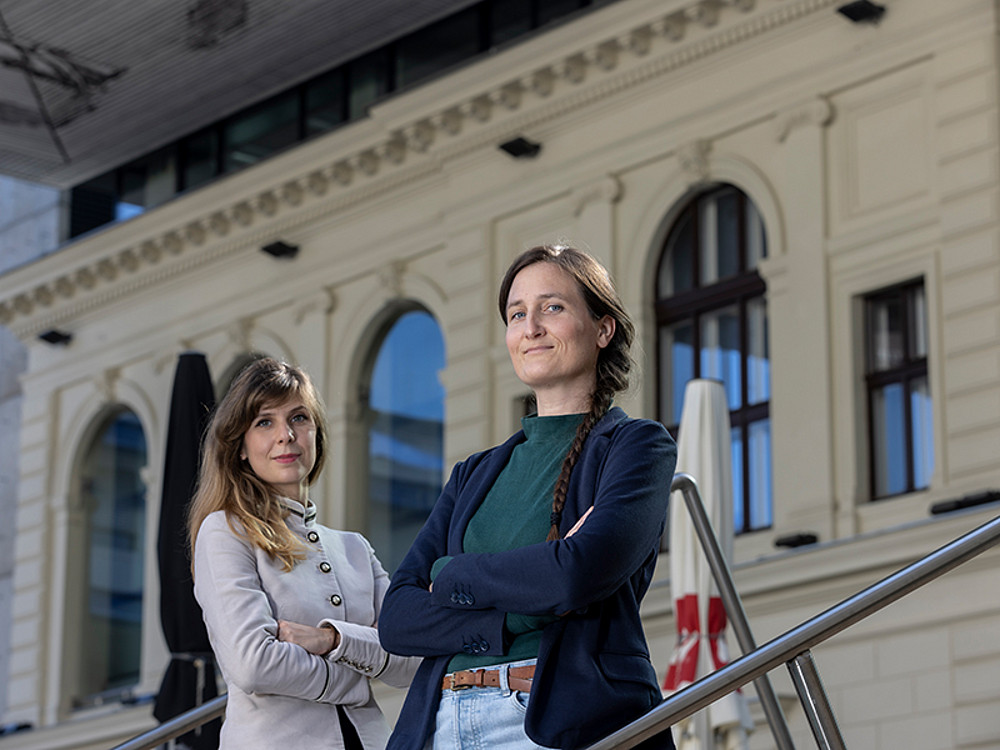
Jelena Tadic und Julia Ring (v.l.) erhielten für ihre Forschungen kürzlich einen Young Investigator Award der Alzheimer-Gesellschaft. Foto: Uni Graz/Lunghammer. ©© Helmut Lunghammer

Jelena Tadic und Julia Ring (v.l.) erhielten für ihre Forschungen kürzlich einen Young Investigator Award der Alzheimer-Gesellschaft. Foto: Uni Graz/Lunghammer.

Für ihre Forschungen zu einem „zweigesichtigen“ Protein erhalten Jelena Tadic und Julia Ring einen Young Investigator Award der Alzheimer-Gesellschaft

Über 220 Millionen Menschen in Europa leiden an einer Erkrankung des Gehirns. Die Folgen sind schleichende Verluste von geistigen und motorischen Fähigkeiten, die zu Isolation und Pflegebedürftigkeit führen. Umso wichtiger ist es daher, die Forschung an neurodegenerativen Krankheiten voranzutreiben. Denn ein besseres Verständnis der molekularen Mechanismen, die hinter Demenz und co. stecken, schafft auch die Grundlage für bessere Therapien dagegen.

Ein besonderer Erfolg in diesem Bereich ist Julia Ring und Jelena Tadic vor Kurzem gelungen. Die beiden Molekularbiologinnen der Universität Graz wurden von der österreichischen Alzheimer-Gesellschaft mit einem Young Investigator Award ausgezeichnet. Mehr als 200 führende Neurolog:innen und Psychiater:innen sowie Vertreter:innen sozialer Dienstleistungen und Grundlagenforscher:innen sind Mitglieder dieser Gesellschaft, die dadurch inhaltlich breit aufgestellt ist.

Die Studie, über die die Wissenschafterinnen auf der Jahrestagung der Gesellschaft berichteten, wurde im April 2022 im Wissenschafts-Journal EMBO Molecular Medicine veröffentlicht. Ihr Hauptaugenmerk legten Julia Ring und Jelena Tadic – gemeinsam mit ihren Kollegen Frank Madeo und Tobias Eisenberg – auf ein bestimmtes Protein namens DnaJA1. Sie fanden heraus, dass es ein mit der Alzheimer-Krankheit assoziiertes Peptid stärker verklumpen lässt und zudem Stress in den Mitochondrien auslöst. Und das, obwohl diese, „Chaperon“ genannte Art der Proteine, eigentlich eine wichtige Helfer-Aufgabe in unserem Körper erfüllt. DnaJA1 spielt, nach jetzigem Wissensstand, aber zumindest eine Doppelrolle.

>> Mehr zur Studie

created by Gerhild Leljak

Related news

Cosmetics in the environment: University of Graz proves danger to ants

Titanium dioxide, which is found in cosmetics, for example, is increasingly entering the environment in the form of nanoparticles. This could also put insects at risk. If ants ingest the substance in combination with the pesticide glyphosate, it disturbs the development of their offspring. Scientists at the University of Graz are drawing attention to the negative consequences of this toxic cocktail.

How are tech companies changing democracy? Uni Graz designs exhibition for schools

Filtered information, conspiracy theories, fake news – certain groups and corporations are using social media and algorithms to try to influence public opinion in their favour. Their goal: to weaken fundamental rights and diversity of opinion and seize power. In a new exhibition, researchers at the University of Graz are working with pupils to explore the impact of social media and AI on democracy. In accompanying workshops, the scientists want to encourage young people to develop their own ideas for a socially and ecologically viable future and to actively help shape it. The exhibition, designed as a travelling exhibition for schools, will open on 9 March 2026 at the Dreihackengasse Gymnasium in Graz.

Step by step: What motivates Mireille van Poppel as a scientist and vice-rector

Improving people's health and eliminating inequalities: Mireille van Poppel pursues these goals both as a public health researcher and as vice-rector for Internationalisation and Equality. In both roles, she pays particular attention to individual needs.

Master's degree in psychotherapy in Graz: registration opens in March

Graz is becoming a hotspot for psychotherapy: from 2026, the University of Graz and the Medical University of Graz will jointly offer the new master's programme. Registration for the admission procedure for the 140 study places will start in March.

Begin of page section:
Additional information:

University of Graz
Universitaetsplatz 3
8010 Graz
Austria
  • Contact
  • Web Editors
  • Moodle
  • UNIGRAZonline
  • Imprint
  • Data Protection Declaration
  • Accessibility Declaration
Weatherstation
Uni Graz

End of this page section. Go to overview of page sections

End of this page section. Go to overview of page sections

Begin of page section:

End of this page section. Go to overview of page sections