



Begin of page section:
Page sections:

  • Go to contents (Accesskey 1)
  • Go to position marker (Accesskey 2)
  • Go to main navigation (Accesskey 3)
  • Go to sub navigation (Accesskey 4)
  • Go to additional information (Accesskey 5)
  • Go to page settings (user/language) (Accesskey 8)
  • Go to search (Accesskey 9)

End of this page section. Go to overview of page sections

Begin of page section:
Page settings:

English en
Deutsch de
Search
Login

End of this page section. Go to overview of page sections

Begin of page section:
Search:

Search for details about Uni Graz
Close

End of this page section. Go to overview of page sections


Search

Begin of page section:
Main navigation:

Page navigation:

  • University

    University
    • About the University
    • Organisation
    • Faculties
    • Library
    • Working at University of Graz
    • Campus
    Developing solutions for the world of tomorrow - that is our mission. Our students and our researchers take on the great challenges of society and carry the knowledge out.
  • Research Profile

    Research Profile
    • Our Expertise
    • Research Questions
    • Research Portal
    • Promoting Research
    • Research Transfer
    • Ethics in Research
    • Commission for Scientific Integrity
    Scientific excellence and the courage to break new ground. Research at the University of Graz creates the foundations for making the future worth living.
  • Studies

    Studies
    • Prospective Students
    • Students
  • Community

    Community
    • International
    • Location
    • Research and Business
    • Alumni
    The University of Graz is a hub for international research and brings together scientists and business experts. Moreover, it fosters the exchange and cooperation in study and teaching.
  • Spotlight
Topics
  • Sustainable University
  • Researchers answer
  • Work for us
Close menu

End of this page section. Go to overview of page sections

Begin of page section:
You are here:

University of Graz News Doppeljubiläum

End of this page section. Go to overview of page sections

Friday, 31 March 2017

Doppeljubiläum

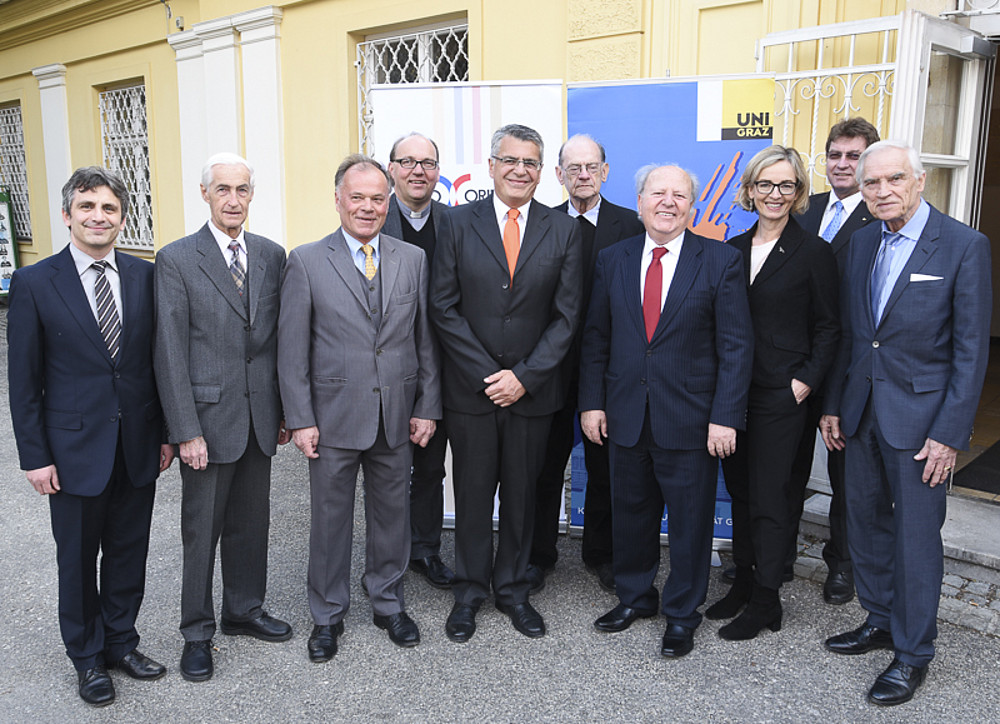
Feierten ein Fest der Ökumene: Dr. Ephrem Ishac, Altbürgermeister Alfred Stingl, Gemeinderat Peter Piffl-Percevic, Bischofsvikar Hermann Glettler, Institutsleiter Pablo Argárate, Philipp Harnoncourt, Grigorios Larentzakis, Landtagsabgeordnete Alexandra

Feierten ein Fest der Ökumene: Dr. Ephrem Ishac, Altbürgermeister Alfred Stingl, Gemeinderat Peter Piffl-Percevic, Bischofsvikar Hermann Glettler, Institutsleiter Pablo Argárate, Philipp Harnoncourt, Grigorios Larentzakis, Landtagsabgeordnete Alexandra Pichler-Jessenko, Vizerektor Peter Scherrer sowie der Präsident von Pro Oriente, Dr. Johann Marte (v.l.) Foto: Uni Graz/Tzivanopoulos

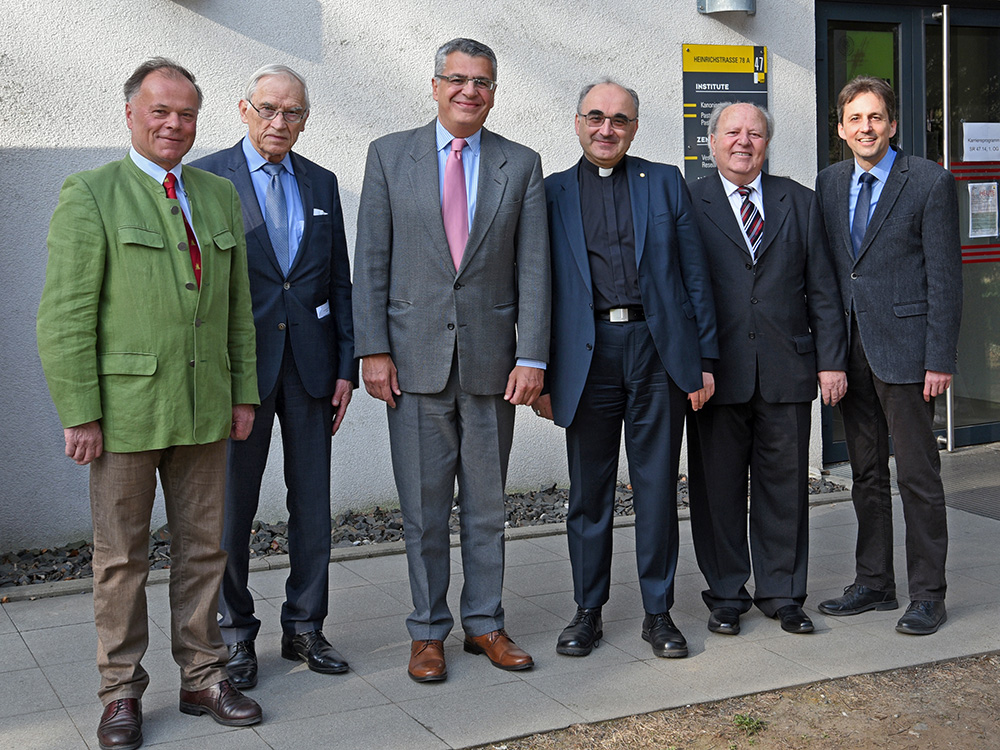
Organisatoren und Ehrengäste des Festsymposiums: Peter Piffl-Percevic und Hans Marte von Pro Oriente, Bischof Wilhelm Krautwaschl, flankiert von den Wissenschaftern Pablo Argarate und Grigorios Larentzakis, sowie Dekan Reinhold Esterbauer; Foto: Uni Graz ©Uni Graz/Eklaude

Organisatoren und Ehrengäste des Festsymposiums: Peter Piffl-Percevic und Hans Marte von Pro Oriente, Bischof Wilhelm Krautwaschl flankiert von Pablo Argarate und Grigorios Larentzakis vom Institut für Ökumne, Ostkirchliche Orthodoxie und Patrologie sowie Theologie-Dekan Reinhold Esterbauer. Foto: Uni Graz/Eklaude

Pro Oriente und das Institut für Ökumenische Theologie feierten gemeinsam ihr Bestehen. Festakt und Symposium standen am gemeinsamen Programm

Zwei Institutionen, ein gemeinsames Fest: Das 50-jährige Bestehen des Instituts für Ökumenische Theologie, Ostkirchliche Orthodoxie und Patrologie an der Uni Graz sowie 30 Jahre Pro Oriente Sektion Graz standen dieser Tage im Mittelpunkt eines Festaktes und eines Symposiums an der Katholisch-Theologischen Fakultät. "Beide sind sozusagen Kinder des 2. Vatikanums", erklärt  Pablo Argárate, der die Leitung des Instituts im Jahre 2012 übernommen hat. "Der inhaltliche Bogen von der Quellenkunde, dem Studium der alten Kirchenväter bis hin zu den aktuellen Problemen und dringenden gesellschaftlichen Fragestellungen unserer Zeit und Aspekten des konkreten Zusammenlebens der Konfessionen ist für beide Programm."

Viele tragende Persönlichkeiten spielten in der Geschichte des Instituts eine wichtige Rolle. In einer kleinen Ausstellung, die den Festakt und die Fachtagung umrahmt, wird besonders die Geschichte beider Institutionen beleuchtet. Darunter zu finden ist die Rede des späteren Papstes Benedikt, der als Joseph Ratzinger im Jänner 1976 an der Uni Graz sprach wie auch die Worte des ökumenischen Patriarchen von Konstantinopel, Bartholomaios  I., der im Jahre 2004 das Ehrendoktorat der Fakultät erhielt.

Die Feierlichkeiten fanden ihre Fortsetzung mit dem internationalen Symposium „Die Eine Kirche – gab es sie jemals wirklich? Alte Kirche zwischen Realität und Mythos“. In seiner Begrüßung wies Institutsleiter Pablo Argárate darauf hin, dass es auch schon im ersten Jahrtausend Spannungen und Spaltungen gegeben hat, man sich aber dennoch auf die Einheit besinne. Bischof Wilhelm Krautwaschl unterstrich das Interesse der unterschiedlichen Konfessionen aneinander und die Wertschätzung füreinander, auch wenn man in vielen Bereichen andere Auffassungen vertrete. Er bedankte sich beim Institut für die Verdienste um die Ökumene in Graz. Dekan Reinhold Esterbauer überbrachte sowohl dem Institut als auch Pro Oriente seine Geburtstagswünsche und lobte die enge, fruchtbringende Kooperation.


created by Konstantinos Tzivanopoulos & Dagmar Eklaude

Related news

Higher Education Strategy 2040: Austria’s universities on course for the future

Austria has 77 higher education institutions, which is above the EU average – but does this really make sense? The new Higher Education Strategy 2040 focuses on cooperation rather than mergers. As one of the six largest universities in Austria, the University of Graz plays a central role in this.

Climate research in Greenland: Old data provides new insights

The polar explorer and University of Graz professor Alfred Wegener left behind a unique collection of climate data from Greenland. A research team from the University of Graz is now analysing this 100-year-old treasure trove of data and comparing it with current measurements.

Diversity in nature and science: How we talk about plants and each other

Ginkgo, kiwi, hemp: they exist as male and female plants. Anyone who paid attention in biology class will confirm this. But is this categorisation, established by Carl von Linné almost 300 years ago, still valid today? An interdisciplinary team at the University of Graz is questioning these attributions and using this as a starting point to provide food for thought for gender-sensitive interaction between students, scientific and teaching staff.

Around the world in eight stops: the Long Night of Research at the University of Graz

On 24 April from 5 pm, you can take a short trip around the globe at the University of Graz, discovering pecularities of foreign countries or new local features in the entrance hall of the University Library. The itinerary takes you through introduced animal species, political attitudes and the omnipotence of algorithms. There will also be a programme in the historic reading hall, as well as at the UniGraz@Museum and the University Archive.

Begin of page section:
Additional information:

University of Graz
Universitaetsplatz 3
8010 Graz
Austria
  • Contact
  • Web Editors
  • Moodle
  • UNIGRAZonline
  • Imprint
  • Data Protection Declaration
  • Accessibility Declaration
Weatherstation
Uni Graz

End of this page section. Go to overview of page sections

End of this page section. Go to overview of page sections

Begin of page section:

End of this page section. Go to overview of page sections

