Begin of page section:
Page sections:

  • Go to contents (Accesskey 1)
  • Go to position marker (Accesskey 2)
  • Go to main navigation (Accesskey 3)
  • Go to sub navigation (Accesskey 4)
  • Go to additional information (Accesskey 5)
  • Go to page settings (user/language) (Accesskey 8)
  • Go to search (Accesskey 9)

End of this page section. Go to overview of page sections

Begin of page section:
Page settings:

English en
Deutsch de
Search
Login

End of this page section. Go to overview of page sections

Begin of page section:
Search:

Search for details about Uni Graz
Close

End of this page section. Go to overview of page sections


Search

Begin of page section:
Main navigation:

Page navigation:

  • University

    University
    • About the University
    • Organisation
    • Faculties
    • Library
    • Working at University of Graz
    • Campus
    Developing solutions for the world of tomorrow - that is our mission. Our students and our researchers take on the great challenges of society and carry the knowledge out.
  • Research Profile

    Research Profile
    • Our Expertise
    • Research Questions
    • Research Portal
    • Promoting Research
    • Research Transfer
    • Ethics in Research
    Scientific excellence and the courage to break new ground. Research at the University of Graz creates the foundations for making the future worth living.
  • Studies

    Studies
    • Prospective Students
    • Students
  • Community

    Community
    • International
    • Location
    • Research and Business
    • Alumni
    The University of Graz is a hub for international research and brings together scientists and business experts. Moreover, it fosters the exchange and cooperation in study and teaching.
  • Spotlight
Topics
  • Sustainable University
  • Researchers answer
  • Work for us
Close menu

End of this page section. Go to overview of page sections

Begin of page section:
You are here:

University of Graz News Doppel-Erfolg

End of this page section. Go to overview of page sections

Friday, 05 December 2014

Doppel-Erfolg

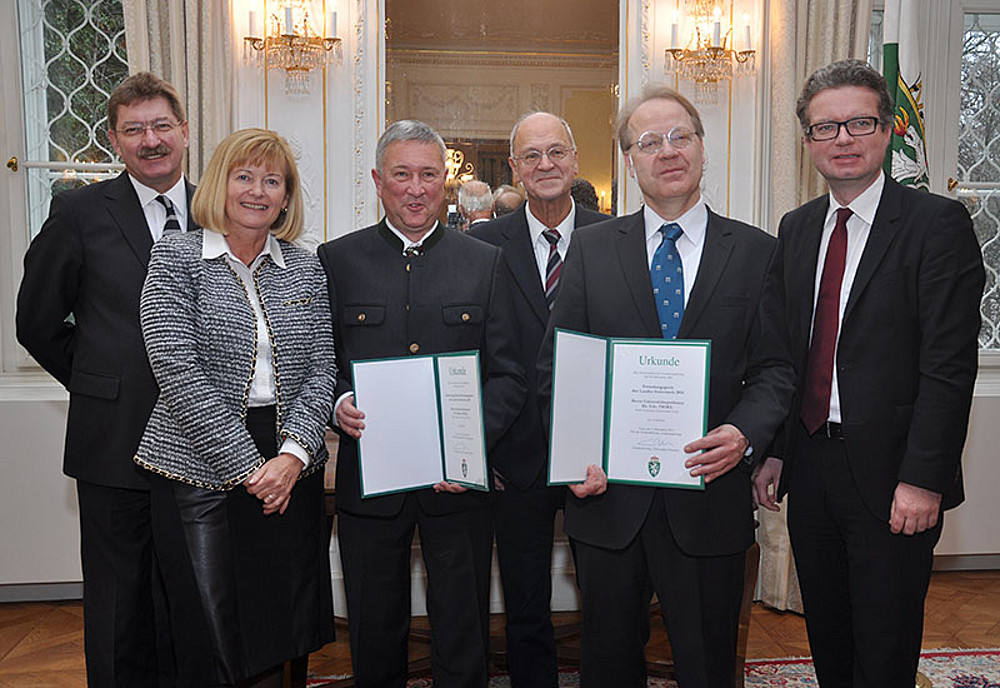
V.l.: Vizerektor Peter Scherrer, Rektorin Christa Neuper, Martin Moll, Laudator Karl Acham, Udo Thiel, Landesrat Christopher Drexler. Foto: Uni Graz/Pichler

V.l.: Vizerektor Peter Scherrer, Rektorin Christa Neuper, Martin Moll, Laudator Karl Acham, Udo Thiel, Landesrat Christopher Drexler. Foto: Uni Graz/Pichler

Historiker und Philosoph der Uni Graz mit Forschungspreisen des Landes Steiermark ausgezeichnet

Gleich zwei der diesjährigen Forschungspreise des Landes Steiermark gehen an Wissenschafter der Karl-Franzens-Universität Graz: Der Historiker Univ.-Doz. Dr. Martin Moll wird mit dem Erzherzog-Johann-Forschungspreis, der Philosoph Univ.-Prof. Dr. Udo Thiel mit dem Forschungspreis des Landes Steiermark 2014 ausgezeichnet. Den Förderungspreis für Wissenschaft und Forschung erhält Dipl.-Ing. Dr. Stefan Freunberger von der TU Graz. Landesrat Christopher Drexler überreichte die Auszeichnungen am 5. Dezember 2014 im Weißen Saal der Grazer Burg.


Martin Moll ist seit 2003 Universitätsdozent am Institut für Geschichte der Uni Graz. Seine Forschungsgebiete umfassen die Weltkriege sowie die Spätphase der Habsburgermonarchie, Medien- und Propagandageschichte. Den Erzherzog-Johann-Forschungspreis des Landes Steiermark 2014 bekommt der Historiker für seine Publikation „Die Steiermark im Ersten Weltkrieg. Der Kampf des Hinterlandes ums Überleben 1914–1918“. In diesem Buch, erschienen bei Styria Premium als Band 43 der Reihe „Veröffentlichungen der Historischen Landeskommission für Steiermark“, entwirft Moll das erste fundierte, quellenbasierte Gesamtpanorama eines hochindustrialisierten, zweisprachigen Kronlandes der Habsburgermonarchie während der vier Kriegsjahre. Basierend auf einer dichten Aktenlage schildert er anschaulich und mit zahlreichen Illustrationen, wie der Kampf an den fernen Fronten auch das Leben der Zivilbevölkerung und die Arbeit der Behörden weitab vom Kriegsgeschehen massiv in Mitleidenschaft zog, und welche Lösungen zur Überwindung der anstehenden Probleme entwickelt wurden.


Udo Thiel ist Universitätsprofessor für Geschichte der Philosophie und Leiter des Alexius Meinong-Instituts der Uni Graz. Zu seinen Forschungsschwerpunkten zählen die Geschichte der Erkenntnistheorie, Metaphysik, die Philosophie des Geistes und der Ästhetik der Frühen Neuzeit. Mit dem Forschungspreis des Landes Steiermark 2014 wird Thiel für seine Publikation „The Early Modern Subject: Self-Consciousness and Personal Identity from Descartes to Hume”, erschienen bei Oxford University Press, ausgezeichnet. In seiner Arbeit unternimmt der Wissenschafter als Erster eine umfassende detaillierte Analyse und kritische Bewertung von mehr als 100 Jahren philosophischer Auseinandersetzung mit Fragen zu Person, Selbstbewusstsein und Identität in Frankreich, Großbritannien und Deutschland. Was ist eine Person? Ist Selbstbewusstsein eine Bedingung von Personalität? Wodurch sind wir gerechtfertigt zu sagen, dass jemand zu verschiedenen Zeiten dieselbe Person ist? Diese Fragen sind von wesentlicher Bedeutung für konkrete praktische, moralisch und rechtlich relevante Zusammenhänge, etwa wenn es um die Zurechnung von Handlungen geht. Somit spielen sie auch in der öffentlichen Diskussion, beispielsweise im Bereich der angewandten Ethik, eine zentrale Rolle.

created by Gudrun Pichler

Related news

Diversity buddies at the University of Graz: Support on equal terms

The University of Graz is strengthening its commitment to equal opportunities with its new Diversity Buddies. University members can find easily accessible contact persons here for questions relating to equality and diversity. All employees can get involved and take action.

When parents find it difficult to have a say

In her dissertation, translation scholar Marie Tschurtschenthaler examines how communication between compulsory schools and parents whose first language is not German works – and what role professional language mediation plays in this. Initial insights show that it is not just about language, but also about resources, responsibilities and the institutional framework.

AI in schools: Maria Bertel drafts legal guidelines for teachers

The legal expert and her team analysed the legal situation regarding the use of artificial intelligence in education as part of an EU project and answered open questions from practice.

Cosmetics in the environment: University of Graz proves danger to ants

Titanium dioxide, which is found in cosmetics, for example, is increasingly entering the environment in the form of nanoparticles. This could also put insects at risk. If ants ingest the substance in combination with the pesticide glyphosate, it disturbs the development of their offspring. Scientists at the University of Graz are drawing attention to the negative consequences of this toxic cocktail.

Begin of page section:
Additional information:

University of Graz
Universitaetsplatz 3
8010 Graz
Austria
  • Contact
  • Web Editors
  • Moodle
  • UNIGRAZonline
  • Imprint
  • Data Protection Declaration
  • Accessibility Declaration
Weatherstation
Uni Graz

End of this page section. Go to overview of page sections

End of this page section. Go to overview of page sections

Begin of page section:

End of this page section. Go to overview of page sections