



Begin of page section:
Page sections:

  • Go to contents (Accesskey 1)
  • Go to position marker (Accesskey 2)
  • Go to main navigation (Accesskey 3)
  • Go to sub navigation (Accesskey 4)
  • Go to additional information (Accesskey 5)
  • Go to page settings (user/language) (Accesskey 8)
  • Go to search (Accesskey 9)

End of this page section. Go to overview of page sections

Begin of page section:
Page settings:

English en
Deutsch de
Search
Login

End of this page section. Go to overview of page sections

Begin of page section:
Search:

Search for details about Uni Graz
Close

End of this page section. Go to overview of page sections


Search

Begin of page section:
Main navigation:

Page navigation:

  • University

    University
    • About the University
    • Organisation
    • Faculties
    • Library
    • Working at University of Graz
    • Campus
    Developing solutions for the world of tomorrow - that is our mission. Our students and our researchers take on the great challenges of society and carry the knowledge out.
  • Research Profile

    Research Profile
    • Our Expertise
    • Research Questions
    • Research Portal
    • Promoting Research
    • Research Transfer
    • Ethics in Research
    • Commission for Scientific Integrity
    Scientific excellence and the courage to break new ground. Research at the University of Graz creates the foundations for making the future worth living.
  • Studies

    Studies
    • Prospective Students
    • Students
    • Registration for Study Programme (Winter semester 2026/27)
    • Welcome Weeks for First Year Students
  • Community

    Community
    • International
    • Location
    • Research and Business
    • Alumni
    The University of Graz is a hub for international research and brings together scientists and business experts. Moreover, it fosters the exchange and cooperation in study and teaching.
Topics
  • Sustainable University
  • Researchers answer
  • Work for us
Close menu

End of this page section. Go to overview of page sections

Begin of page section:
You are here:

University of Graz News Science communication and the role of young researchers in times of crisis

End of this page section. Go to overview of page sections

Friday, 24 November 2023

Science communication and the role of young researchers in times of crisis

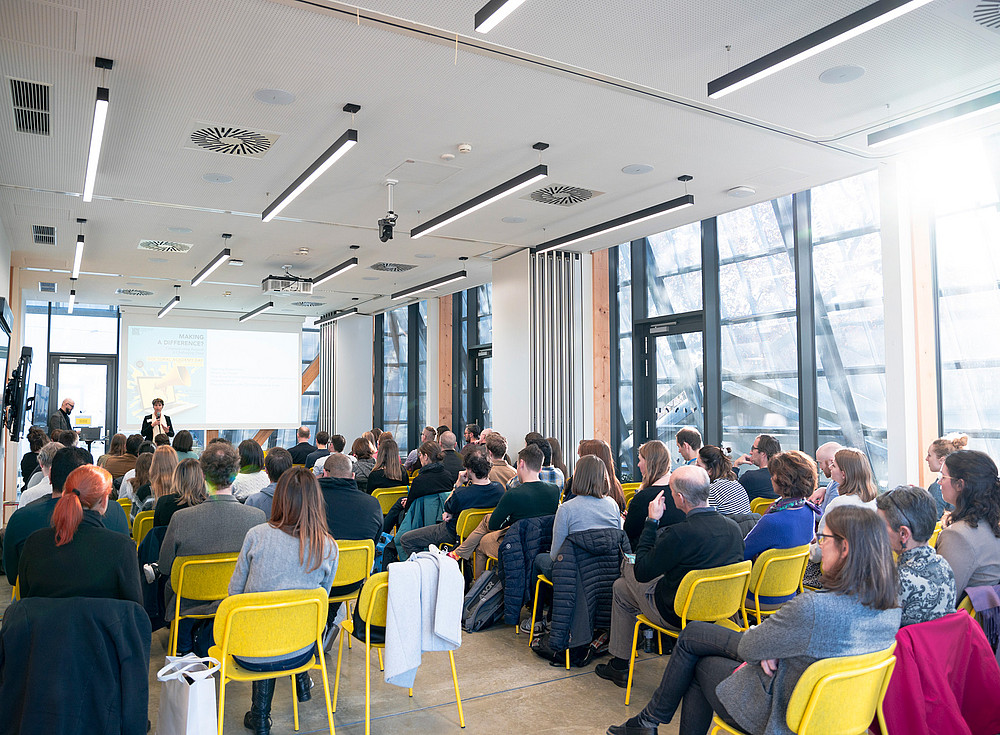
A seated room filled with people looking at a lady on the podium.

Vice-Rector Mireille van Poppel opened the Doctoral Academy Day. Photo: Uni Graz/Angele

What is the best way to communicate your own research? And are researchers allowed to engage in activism? These were the questions the participants asked themselves of this year's Doctoral Academy Day.

Climate change, pandemics and political crises - recent years have shown how important scientifically sound information is for everyday life. This increases the pressure on researchers to share their findings outside their own community. On November 23, the Doctoral Academy invited PhD researchers, Master's students and their supervisors to Unicorn to discuss this role as mediators.

"Our research provides answers and solutions to important questions about the future. If we don't communicate them, these questions will be answered by others who may pursue negative interests," emphasizes Lydia Lienhart, doctoral candidate at the Wegener Center at the University of Graz. She runs a YouTube channel in which she explains the economic aspects of climate change, such as the CO2 tax.

The aim of the annual Doctoral Academy Day is to create a platform for exchange and discussion for young scientists. Anyone interested in a career in science should take a look at the Doctoral Academy website.

created by Michael Angele

Related news

Wie aus Abgasen Rohstoff werden soll

Kohlendioxid gilt als Klimaproblem. Es kann aber auch Rohstoff sein. Der Grazer Chemiker Johann Hlina untersucht, wie sich Kohlenoxide wieder in Kohlenwasserstoffe verwandeln lassen – also in Ausgangsmaterial für Treibstoffe, Kunststoffe und Medikamente. Helfen sollen dabei Seltenerdmetalle

The Arctic up close: ORF special feature on the University of Graz’s research station in S

Students from the University of Graz are spending two weeks conducting research at the Univerisity of Graz research station at the Sermilik Fjord in Greenland, which has been operational for three years. They are measuring glacial runoff, tracking ice melt in real time and installing weather stations. ORF is following the expedition and will be reporting on the special feature ‘Arctic Adventure’ across its various channels from 20 July.

Chemical crash: Researchers at the University of Graz are investigating the reactions in detail for the first time

Matthew Timm and Leonhard Grill have, for the first time, succeeded in unravelling how fundamental chemical processes take place and how new molecules are formed. The findings of this study have just been published in the journal Science.

What is ‘Dr AI’ supposed to decide, Giovanni Rubeis?

Analysing X-rays, documenting diagnoses, searching through databases: artificial intelligence is already providing significant support with administrative and routine tasks in the healthcare sector. To what extent should it be involved in clinical matters – that is, in treatment recommendations or treatment decisions? How do we prevent built-in biases that could be detrimental to certain individuals?

Begin of page section:
Additional information:

University of Graz
Universitaetsplatz 3
8010 Graz
Austria
  • Contact
  • Web Editors
  • Moodle
  • UNIGRAZonline
  • Imprint
  • Data Protection Declaration
  • Accessibility Declaration
Weatherstation
Uni Graz

End of this page section. Go to overview of page sections

End of this page section. Go to overview of page sections

Begin of page section:

End of this page section. Go to overview of page sections