
Begin of page section:
Page sections:

  • Go to contents (Accesskey 1)
  • Go to position marker (Accesskey 2)
  • Go to main navigation (Accesskey 3)
  • Go to sub navigation (Accesskey 4)
  • Go to additional information (Accesskey 5)
  • Go to page settings (user/language) (Accesskey 8)
  • Go to search (Accesskey 9)

End of this page section. Go to overview of page sections

Begin of page section:
Page settings:

English en
Deutsch de
Search
Login

End of this page section. Go to overview of page sections

Begin of page section:
Search:

Search for details about Uni Graz
Close

End of this page section. Go to overview of page sections


Search

Begin of page section:
Main navigation:

Page navigation:

  • University

    University
    • About the University
    • Organisation
    • Faculties
    • Library
    • Working at University of Graz
    • Campus
    Developing solutions for the world of tomorrow - that is our mission. Our students and our researchers take on the great challenges of society and carry the knowledge out.
  • Research Profile

    Research Profile
    • Our Expertise
    • Research Questions
    • Research Portal
    • Promoting Research
    • Research Transfer
    • Ethics in Research
    Scientific excellence and the courage to break new ground. Research at the University of Graz creates the foundations for making the future worth living.
  • Studies

    Studies
    • Prospective Students
    • Students
  • Community

    Community
    • International
    • Location
    • Research and Business
    • Alumni
    The University of Graz is a hub for international research and brings together scientists and business experts. Moreover, it fosters the exchange and cooperation in study and teaching.
  • Spotlight
Topics
  • Sustainable University
  • Researchers answer
  • Work for us
Close menu

End of this page section. Go to overview of page sections

Begin of page section:
You are here:

University of Graz News Digitale Heldengeschichten

End of this page section. Go to overview of page sections

Friday, 31 March 2017

Digitale Heldengeschichten

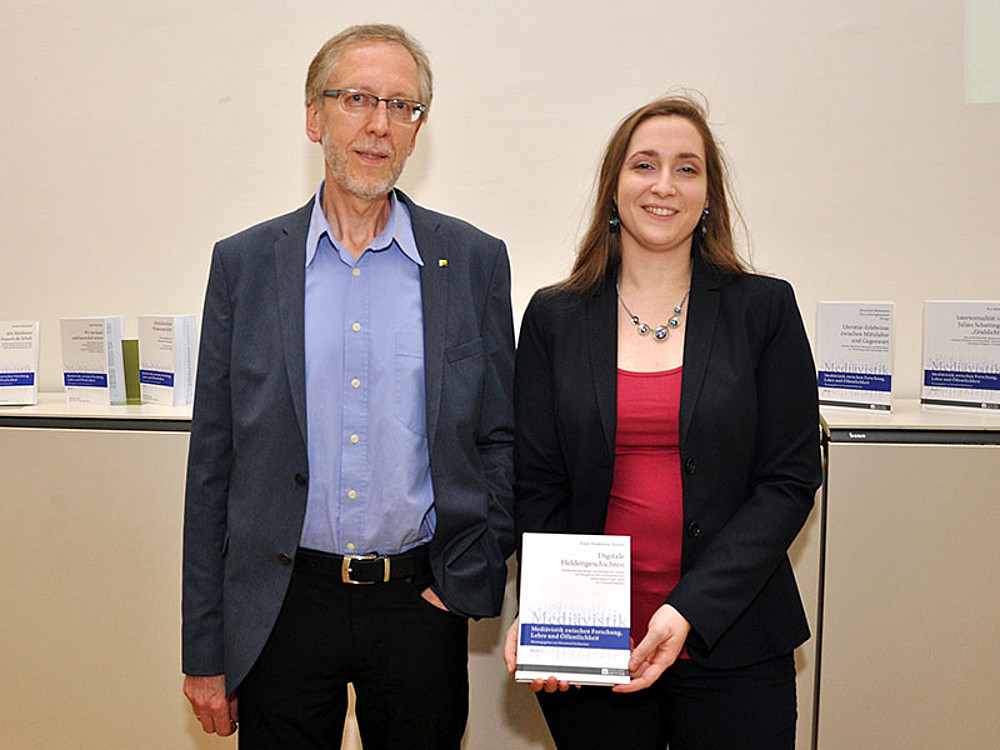
Aline Holzer, Autorin des neu erschienenen Buchs "Digitale Heldengeschichten", und Wernfried Hofmeister, Herausgeber der Reihe "Mediävistik zwischen Forschung, Lehre und Öffentlichkeit". Fotos: Uni Graz/Pichler

Aline Holzer, Autorin des neu erschienenen Buchs "Digitale Heldengeschichten", und Wernfried Hofmeister, Herausgeber der Reihe "Mediävistik zwischen Forschung, Lehre und Öffentlichkeit". Fotos: Uni Graz/Pichler

Am Buffet gab es, passend zur präsentierten Publikation, Bitcoins, "geprägt" von Andrea Hofmeister.

Am Buffet gab es, passend zur präsentierten Publikation, Bitcoins, "geprägt" von Andrea Hofmeister.

Germanistin spürt Elemente mittelalterlicher Erzählungen in Computerspielen auf

Computerspiele wie „Dragon Age: Inquisition“, „Guild Wars 2“ oder „Star Wars: The Old Republic“ üben eine besondere Faszination aus. „Sie vermitteln den SpielerInnen das Gefühl, AkteurInnen einer heroischen, archaischen, bedeutungsvollen Geschichte zu sein“, erklärt Aline Holzer, MA, selbst begeisterte „Gamerin“. Die Germanistin weiß auch warum: „Es sind Anleihen aus mittelalterlichen Erzählungen, die den SpielerInnen zwar meist nicht bewusst sind, ihre Wirkung aber – vielleicht gerade deshalb – nicht verfehlen.“ Wie Elemente und Strukturen dieser Epen eingesetzt werden, hat Holzer im Rahmen ihrer Masterarbeit, betreut von Ao.Univ.-Prof. Dr. Wernfried Hofmeister, untersucht. Das daraus entstandene Buch „Digitale Heldengeschichten“ präsentierte die Autorin am 30. März 2017 an der Uni Graz. Die Publikation ist im Verlag Peter Lang erschienen, als Band 12 der von Hofmeister herausgegebenen Reihe „Mediävistik zwischen Forschung, Lehre und Öffentlichkeit“, die heuer ihr zehnjähriges Bestehen feiert.

Die bislang großteils unentdeckten Parallelen, die Holzer ans Licht bringt, sind vielfältig. Sie umfassen unter anderem Namen und Begriffe – wie zum Beispiel „Hagen“, entlehnt von der Figur aus dem Nibelungenlied, oder „Buhurt“, die Bezeichnung für eine mittelalterliche Turnierform. Ebenso finden sich Motive, Stoffe und Szenarien wieder – etwa der Sohn, der nicht weiß, dass er im Zweikampf seinem Vater gegenübersteht, wie im Hildebrandslied. „Dabei werden diese Elemente nicht einfach übernommen, sondern an die heutige Lebenswirklichkeit angepasst und verfremdet“, berichtet Holzer.

Die Autorin zeigt, wie sie eingebunden werden und ihre Wirkung erzielen und welche Rolle dabei der Rezeption deutschsprachiger Epik des Mittelalters zukommt. Darüber hinaus deckt sie auf, wie sich narrative Strategien der mittelalterlichen Epik – etwa in Form von Quests oder Handlungsvorausdeutungen – in der Erzählwelt moderner PC-Heldenepen widerspiegeln. Auf Basis theoretischer Überlegungen zur Narrativik von PC-Spielen bietet das Buch erstmals einen Gesamtüberblick und exemplarische Einzelanalysen.

Aline Madeleine Holzer
Digitale Heldengeschichten. Medienübergreifende narratologische Studie zur Rezeption der mittelalterlichen deutschsprachigen Epik in Computerspielen
In: Mediävistik zwischen Forschung, Lehre und Öffentlichkeit, Hg. Wernfried Hofmeister, Band 12
Peter Lang 2017

created by Gudrun Pichler

Related news

AI in schools: Maria Bertel drafts legal guidelines for teachers

The legal expert and her team analysed the legal situation regarding the use of artificial intelligence in education as part of an EU project and answered open questions from practice.

Cosmetics in the environment: University of Graz proves danger to ants

Titanium dioxide, which is found in cosmetics, for example, is increasingly entering the environment in the form of nanoparticles. This could also put insects at risk. If ants ingest the substance in combination with the pesticide glyphosate, it disturbs the development of their offspring. Scientists at the University of Graz are drawing attention to the negative consequences of this toxic cocktail.

Varied and healthy: studies move

Exercise is the ideal way to balance out everyday stress, prevent illness and keep fit. Why this is the case, how to do it properly and what role human bodily functions and psychology play can be studied at the University of Graz.

Religious scholar Theresia Heimerl: Fasting as a spiritual boost

Fasting is not just a strategy for losing weight – it is a ritual dating back thousands of years with spiritual and evolutionary roots that has positive effects on the body. At the University of Graz, religious scholar Theresia Heimerl is investigating why fasting is a "spiritual boost".

Begin of page section:
Additional information:

University of Graz
Universitaetsplatz 3
8010 Graz
Austria
  • Contact
  • Web Editors
  • Moodle
  • UNIGRAZonline
  • Imprint
  • Data Protection Declaration
  • Accessibility Declaration
Weatherstation
Uni Graz

End of this page section. Go to overview of page sections

End of this page section. Go to overview of page sections

Begin of page section:

End of this page section. Go to overview of page sections