



Begin of page section:
Page sections:

  • Go to contents (Accesskey 1)
  • Go to position marker (Accesskey 2)
  • Go to main navigation (Accesskey 3)
  • Go to sub navigation (Accesskey 4)
  • Go to additional information (Accesskey 5)
  • Go to page settings (user/language) (Accesskey 8)
  • Go to search (Accesskey 9)

End of this page section. Go to overview of page sections

Begin of page section:
Page settings:

English en
Deutsch de
Search
Login

End of this page section. Go to overview of page sections

Begin of page section:
Search:

Search for details about Uni Graz
Close

End of this page section. Go to overview of page sections


Search

Begin of page section:
Main navigation:

Page navigation:

  • University

    University
    • About the University
    • Organisation
    • Faculties
    • Library
    • Working at University of Graz
    • Campus
    Developing solutions for the world of tomorrow - that is our mission. Our students and our researchers take on the great challenges of society and carry the knowledge out.
  • Research Profile

    Research Profile
    • Our Expertise
    • Research Questions
    • Research Portal
    • Promoting Research
    • Research Transfer
    • Ethics in Research
    • Commission for Scientific Integrity
    Scientific excellence and the courage to break new ground. Research at the University of Graz creates the foundations for making the future worth living.
  • Studies

    Studies
    • Prospective Students
    • Students
    • Welcome Weeks for First Year Students
  • Community

    Community
    • International
    • Location
    • Research and Business
    • Alumni
    The University of Graz is a hub for international research and brings together scientists and business experts. Moreover, it fosters the exchange and cooperation in study and teaching.
Topics
  • Sustainable University
  • Researchers answer
  • Work for us
Close menu

End of this page section. Go to overview of page sections

Begin of page section:
You are here:

University of Graz News Digital geboostet

End of this page section. Go to overview of page sections

Friday, 01 October 2021

Digital geboostet

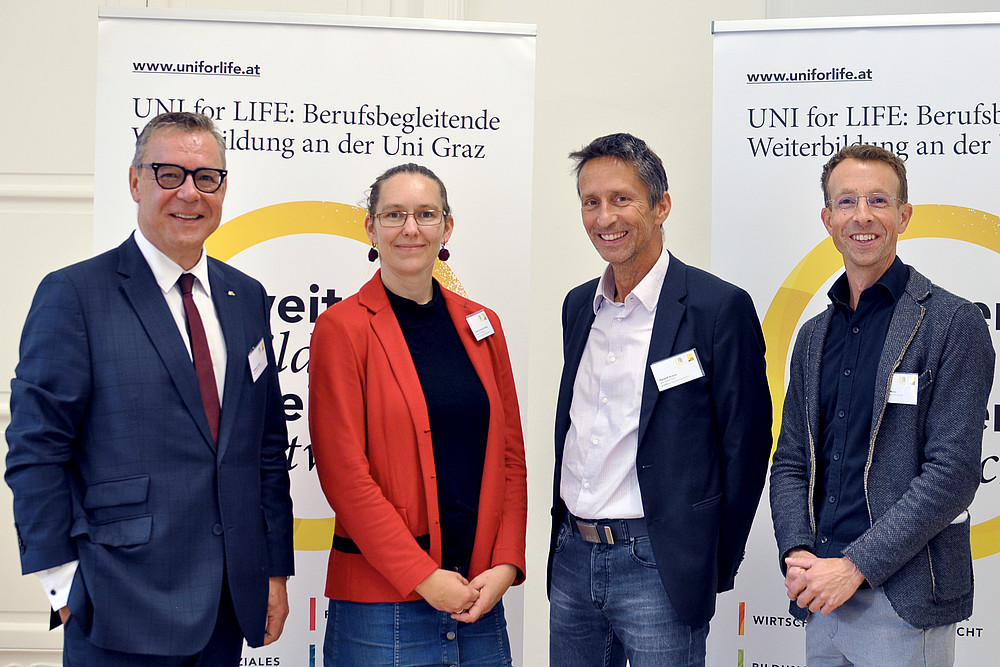
Die Keynote-Speaker des Business Brunch 2021 (v.l.n.r.): Dr. Wolfgang Gratzer, Generaldirektor der Generali Group, Prof.in Dr.in Viktoria Pammer-Schindler, Research Area Manager der Know-Center GmbH und Ing. Mag. Randolf Scholz, AVL Head of Software Development IODP-X mit UNI for LIFE Geschäftsführer Mag. Stephan Witzel Foto: UNI for LIFE

Die Keynote-Speaker des Business Brunch 2021 (v.l.n.r.): Dr. Wolfgang Gratzer, Generaldirektor der Generali Group, Prof.in Dr.in Viktoria Pammer-Schindler, Research Area Manager der Know-Center GmbH und Ing. Mag. Randolf Scholz, AVL Head of Software Development IODP-X mit UNI for LIFE Geschäftsführer Mag. Stephan Witzel Foto: UNI for LIFE

Der diesjährige Business Brunch der UNI for LIFE stand ganz im Zeichen der "Bewährungsprobe" Digitalisierung.

Unter dem Motto "Experience Learning: Digital Boost – eine Bewährungsprobe?" ging der diesjährige Business Brunch der UNI for LIFE der Frage nach, welche Chance und Konflikte bei schnelllebigen Veränderungen mitgedacht werden müssen und welche Rolle dabei u.a. Digital Agents, Fehlerkultur und Abkürzungen spielen. Denn die sich rasch wandelnde Umgebung wirkt auf uns alle ein. "Technologie ist trotzdem nicht der einzige Trick schlechthin, um Innovation zu begegnen", meint Keynote-Speakerin und Forschermind Assoz.-Prof.in Dr.in Viktoria Pammer-Schindler an den Beginn der Veranstaltung. "Digitalisierung und eine dynamische Umgebung sind Treiber und Veränderer, üben aber auch automatisch Druck auf Mensch und Unternehmen aus. Daraus resultieren Lernprozesse, die ein soziotechnisches Design von neuen Prozessen, Produkten und Services sowie eine Harmonie aus Technologie, Strategie und BenutzerInnen bedingen", konstatiert Pammer-Schindler, Teil des Know Centers in Graz. 

Wildnis der Transformation

Eine ihrer Thesen: Während Technologie Zeit "frei macht" fürs Lernen, nimmt die Automatisierung wiederum Lernmöglichkeiten. Ein ideologischer Zwiespalt in der Wildnis der Transformation? "Essentiell ist zu erkennen, dass es zur Expertise keine Abkürzungen gibt. Echte Expertise ist kein Sprint, sondern ein Marathon", lässt Pammer-Schindler anklingen. Auch Ing. Mag. Randolf Scholz, AVL Global Head of Software Development IODP-X, unterstreicht in seinem Vortrag die Bedeutsamkeit des Lernwillens: "Ein Boost ist per se eine Beschleunigung. Das hat immer etwas mit Druck und Lernfähigkeit zu tun. Ich halte es daher für sehr wichtig, Ausgleichendes wie eine stabile Wertehaltung, Vertrauen und Wertschätzung im Team nicht zu vergessen.“ Sinnvolle Jobdesigns und autonome Power für MitarbeiterInnen, Dinge umsichtig entscheiden zu dürfen, kristallisieren sich für die anwesenden Speaker als Basis für Transformationen heraus. „40 Prozent meiner Arbeit besteht nur aus permanentem Lernen. Ich will schließlich verstehen, was mein Team tut. Fehler sind Teil eines Lernprozesses“, unterstreicht Scholz. Automatisierung könne ohne vorangegangene Fehlerbereinigung schlichtweg nicht gelingen.

Erfahrung, die man nicht googeln kann

Dr. Wolfgang Gratzer, Regionaldirektor der Generali Group, zeigt in seiner Keynote auf, wie MitarbeiterInnen seines Unternehmens mittels Digital Agents, digitalen Lernplattformen in vielen Sprachen und Sociabble unterstützt werden, Begeisterung und Know-how für Digitalisierungsschritte zu erlangen. „Wer will schon ein Nokia-Schicksal erleiden“, erinnert der Versicherungsexperte. Zudem gehe es auch darum, Erfahrung wertzuschätzen, die man „nicht googlen kann“ und Neues nicht als Gefahr, sondern stets als Möglichkeit zu bewerten. In der anschließenden Podiumsdiskussion, moderiert von UNI for LIFE Geschäftsführer Mag. Stephan Witzel, wurden zudem dank reger Beteiligung des Präsenz- und Onlinepublikums spezielle Konfliktpotenziale in Change-Prozessen und Motivationstipps für mehr Weiterbildungsfreude in unterschiedlichen Unternehmensebenen ausgetauscht. Der nächste Business Brunch findet im Herbst 2023 statt. 

Zu den Weiterbildungsangeboten der UNI for LIFE:
Digital Innovation Modelling
Agile Organisationen
Führungskräfteentwicklung
Systemische Beratung


created by Joachim Hirtenfellner

Related news

Electrifying: Researchers film the first moments on the way from light to electricity

Physicists at the University of Graz (Austria), in collaboration with colleagues from Marburg University and Forschungszentrum Jülich (Germany), have achieved a scientific breakthrough. For the first time, the generation of electrical energy from light has been filmed and described theoretically. This work is of far-reaching significance, not least for optimising sustainable energy production from photovoltaics. This is because it provides fundamental building blocks for understanding the physical processes that take place, for example, in organic solar cells. The paper was published in the journal Physical Review X, one of the world’s most prestigious physics journals.

University of Graz: Working together to make Styria a sustainable centre of learning

Round table calls for sustainable funding for the 2028–2030 performance agreement period between the five Styrian universities and the federal government.

How can we teach using YouTube and AI? The University of Graz is strengthening media education in schools

A journey through the blood vessels using VR headsets brings biology lessons to life. An interactive quiz brings physics to life. The YouTube video explains the First World War. Whilst mobile phones are increasingly being banned from the classroom, social media platforms, apps and AI are playing an ever-greater role in knowledge transfer at school. But how can teaching with media be made even more effective? What are the challenges in media-based teaching? At the University of Graz, researchers are discussing these issues at a conference being held in Austria for the first time.

Jurassic Sounds: Biologist reconstructs insect songs from 165 million years ago

It was apparently not just the roars of the dinosaurs that made up the soundscape of the animal world during the Jurassic period. Crickets and grasshoppers communicated through a variety of songs and high-pitched sounds, as Thorin Jonsson from the Institute of Biology at the University of Graz discovered together with colleagues from the universities of Lincoln, Bristol (UK), Beijing (China) and Tempe (USA). The findings on what are so far the oldest traces of sound on Earth have just been published in the journal PNAS.

Begin of page section:
Additional information:

University of Graz
Universitaetsplatz 3
8010 Graz
Austria
  • Contact
  • Web Editors
  • Moodle
  • UNIGRAZonline
  • Imprint
  • Data Protection Declaration
  • Accessibility Declaration
Weatherstation
Uni Graz

End of this page section. Go to overview of page sections

End of this page section. Go to overview of page sections

Begin of page section:

End of this page section. Go to overview of page sections

