Begin of page section:
Page sections:

  • Go to contents (Accesskey 1)
  • Go to position marker (Accesskey 2)
  • Go to main navigation (Accesskey 3)
  • Go to sub navigation (Accesskey 4)
  • Go to additional information (Accesskey 5)
  • Go to page settings (user/language) (Accesskey 8)
  • Go to search (Accesskey 9)

End of this page section. Go to overview of page sections

Begin of page section:
Page settings:

English en
Deutsch de
Search
Login

End of this page section. Go to overview of page sections

Begin of page section:
Search:

Search for details about Uni Graz
Close

End of this page section. Go to overview of page sections


Search

Begin of page section:
Main navigation:

Page navigation:

  • University

    University
    • About the University
    • Organisation
    • Faculties
    • Library
    • Working at University of Graz
    • Campus
    Developing solutions for the world of tomorrow - that is our mission. Our students and our researchers take on the great challenges of society and carry the knowledge out.
  • Research Profile

    Research Profile
    • Our Expertise
    • Research Questions
    • Research Portal
    • Promoting Research
    • Research Transfer
    • Ethics in Research
    Scientific excellence and the courage to break new ground. Research at the University of Graz creates the foundations for making the future worth living.
  • Studies

    Studies
    • Prospective Students
    • Students
  • Community

    Community
    • International
    • Location
    • Research and Business
    • Alumni
    The University of Graz is a hub for international research and brings together scientists and business experts. Moreover, it fosters the exchange and cooperation in study and teaching.
  • Spotlight
Topics
  • Our digital Advent calendar
  • Sustainable University
  • Researchers answer
  • Work for us
Close menu

End of this page section. Go to overview of page sections

Begin of page section:
You are here:

University of Graz News Rethinking our world

End of this page section. Go to overview of page sections

Friday, 07 April 2023

Rethinking our world

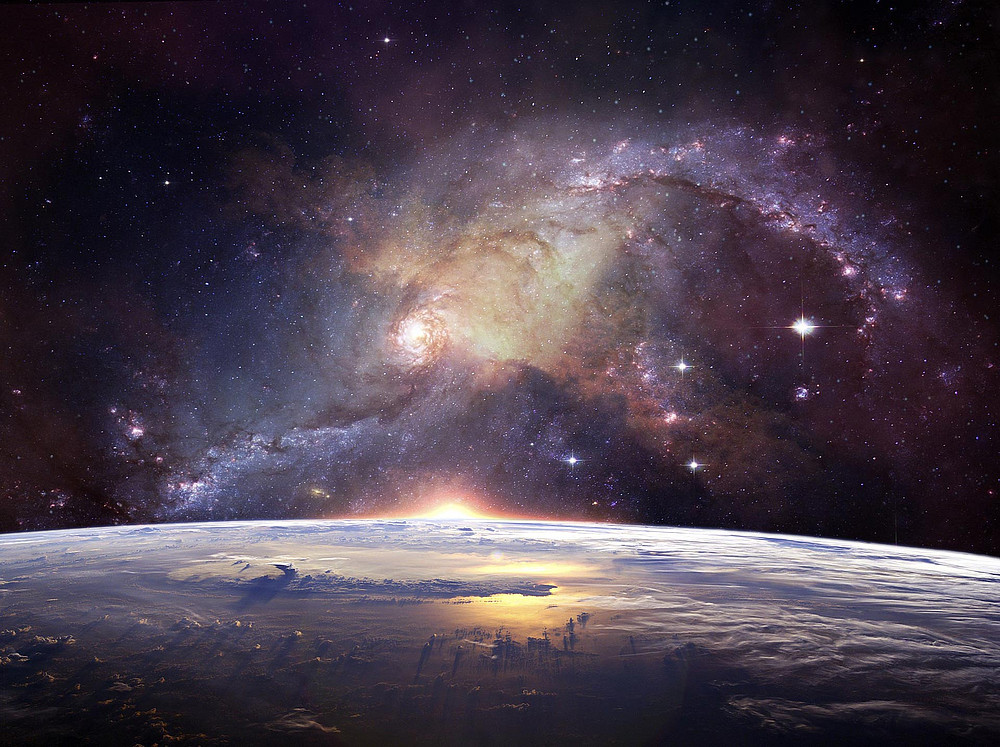
purple-yellow swathes in the universe above the earth's atmosphere

Physicist Axel Maas and philosopher Philipp Berghofer from the University of Graz abandon the image of point-like elementary particles and describe them completely anew as extended objects. Photo: pixabay

Physics and philosophy explain the building blocks of nature anew

What is our world made of? Do the conventional ideas of elementary particles like quarks and electrons really correspond to reality? "If we take our theories seriously, we get a new picture of the basic building blocks of the universe that turns our concept of the laws of nature upside down. We have to rethink our world," says Axel Maas, a physicist at the University of Graz. Together with Philipp Berghofer from the Institute of Philosophy and international colleagues, the researchers resolve contradictions between theory and the previous interpretation of experiments. The interdisciplinary work has been published as a book by Cambridge University Press.

If you believe popular science literature and physics textbooks, our universe is composed of point-like particles. "However, this assumption gives rise to a problem with the theory," Maas and Berghofer say. "Because if we follow the theory consistently, then the elementary building blocks we observe must be more complex objects that have structure and extension."
Physicists were already discussing the existence of a more complex concept of elementary particles in the 1970s and 80s. But because experimental observations allowed a simplified interpretation, these considerations were shelved. This was not the case in philosophy, which always accused physics of not taking a closer look and not questioning its interpretations and their contradiction to theory.

In their publication, the authors now present a constructive solution to the problem based on work from physics over the last 50 years: "We abandon the image of point-like elementary particles and describe them completely anew as extended objects," Maas explains. "This has far-reaching consequences for our understanding of the world and its laws of nature."
For lack of technical possibilities, this cannot yet be confirmed with certainty through experimental observations. "But the probability that we will see the differences clearly in future experiments with a new generation of particle accelerators with which we can measure the extension of particles, is relatively high," says Maas confidently. "Then the textbooks will have to be rewritten."

Publication
Gauge Symmetries, Symmetry Breaking, and Gauge-Invariant Approaches
Philipp Berghofer, Jordan François, Simon Friederich, Henrique Gomes, Guy Hetzroni, Axel Maas, René Sondenheimer
Cambridge Elements

created by Gudrun Pichler

Related news

Chemical Christmas show at the University of Graz: An explosive evening at the Schauspielh

At the beginning of December, the University of Graz transformed the theater into a laboratory: as part of “Chemical Life,” teacher training students staged a chemical Christmas show for Styrian school classes—complete with ethanol rockets, nitrogen snow, and glowing effects. An evening designed to inspire interest in studying chemistry.

Train by train: Koralm railway accelerates exchange between the Universities

Lectures at the University of Klagenfurt in the morning, seminars at the University of Graz in the afternoon: Austria's longest tunnel and a journey time of around 45 minutes make it easy. The Koralm railway increases the speed of networking between the two university locations. The collaboration builds on existing cooperation - for example in the areas of teacher training, Slavic studies and as employers, the universities are well coordinated.

On the trail of the Big Bang: University of Graz receives 1.5 million euros for doctoral programmes

The Austrian Science Fund FWF has selected the Doctoral Programme in Theoretical Particle Physics at the University of Graz for funding from the Doc.funds. Six young scientists will be funded for 3.5 years. They will gain fundamentally new insights into the origins of the world.

From trans women and knee prostheses: sports science prizes awarded

Walking better with a prosthesis, successfully getting rid of excess weight, training more effectively, more fairness for trans people in sport: these were the topics addressed by the students at the University of Graz who were awarded the sports science prizes for their Master's theses on 3 December 2025.

Begin of page section:
Additional information:

University of Graz
Universitaetsplatz 3
8010 Graz
Austria
  • Contact
  • Web Editors
  • Moodle
  • UNIGRAZonline
  • Imprint
  • Data Protection Declaration
  • Accessibility Declaration
Weatherstation
Uni Graz

End of this page section. Go to overview of page sections

End of this page section. Go to overview of page sections

Begin of page section:

End of this page section. Go to overview of page sections