Begin of page section:
Page sections:

  • Go to contents (Accesskey 1)
  • Go to position marker (Accesskey 2)
  • Go to main navigation (Accesskey 3)
  • Go to sub navigation (Accesskey 4)
  • Go to additional information (Accesskey 5)
  • Go to page settings (user/language) (Accesskey 8)
  • Go to search (Accesskey 9)

End of this page section. Go to overview of page sections

Begin of page section:
Page settings:

English en
Deutsch de
Search
Login

End of this page section. Go to overview of page sections

Begin of page section:
Search:

Search for details about Uni Graz
Close

End of this page section. Go to overview of page sections


Search

Begin of page section:
Main navigation:

Page navigation:

  • University

    University
    • About the University
    • Organisation
    • Faculties
    • Library
    • Working at University of Graz
    • Campus
    Developing solutions for the world of tomorrow - that is our mission. Our students and our researchers take on the great challenges of society and carry the knowledge out.
  • Research Profile

    Research Profile
    • Our Expertise
    • Research Questions
    • Research Portal
    • Promoting Research
    • Research Transfer
    • Ethics in Research
    Scientific excellence and the courage to break new ground. Research at the University of Graz creates the foundations for making the future worth living.
  • Studies

    Studies
    • Prospective Students
    • Students
  • Community

    Community
    • International
    • Location
    • Research and Business
    • Alumni
    The University of Graz is a hub for international research and brings together scientists and business experts. Moreover, it fosters the exchange and cooperation in study and teaching.
  • Spotlight
Topics
  • Sustainable University
  • Researchers answer
  • Work for us
Close menu

End of this page section. Go to overview of page sections

Begin of page section:
You are here:

University of Graz News Die Natur scannen

End of this page section. Go to overview of page sections

Tuesday, 20 December 2022

Die Natur scannen

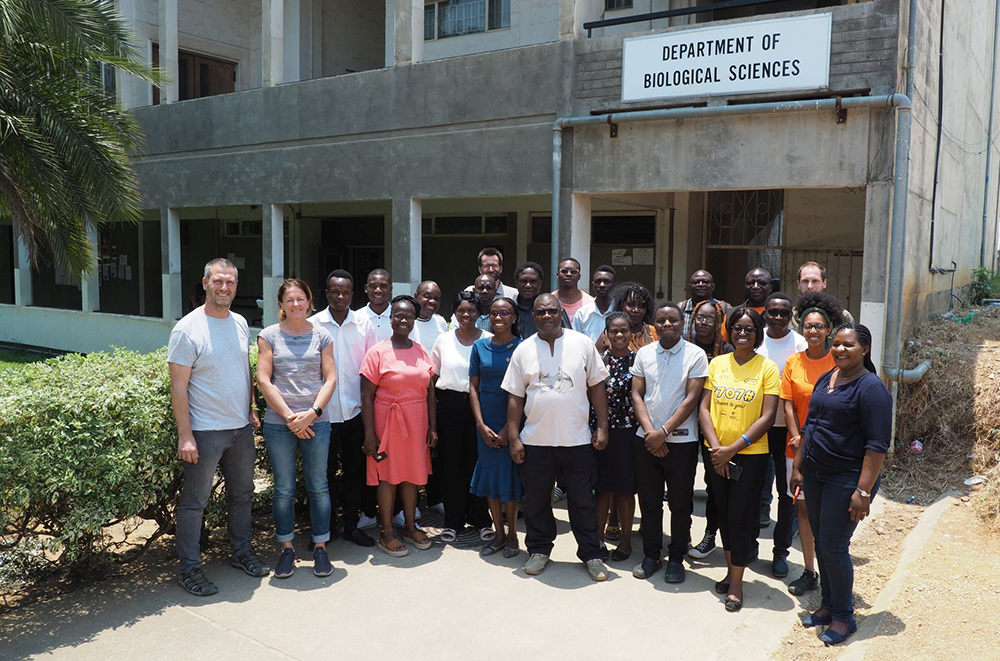
Uni-Graz-Biologe Stephan Koblmüller (ganz links) forscht zur Biodiversität in Sambia. Foto: NHM Wie

Uni-Graz-Biologe Stephan Koblmüller (ganz links) forscht zur Biodiversität in Sambia. Foto: NHM Wien

Zum Schutz der biologischen Vielfalt: Universität Graz leitet DNA-Barcoding in Sambia

DNA-Barcoding – die Bestimmung von Tieren, Pflanzen und Pilzen über den Vergleich kurzer Abschnitte des Erbguts (der DNA) – eröffnet der Wissenschaft ganz neue Möglichkeiten, Arten nachzuweisen. Dieser Ansatz wird nun auch dort angewandt, wo Biodiversität am höchsten ist, weiße Flecken in der Forschung am größten sind: im tropischen Afrika. Im Rahmen des OeAD-Kooperationsprojekts „DNA barcoding of Zambias Biodiversity“ – unter der Leitung der Universität Graz – wurde im Herbst ein DNA-Barcoding-Workshop an der Universität von Sambia in Lusaka mit Expert:innen der österreichischen Barcoding-Initiative ABOL, koordiniert vom Naturhistorischen Museum Wien, abgehalten.

Von Fischen und Libellen
„Im Vergleich zu Österreich, wo es hauptsächlich darum geht, Wissenslücken zu schließen, war in Afrika das Ziel, mit Fischen und Libellen einen guten Ausgangspunkt für eine breitere Erfassung und ein Monitoring der in Sambia beheimateten Biodiversität zu finden“, erklärt Stephan Koblmüller von der Uni Graz. Die Kenntnis der biologischen Vielfalt ist nämlich Voraussetzung, um den globalen Verlust und dessen Konsequenzen für die Menschheit eindämmen zu können. Koblmülller beurteilt daher positiv, dass sich 196 Staaten beim Weltnaturgipfel in Montreal am 19. Dezember 2022 geeinigt haben, mindestens 30 Prozent der weltweiten Land- und Meeresflächen bis 2030 unter Schutz zu stellen: „Der Erklärung müssen aber auch Taten folgen.“

Sammelexkursion
Das Ziel war es, sambischen Biolog:innen die theoretischen Grundlagen zu DNA-Barcoding zu vermitteln sowie diesen methodischen Ansatz zur Biodiversitätserfassung auch in der Praxis durchzuspielen“, erklärt Nikolaus Szucsich, Koordinator der Initiative ABOL am Naturhistorischen Museum Wien. Dies umfasste neben vielen Vorträgen eine Sammelexkursion an den Fluss Kafue, bei der die Teilnehmenden, mit Insektennetzen und Ehrgeiz ausgestattet, Libellen fingen. Die gesammelten Tiere wurden im Labor auf ihre Art bestimmt und Gewebeproben für die DNA-Analyse entnommen.
Libellen gelten als gute Indikatoren für den ökologischen Zustand von Gewässern. Auch Proben von Fischen wurden für den Testlauf herangezogen, weil sie für Sambia eine große wirtschaftliche Bedeutung haben. „Auch wenn es nicht möglich sein wird, global jede einzelne Art zu erfassen, muss die Datengrundlage geschaffen werden, um besonders vulnerable Habitate zu erkennen und sie zu schützen“, betont Lukas Zangl vom Universalmuseum Joanneum Graz.

Die Risiken
Dies ist bereits in Österreich eine Herausforderung – wie auch in den Ländern des Globalen Südens, die die Biodiversitätshotspots der Erde besitzen. Die Gefährdungsfaktoren für die Biodiversität sind dort die gleichen wie hier, wie etwa Landnutzung, Umweltverschmutzung und Klimawandel.
Dazu kommen noch ein rasantes Bevölkerungswachstum einerseits und ein enormes Entwicklungspotenzial andererseits, verbunden mit steigendem Flächenbedarf. Umso wichtiger ist es, zu wissen, wo der große Anteil an Biodiversität vorhanden ist und diese Gebiete zu schützen.

Wissenstransfer
„Durch diesen Wissenstransfer wurde ein Grundstein für weitere Bemühungen zur Etablierung einer sambischen Barcoding-Initiative gelegt“, zeigt sich Cyprian Katongo, Professor an der Universität von Sambia (UNZA) optimistisch, zumal mit der frühen Einbindung politischer Stakeholder bereits ein wichtiger Beitrag zum Erfolg gelungen ist. „Allein schon der Enthusiasmus und das Engagement der Workshopteilnehmer:innen zeigt, dass das Kernziel dieses Projekts, nämlich Wissenstransfer, nachhaltig erreicht werden konnte“, ergänzt Michaela Sonnleitner vom Naturhistorischen Museum Wien.

>> über ABOL - Austrian Barcoding of Life mehr erfahren

created by Naturhistorisches Museum Wien & Andreas Schweiger

Related news

Cosmetics in the environment: University of Graz proves danger to ants

Titanium dioxide, which is found in cosmetics, for example, is increasingly entering the environment in the form of nanoparticles. This could also put insects at risk. If ants ingest the substance in combination with the pesticide glyphosate, it disturbs the development of their offspring. Scientists at the University of Graz are drawing attention to the negative consequences of this toxic cocktail.

How are tech companies changing democracy? Uni Graz designs exhibition for schools

Filtered information, conspiracy theories, fake news – certain groups and corporations are using social media and algorithms to try to influence public opinion in their favour. Their goal: to weaken fundamental rights and diversity of opinion and seize power. In a new exhibition, researchers at the University of Graz are working with pupils to explore the impact of social media and AI on democracy. In accompanying workshops, the scientists want to encourage young people to develop their own ideas for a socially and ecologically viable future and to actively help shape it. The exhibition, designed as a travelling exhibition for schools, will open on 9 March 2026 at the Dreihackengasse Gymnasium in Graz.

Step by step: What motivates Mireille van Poppel as a scientist and vice-rector

Improving people's health and eliminating inequalities: Mireille van Poppel pursues these goals both as a public health researcher and as vice-rector for Internationalisation and Equality. In both roles, she pays particular attention to individual needs.

Master's degree in psychotherapy in Graz: registration opens in March

Graz is becoming a hotspot for psychotherapy: from 2026, the University of Graz and the Medical University of Graz will jointly offer the new master's programme. Registration for the admission procedure for the 140 study places will start in March.

Begin of page section:
Additional information:

University of Graz
Universitaetsplatz 3
8010 Graz
Austria
  • Contact
  • Web Editors
  • Moodle
  • UNIGRAZonline
  • Imprint
  • Data Protection Declaration
  • Accessibility Declaration
Weatherstation
Uni Graz

End of this page section. Go to overview of page sections

End of this page section. Go to overview of page sections

Begin of page section:

End of this page section. Go to overview of page sections