Begin of page section:
Page sections:

  • Go to contents (Accesskey 1)
  • Go to position marker (Accesskey 2)
  • Go to main navigation (Accesskey 3)
  • Go to sub navigation (Accesskey 4)
  • Go to additional information (Accesskey 5)
  • Go to page settings (user/language) (Accesskey 8)
  • Go to search (Accesskey 9)

End of this page section. Go to overview of page sections

Begin of page section:
Page settings:

English en
Deutsch de
Search
Login

End of this page section. Go to overview of page sections

Begin of page section:
Search:

Search for details about Uni Graz
Close

End of this page section. Go to overview of page sections


Search

Begin of page section:
Main navigation:

Page navigation:

  • University

    University
    • About the University
    • Organisation
    • Faculties
    • Library
    • Working at University of Graz
    • Campus
    Developing solutions for the world of tomorrow - that is our mission. Our students and our researchers take on the great challenges of society and carry the knowledge out.
  • Research Profile

    Research Profile
    • Our Expertise
    • Research Questions
    • Research Portal
    • Promoting Research
    • Research Transfer
    • Ethics in Research
    Scientific excellence and the courage to break new ground. Research at the University of Graz creates the foundations for making the future worth living.
  • Studies

    Studies
    • Prospective Students
    • Students
  • Community

    Community
    • International
    • Location
    • Research and Business
    • Alumni
    The University of Graz is a hub for international research and brings together scientists and business experts. Moreover, it fosters the exchange and cooperation in study and teaching.
  • Spotlight
Topics
  • Sustainable University
  • Researchers answer
  • Work for us
Close menu

End of this page section. Go to overview of page sections

Begin of page section:
You are here:

University of Graz News Detached

End of this page section. Go to overview of page sections

Tuesday, 01 March 2022

Detached

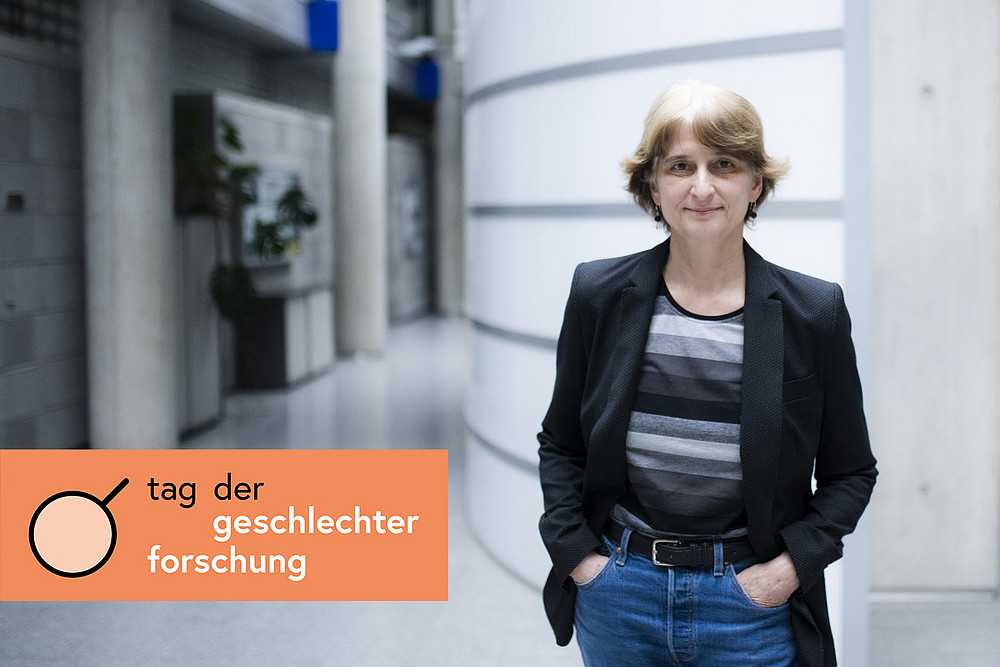
Sociologist Libora Oates-Indruchová explains Gender Research and how it helps us to let go of old thought patterns. Photo: Uni Graz/Tzivanopoulos.

Sociologist Libora Oates-Indruchová explains Gender Research and how it helps us to let go of old thought patterns. Photo: Uni Graz/Tzivanopoulos.

Today, to celebrate Gender Research Day, sociologist Libora Oates-Indruchová explains what direction the discipline is moving in and how it helps us to let go of old thought patterns

What does gender research concern itself with?
LIBORA OATES-INDRUCHOVA:
Gender is a category to which we are all allocated and that affects us in almost all areas of life. Age, ethnicity, educational level, or physical ability are other such categories. Their consequence often is the creation of hierarchies and inequalities, placing us in socially, economically or culturally privileged or disadvantaged positions. We study how this process works.


So, you study the effects of wearing “gender glasses”, but not only the effects on us as individuals?
LIBORA OATES-INDRUCHOVA:
We study hierarchies and power structures that are based on assumptions about gender. We analyze where these come from and ask how they shape politics, the economy, culture and people’s everyday lives. The more intensively we study this, the more likely we are to create conditions for a fairer society that allows everyone to reach their full potential.


But it’s well known that life’s not fair. What’s really left to explore from a gender perspective?
LIBORA OATES-INDRUCHOVA:
New questions always arise, and we will always have to ask old questions again, because the conditions or contexts have changed. Gender research helps us to understand the world we live in more fully. It also strengthens democratic values like equality.


In which direction should gender research continue to develop?
LIBORA OATES-INDRUCHOVA:
Findings from gender research are significant in all branches of science, scholarship and aspects of life. So, it is not possible to give a general prescription as to what needs to be researched. However, the Covid-19 pandemic has brought gender, alongside other categories of inequality, into prominence. Inequality generates vulnerability. A society with many or large vulnerable groups is less resilient to sudden events like a pandemic.


>> More on this topic in the AirCampus Podcast of the Week (German only)


Gabriele Possanner Honorary Prizes for Irmtraud Fischer

Since 1997, the Federal Ministry of Education, Science and Research has awarded the Gabriele Possanner Prizes every two years for scientific achievements in the field of gender research. The prize is named after the physician Gabriele Possanner von Ehrenthal, who in 1897 was the first woman in Austria to obtain an academic degree. One state prize, one honorary prize and two promotional prizes are awarded.

First female habilitated Catholic theologian in Austria

This year, the Honorary Prize goes to Univ.-Prof. Dr. Irmtraud Fischer, Professor of Old Testament Biblical Studies at the Faculty of Catholic Theology at the University of Graz. She was the first habilitated Catholic theologian in Austria. She is currently co-editor and director of the project "The Bible and Women”. More than 20 volumes on the history of biblical interpretation, with a focus on gender-relevant themes and biblical female figures, will be published in four languages within this framework. The appreciation award is a symbolic award in the form of a sculpture by the artist Claudia Hirtl and is not connected with any prize money.

New podcast: "Gender & more - easily said!"

Irmtraud Fischer is a guest in the first episode of the new podcast "Gender & more - easily said!", which is designed and implemented by the Coordination Centre for Gender Studies and Equal Opportunities at the University of Graz. >> Listen to the episode here (German only)

> > More information about the Gender Research Day and ongoing research projects in this field at the University of Graz can be found at: https://koordination-gender.uni-graz.at/en/

created by Gerhild Leljak

Related news

Cosmetics in the environment: University of Graz proves danger to ants

Titanium dioxide, which is found in cosmetics, for example, is increasingly entering the environment in the form of nanoparticles. This could also put insects at risk. If ants ingest the substance in combination with the pesticide glyphosate, it disturbs the development of their offspring. Scientists at the University of Graz are drawing attention to the negative consequences of this toxic cocktail.

How are tech companies changing democracy? Uni Graz designs exhibition for schools

Filtered information, conspiracy theories, fake news – certain groups and corporations are using social media and algorithms to try to influence public opinion in their favour. Their goal: to weaken fundamental rights and diversity of opinion and seize power. In a new exhibition, researchers at the University of Graz are working with pupils to explore the impact of social media and AI on democracy. In accompanying workshops, the scientists want to encourage young people to develop their own ideas for a socially and ecologically viable future and to actively help shape it. The exhibition, designed as a travelling exhibition for schools, will open on 9 March 2026 at the Dreihackengasse Gymnasium in Graz.

Step by step: What motivates Mireille van Poppel as a scientist and vice-rector

Improving people's health and eliminating inequalities: Mireille van Poppel pursues these goals both as a public health researcher and as vice-rector for Internationalisation and Equality. In both roles, she pays particular attention to individual needs.

Master's degree in psychotherapy in Graz: registration opens in March

Graz is becoming a hotspot for psychotherapy: from 2026, the University of Graz and the Medical University of Graz will jointly offer the new master's programme. Registration for the admission procedure for the 140 study places will start in March.

Begin of page section:
Additional information:

University of Graz
Universitaetsplatz 3
8010 Graz
Austria
  • Contact
  • Web Editors
  • Moodle
  • UNIGRAZonline
  • Imprint
  • Data Protection Declaration
  • Accessibility Declaration
Weatherstation
Uni Graz

End of this page section. Go to overview of page sections

End of this page section. Go to overview of page sections

Begin of page section:

End of this page section. Go to overview of page sections