



Begin of page section:
Page sections:

  • Go to contents (Accesskey 1)
  • Go to position marker (Accesskey 2)
  • Go to main navigation (Accesskey 3)
  • Go to sub navigation (Accesskey 4)
  • Go to additional information (Accesskey 5)
  • Go to page settings (user/language) (Accesskey 8)
  • Go to search (Accesskey 9)

End of this page section. Go to overview of page sections

Begin of page section:
Page settings:

English en
Deutsch de
Search
Login

End of this page section. Go to overview of page sections

Begin of page section:
Search:

Search for details about Uni Graz
Close

End of this page section. Go to overview of page sections


Search

Begin of page section:
Main navigation:

Page navigation:

  • University

    University
    • About the University
    • Organisation
    • Faculties
    • Library
    • Working at University of Graz
    • Campus
    Developing solutions for the world of tomorrow - that is our mission. Our students and our researchers take on the great challenges of society and carry the knowledge out.
  • Research Profile

    Research Profile
    • Our Expertise
    • Research Questions
    • Research Portal
    • Promoting Research
    • Research Transfer
    • Ethics in Research
    • Commission for Scientific Integrity
    Scientific excellence and the courage to break new ground. Research at the University of Graz creates the foundations for making the future worth living.
  • Studies

    Studies
    • Prospective Students
    • Students
    • Registration for Study Programme (Winter semester 2026/27)
    • Study Days 22-26 June 2026
  • Community

    Community
    • International
    • Location
    • Research and Business
    • Alumni
    The University of Graz is a hub for international research and brings together scientists and business experts. Moreover, it fosters the exchange and cooperation in study and teaching.
Topics
  • Sustainable University
  • Researchers answer
  • Work for us
Close menu

End of this page section. Go to overview of page sections

Begin of page section:
You are here:

University of Graz News Der Minimalist

End of this page section. Go to overview of page sections

Tuesday, 18 May 2021

Der Minimalist

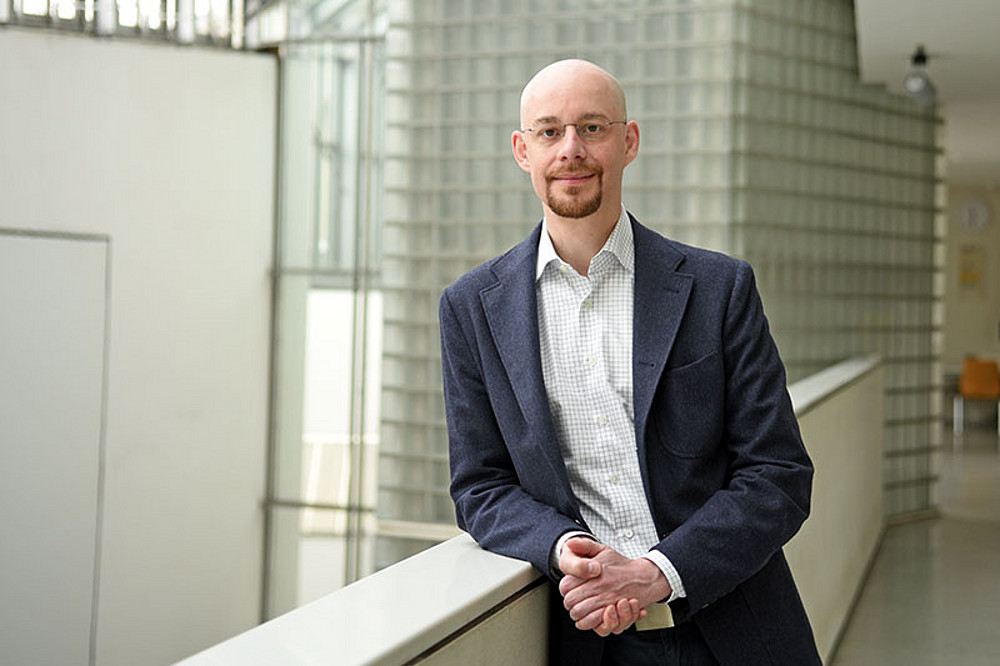
Aus dem Minimum von Funktionen holt er das Maximum heraus: Christian Clason ist Professor für Mathematische Optimierung an der Universität Graz. Foto: Uni Graz/Eklaude

Aus dem Minimum von Funktionen holt er das Maximum heraus: Christian Clason ist Professor für Mathematische Optimierung an der Universität Graz. Foto: Uni Graz/Eklaude

Christian Clason sucht nach den optimalen mathematischen Funktionen für verschiedenste Computermodelle

Die österreichische Covid-Impfstrategie und Stahlträger haben erstaunlich viel gemeinsam – zumindest aus Sicht der Mathematik. Um die ideale Verteilung der Vakzine zu ermitteln oder die Verformung des Trägers unter Last zu planen, muss man das Minimum von geeigneten Funktionen finden. Christian Clason befasst sich in seiner Forschung mit solchen Problemen der Optimierung und der optimalen Steuerung: „Solche Funktionen ordnen beispielsweise in einem digitalen Bild jedem Pixel einen Farbwert zu oder beschreiben direkt die Ausgaben eines Unternehmens im Verlauf des nächsten Jahres“, führt der Forscher aus. „Das Schwierige dabei ist, dass man selten die gesuchte Funktion selbst direkt kontrollieren kann, sondern sie nur indirekt über eine andere Funktion steuern kann.“ Ein Spezialgebiet des Mathematikers ist die sogenannte nicht-glatte Optimierung, bei der der klassische Ansatz „Ableitung gleich Null setzen“ versagt. „Solche Probleme treten auf, wenn sich das Verhalten der zu minimierenden Funktion sprunghaft ändern kann“, so Clason. Das ist etwa der Fall, wenn ein Eiswürfel in einem Glas Wasser schmilzt. Hierfür effiziente Verfahren zu entwickeln, um sie am Computer lösen zu können, ist eine Herausforderung, mit der sich der Forscher schwerpunktmäßig beschäftigt.

Der gebürtige Münchner Clason war bereits von 2007 bis 2014 an der Universität Graz tätig und habilitierte sich hier. Danach nahm er den Ruf nach Essen an, um im März 2021 für seine „Wunschstelle“, die Professur für Mathematische Optimierung, nach Österreich zurückzukommen. „Graz ist eine traumhafte Stadt; noch mehr schätze ich aber das berufliche Umfeld mit den vielen Kooperationsmöglichkeiten mit KollegInnen am Institut und an anderen Universitäten – zum Beispiel im Bereich der Bildverarbeitung, der Data Science oder der Medizintechnik“, schwärmt der Forscher.

created by Dagmar Eklaude

Related news

Getting even hotter: Researchers predict global warming of 1.7 degrees by 2027

While Europe is currently sweltering in the heat, global temperatures are also rising towards concerning record levels. In 2026, Earth’s surface air temperature is expected to reach 1.62 degrees, and in 2027 even 1.71 degrees Celsius above pre-industrial levels. The long-term temperature rise – an average over a 20-year period – is predicted to exceed the 1.5-degree threshold of the Paris Agreement as of 2026 already. For the first time, researchers at the University of Graz have been able to make such a forecast so far in advance. The intensifying El Niño climate event favors forecast skill and thereby facilitates a reliable computation.

Forest fire at Rosenhain: Volunteer fire brigade carried out an evacuation drill at the Jesuit refectory

Thick smoke in the stairwell, flames at the edge of the forest, people missing in the Jesuit refectory at the University of Graz: at Rosenhain, the Graz Volunteer Fire Brigade carried out a drill simulating a scenario that is becoming increasingly realistic given the heat and drought

Full effort in the heat: the Sports Centre was in full swing at the Kleeblattlauf

On 19 June 2026, 2,000 runners and hundreds of supporters made their way to the Rosenhain for a sporting end-of-term event.

Save, invest or guarantee: What Austrians expect from the state

Austria needs to make savings. But where? And what should the Republic actually be spending its money on? The answers are provided by the initial findings of a major study involving the University of Graz. 99 per cent of those surveyed are in favour of the state ensuring healthcare provision. Almost three-quarters would like to see more public funding for education, whilst only around three per cent are in favour of cuts in this sector.

Begin of page section:
Additional information:

University of Graz
Universitaetsplatz 3
8010 Graz
Austria
  • Contact
  • Web Editors
  • Moodle
  • UNIGRAZonline
  • Imprint
  • Data Protection Declaration
  • Accessibility Declaration
Weatherstation
Uni Graz

End of this page section. Go to overview of page sections

End of this page section. Go to overview of page sections

Begin of page section:

End of this page section. Go to overview of page sections

