



Begin of page section:
Page sections:

  • Go to contents (Accesskey 1)
  • Go to position marker (Accesskey 2)
  • Go to main navigation (Accesskey 3)
  • Go to sub navigation (Accesskey 4)
  • Go to additional information (Accesskey 5)
  • Go to page settings (user/language) (Accesskey 8)
  • Go to search (Accesskey 9)

End of this page section. Go to overview of page sections

Begin of page section:
Page settings:

English en
Deutsch de
Search
Login

End of this page section. Go to overview of page sections

Begin of page section:
Search:

Search for details about Uni Graz
Close

End of this page section. Go to overview of page sections


Search

Begin of page section:
Main navigation:

Page navigation:

  • University

    University
    • About the University
    • Organisation
    • Faculties
    • Library
    • Working at University of Graz
    • Campus
    Developing solutions for the world of tomorrow - that is our mission. Our students and our researchers take on the great challenges of society and carry the knowledge out.
  • Research Profile

    Research Profile
    • Our Expertise
    • Research Questions
    • Research Portal
    • Promoting Research
    • Research Transfer
    • Ethics in Research
    • Commission for Scientific Integrity
    Scientific excellence and the courage to break new ground. Research at the University of Graz creates the foundations for making the future worth living.
  • Studies

    Studies
    • Prospective Students
    • Students
    • Registration for Study Programme (Winter semester 2026/27)
  • Community

    Community
    • International
    • Location
    • Research and Business
    • Alumni
    The University of Graz is a hub for international research and brings together scientists and business experts. Moreover, it fosters the exchange and cooperation in study and teaching.
Topics
  • Sustainable University
  • Researchers answer
  • Work for us
Close menu

End of this page section. Go to overview of page sections

Begin of page section:
You are here:

University of Graz News Den Geheimnissen der Sonne auf der Spur

End of this page section. Go to overview of page sections

Wednesday, 20 September 2017

Den Geheimnissen der Sonne auf der Spur

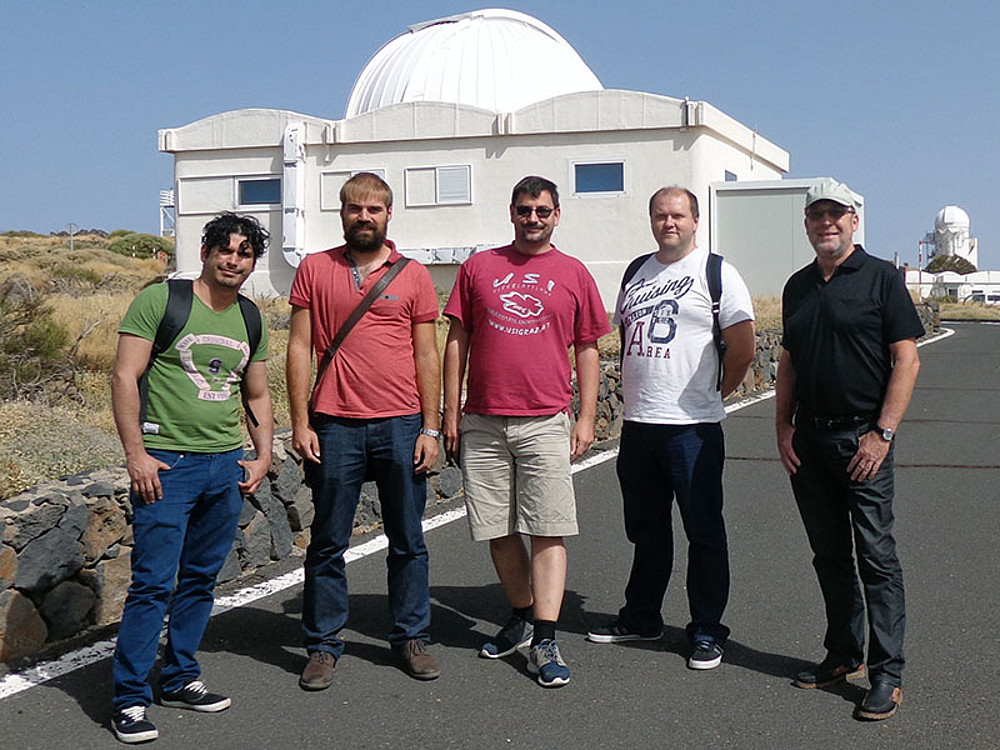
Teilnehmer der Beobachtungskampagne auf Teneriffa. Fotos: Utz/Uni Graz

Die Teilnehmer der Beobachtungskampagne auf Teneriffa: Jose Ivan Campos Rozo und Stefan Hofmeister, beide PhD-Studenten an der Uni Graz, Kampagnen-Leiter Dominik Utz, Peter Gömöry vom Astronomical Institute of the Slovak Academy of Sciences und Otmar Kühner von der Uni Graz (v.l.). Zum Team gehören auch Horst Balthasar und Christoph Kuckein vom Astronomischen Institut Potsdam sowie Norbert Magyar vom Centre for Mathematical Plasma Astrophyiscs an der Katholischen Universität Leuven. Fotos: Utz/Uni Graz

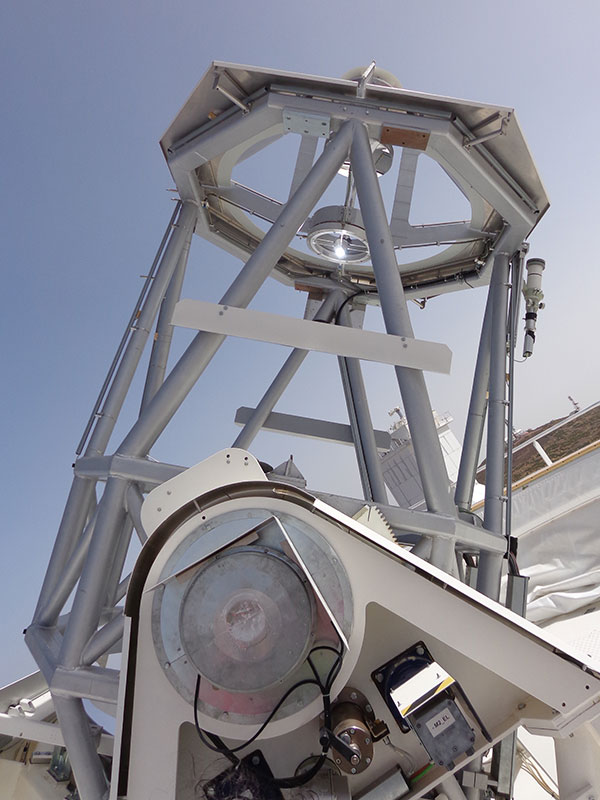
Gregor, das größte europäische Sonnenteleskop

Gregor ist das größte europäische Sonnenteleskop.

Grazer Astrophysiker leitet Beobachtungskampagne eines hochkarätigen internationalen ForscherInnen-Teams auf Teneriffa

Unter der Leitung von Dr. Dominik Utz, Astrophysiker der Uni Graz, beobachtet ein internationales ForscherInnen-Team derzeit in Teneriffa mit dem größten europäischen Sonnenteleskop die Vorgänge auf dem heißen Stern. Zum ersten Mal beteiligen sich an diesem vom österreichischen Wissenschaftsfond FWF co-finanzierten Forschungsprojekt auch das amerikanische Weltraumteleskop IRIS sowie die japanische Weltraummission Hinode.

Etwa zwei Wochen lang wird auf Teneriffa mit dem 1.5-Meter-Gregor-Teleskop die Dynamik kleinskaliger Magnetfelder mit einem Durchmesser von rund 200 bis 400 Kilometern – also in der Größenordnung der Schweiz – untersucht. „Diese Dynamik verursacht eine vielfältige Reaktion in den höheren Atmosphärenschichten der Sonne“, erklärt Utz. Die Unterstützung der Satelliten der NASA und der japanischen Weltraumagentur JAXA ermögliche es, die Sonne in Wellenlängen zu beobachten, die von der Erde aus – zum Glück – nicht zugänglich seien, wie etwa Röntgenstrahlung oder Ultraviolettstrahlung. Diese Wellenlängen entstehen in den äußeren und bis zu Millionen Grad Celsius heißen Schichten der Sonnenatmosphäre, der Korona.

Die aktuelle Beobachtungskampagne soll dazu beitragen, den letzten Geheimnissen der Sonne auf die Spur zu kommen, wie zum Beispiel den Massentransportvorgängen in der solaren Atmosphäre, der Heizung der äußeren Schichten, aber auch etwaigen Strahlungsveränderungen. Letztere werden für den Klimawandel mit verantwortlich gemacht und beeinflussen auch sehr stark die Bedingungen im erdnahen Weltraum, die für Satellitenbetreiber und bemannte Weltraummissionen von Bedeutung sind. „Das vom Institut für Physik der Karl-Franzens Universität Graz aus koordinierte, international hochkarätig besetzte Forschungsprojekt wird zum besseren Verständnis dieser physikalischen Vorgänge auf der Sonne beitragen“, so Utz.


created by Dominik Utz und Gudrun Pichler

Related news

In hot water: New Report reveals record losses in glaciers, permafrost and snow cover

Climate change is driving up temperatures not only in summer. Winters are also getting warmer – with dramatic consequences for glaciers, permafrost, snow cover and the freezing of lakes. The recently published cryosphere report provides specific figures for Austria. “Our monitoring shows a clear trend with record losses of ice and snow,” says project leader Wolfgang Schöner from the University of Graz.

Theologian at the University of Graz: What the excommunication of the Society of St Pius X

Following the schism involving the Society of St Pius X, there is a need for discussion. Bernd Hillebrand from the University of Graz explains why the Vatican took this step, what role anti-democratic tendencies play, and why the Society’s sacraments are no longer recognised as valid under canon law for Catholics with immediate effect.

“HeinrichBiCool”: University of Graz demonstrates the effects of green facades and roofs

The University of Graz has launched a pioneering project at the University Centre for Theology. Its name, “HeinrichBiCool”, says it all: a comprehensive system of green facades and roof will cool the building at Heinrichstraße 80 during the summer. At the same time, this will create a new habitat for plants and animals, helping to increase biodiversity. The accompanying monitoring programme will provide detailed data on the impact of the measures on indoor climate, energy consumption and biodiversity. The findings will lay a scientifically sound foundation for further projects aimed at making cities sustainable, climate-resilient and liveable. The partners in this project, funded by the Austrian Research Promotion Agency (FFG), are AEE INTEC – Institute for Sustainable Technologies, Technisches Büro Siegfried Stark, the landscape architecture and urban planning firm “studio boden”, and Ökoteam Graz.

When stress melts away in your mouth: nicotine pouches are widespread among Styrian students

Sociologists at the University of Graz, in collaboration with VIVID – the Centre for Addiction Prevention, have carried out a survey involving more than 600 participants. Around a quarter of them use these products. The ability to use them discreetly and flexibly is a key motivation.

Begin of page section:
Additional information:

University of Graz
Universitaetsplatz 3
8010 Graz
Austria
  • Contact
  • Web Editors
  • Moodle
  • UNIGRAZonline
  • Imprint
  • Data Protection Declaration
  • Accessibility Declaration
Weatherstation
Uni Graz

End of this page section. Go to overview of page sections

End of this page section. Go to overview of page sections

Begin of page section:

End of this page section. Go to overview of page sections

