Begin of page section:
Page sections:

  • Go to contents (Accesskey 1)
  • Go to position marker (Accesskey 2)
  • Go to main navigation (Accesskey 3)
  • Go to sub navigation (Accesskey 4)
  • Go to additional information (Accesskey 5)
  • Go to page settings (user/language) (Accesskey 8)
  • Go to search (Accesskey 9)

End of this page section. Go to overview of page sections

Begin of page section:
Page settings:

English en
Deutsch de
Search
Login

End of this page section. Go to overview of page sections

Begin of page section:
Search:

Search for details about Uni Graz
Close

End of this page section. Go to overview of page sections


Search

Begin of page section:
Main navigation:

Page navigation:

  • University

    University
    • About the University
    • Organisation
    • Faculties
    • Library
    • Working at University of Graz
    • Campus
    Developing solutions for the world of tomorrow - that is our mission. Our students and our researchers take on the great challenges of society and carry the knowledge out.
  • Research Profile

    Research Profile
    • Our Expertise
    • Research Questions
    • Research Portal
    • Promoting Research
    • Research Transfer
    • Ethics in Research
    Scientific excellence and the courage to break new ground. Research at the University of Graz creates the foundations for making the future worth living.
  • Studies

    Studies
    • Prospective Students
    • Students
  • Community

    Community
    • International
    • Location
    • Research and Business
    • Alumni
    The University of Graz is a hub for international research and brings together scientists and business experts. Moreover, it fosters the exchange and cooperation in study and teaching.
  • Spotlight
Topics
  • Our digital Advent calendar
  • Sustainable University
  • Researchers answer
  • Work for us
Close menu

End of this page section. Go to overview of page sections

Begin of page section:
You are here:

University of Graz News Den Geheimnissen der Sonne auf der Spur

End of this page section. Go to overview of page sections

Wednesday, 20 September 2017

Den Geheimnissen der Sonne auf der Spur

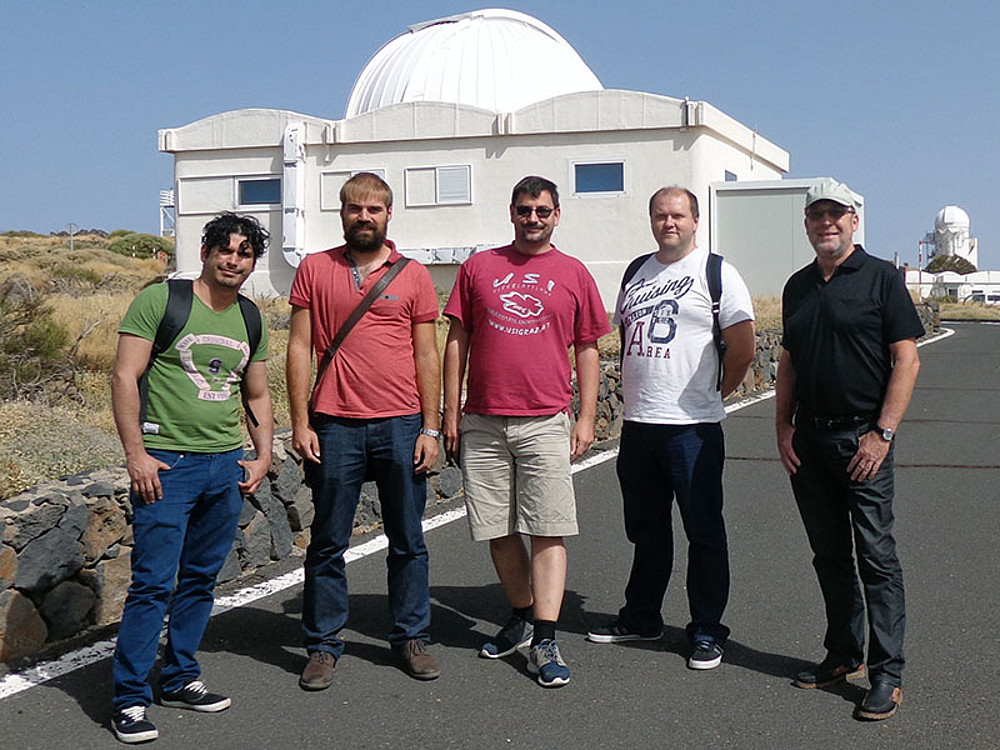
Teilnehmer der Beobachtungskampagne auf Teneriffa. Fotos: Utz/Uni Graz

Die Teilnehmer der Beobachtungskampagne auf Teneriffa: Jose Ivan Campos Rozo und Stefan Hofmeister, beide PhD-Studenten an der Uni Graz, Kampagnen-Leiter Dominik Utz, Peter Gömöry vom Astronomical Institute of the Slovak Academy of Sciences und Otmar Kühner von der Uni Graz (v.l.). Zum Team gehören auch Horst Balthasar und Christoph Kuckein vom Astronomischen Institut Potsdam sowie Norbert Magyar vom Centre for Mathematical Plasma Astrophyiscs an der Katholischen Universität Leuven. Fotos: Utz/Uni Graz

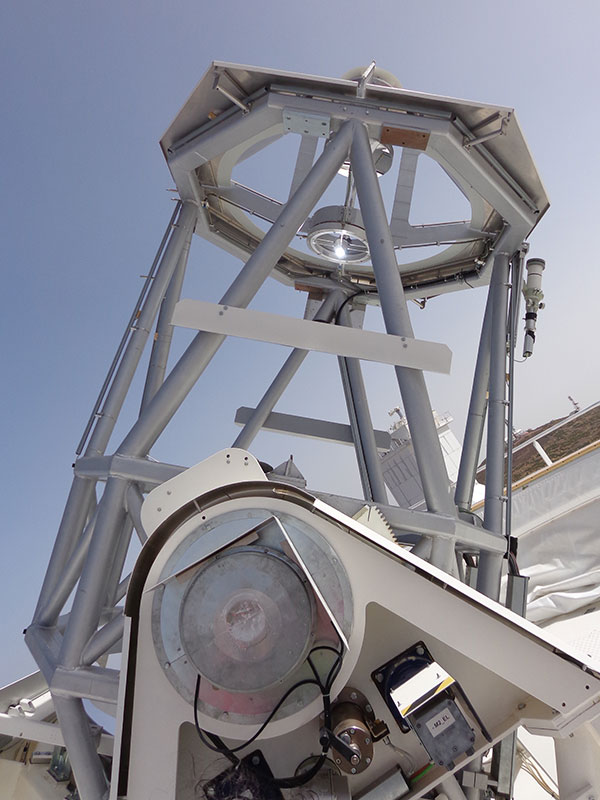
Gregor, das größte europäische Sonnenteleskop

Gregor ist das größte europäische Sonnenteleskop.

Grazer Astrophysiker leitet Beobachtungskampagne eines hochkarätigen internationalen ForscherInnen-Teams auf Teneriffa

Unter der Leitung von Dr. Dominik Utz, Astrophysiker der Uni Graz, beobachtet ein internationales ForscherInnen-Team derzeit in Teneriffa mit dem größten europäischen Sonnenteleskop die Vorgänge auf dem heißen Stern. Zum ersten Mal beteiligen sich an diesem vom österreichischen Wissenschaftsfond FWF co-finanzierten Forschungsprojekt auch das amerikanische Weltraumteleskop IRIS sowie die japanische Weltraummission Hinode.

Etwa zwei Wochen lang wird auf Teneriffa mit dem 1.5-Meter-Gregor-Teleskop die Dynamik kleinskaliger Magnetfelder mit einem Durchmesser von rund 200 bis 400 Kilometern – also in der Größenordnung der Schweiz – untersucht. „Diese Dynamik verursacht eine vielfältige Reaktion in den höheren Atmosphärenschichten der Sonne“, erklärt Utz. Die Unterstützung der Satelliten der NASA und der japanischen Weltraumagentur JAXA ermögliche es, die Sonne in Wellenlängen zu beobachten, die von der Erde aus – zum Glück – nicht zugänglich seien, wie etwa Röntgenstrahlung oder Ultraviolettstrahlung. Diese Wellenlängen entstehen in den äußeren und bis zu Millionen Grad Celsius heißen Schichten der Sonnenatmosphäre, der Korona.

Die aktuelle Beobachtungskampagne soll dazu beitragen, den letzten Geheimnissen der Sonne auf die Spur zu kommen, wie zum Beispiel den Massentransportvorgängen in der solaren Atmosphäre, der Heizung der äußeren Schichten, aber auch etwaigen Strahlungsveränderungen. Letztere werden für den Klimawandel mit verantwortlich gemacht und beeinflussen auch sehr stark die Bedingungen im erdnahen Weltraum, die für Satellitenbetreiber und bemannte Weltraummissionen von Bedeutung sind. „Das vom Institut für Physik der Karl-Franzens Universität Graz aus koordinierte, international hochkarätig besetzte Forschungsprojekt wird zum besseren Verständnis dieser physikalischen Vorgänge auf der Sonne beitragen“, so Utz.

created by Dominik Utz und Gudrun Pichler

Related news

Rector Peter Riedler: Starting the year with confidence

In 2026, we will continue to work consistently on positioning the University of Graz as a relevant player in Europe, while at the same time focusing on a modern, sustainable and climate-friendly university campus. When new digital applications are rolled out in January, we will not only create a stable and secure IT environment, but also modern working and studying conditions for future generations. Peter Rielder, Rector of the University of Graz

Uni Vibes 2026: the campus festival that transcends borders again

On 29 May 2026, it's that time again: the University of Graz celebrates, dances and vibrates. The campus will become a stage for art, science and music.

Setback: Austria's greenhouse gas emissions rise in 2025

Climate protection is currently facing an uphill battle. The United Nations have recently been unable to agree on a roadmap for phasing out fossil fuels, even though global warming continues to accelerate. Also Austria still does not have a national climate law with a clear target path for reducing emissions. This is evidently taking its toll: Austria’s greenhouse gas emissions rose again in 2025 for the first time in years, by around two and a half percent, according to calculations by researchers at the University of Graz. In addition to overly cautious climate action measures, this is due to somewhat colder winter months compared to 2024, which are driving up natural gas consumption.

Profound: Geoscientist Marko Bermanec deciphers processes of the Earth's plates

What happens deep down is very important to us above ground. Especially when hidden chemical processes between tectonic plates have serious consequences. Earth scientist Marko Bermanec investigates these processes in depth.

Begin of page section:
Additional information:

University of Graz
Universitaetsplatz 3
8010 Graz
Austria
  • Contact
  • Web Editors
  • Moodle
  • UNIGRAZonline
  • Imprint
  • Data Protection Declaration
  • Accessibility Declaration
Weatherstation
Uni Graz

End of this page section. Go to overview of page sections

End of this page section. Go to overview of page sections

Begin of page section:

End of this page section. Go to overview of page sections