Begin of page section:
Page sections:

  • Go to contents (Accesskey 1)
  • Go to position marker (Accesskey 2)
  • Go to main navigation (Accesskey 3)
  • Go to sub navigation (Accesskey 4)
  • Go to additional information (Accesskey 5)
  • Go to page settings (user/language) (Accesskey 8)
  • Go to search (Accesskey 9)

End of this page section. Go to overview of page sections

Begin of page section:
Page settings:

English en
Deutsch de
Search
Login

End of this page section. Go to overview of page sections

Begin of page section:
Search:

Search for details about Uni Graz
Close

End of this page section. Go to overview of page sections


Search

Begin of page section:
Main navigation:

Page navigation:

  • University

    University
    • About the University
    • Organisation
    • Faculties
    • Library
    • Working at University of Graz
    • Campus
    Developing solutions for the world of tomorrow - that is our mission. Our students and our researchers take on the great challenges of society and carry the knowledge out.
  • Research Profile

    Research Profile
    • Our Expertise
    • Research Questions
    • Research Portal
    • Promoting Research
    • Research Transfer
    • Ethics in Research
    • Commission for Scientific Integrity
    Scientific excellence and the courage to break new ground. Research at the University of Graz creates the foundations for making the future worth living.
  • Studies

    Studies
    • Prospective Students
    • Students
    • Welcome Weeks for First Year Students
  • Community

    Community
    • International
    • Location
    • Research and Business
    • Alumni
    The University of Graz is a hub for international research and brings together scientists and business experts. Moreover, it fosters the exchange and cooperation in study and teaching.
Topics
  • Sustainable University
  • Researchers answer
  • Work for us
Close menu

End of this page section. Go to overview of page sections

Begin of page section:
You are here:

University of Graz News Das Schweigen der Gene

End of this page section. Go to overview of page sections

Monday, 19 February 2018

Das Schweigen der Gene

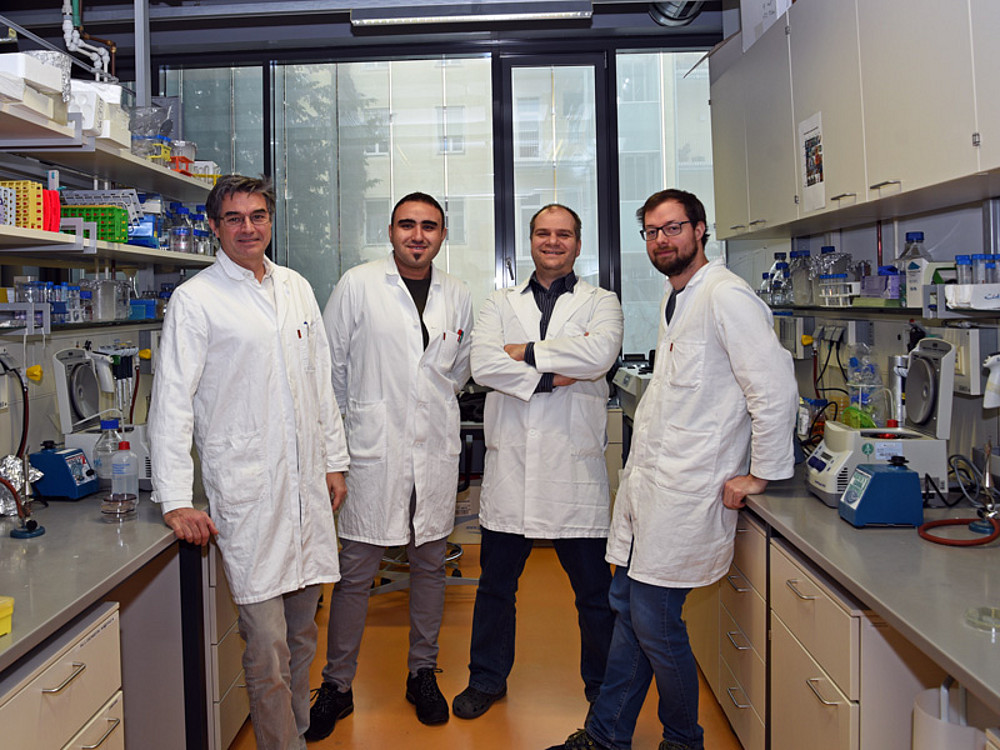
Neuer Ansatz im Kampf gegen Cholera: Joachim Reidl, Fatih Cakar, Stefan Schild und Franz G. Zingl erforschen ausgeschaltete Gene. Foto: Uni Graz/Eklaude ©Uni Graz/Eklaude
©Uni Graz/Eklaude

Neuer Ansatz im Kampf gegen Cholera: Joachim Reidl, Fatih Cakar, Stefan Schild und Franz G. Zingl erforschen ausgeschaltete Gene. Foto: Uni Graz/Eklaude

BiowissenschafterInnen der Uni Graz entdecken völlig neuen Ansatz zur Bekämpfung von Cholera

Das Bakterium Vibrio cholerae, Auslöser der gefürchteten Cholera-Erkrankung, bringt Gene zum Schweigen, um überleben zu können. Zu dieser Erkenntnis gelangten BiowissenschafterInnen der Uni Graz dank einer von ihnen weiterentwickelten Forschungsmethode. Die verwendete Technik und die dadurch gewonnenen Ergebnisse haben sie soeben im Journal PNAS publiziert.

Der Cholera-Erreger ist ein wahrer Überlebenskünstler. Er gedeiht einerseits in Teichen, Tümpeln oder im Ozean, andererseits unter völlig anderen Bedingungen im menschlichen Darm. Wie er sich seiner jeweiligen Umwelt anpasst, untersucht das Team um Assoz. Prof. Dr. Stefan Schild vom Institut für Molekulare Biowissenschaften der Uni Graz, um neue Wege zur Bekämpfung der tödlichen Krankheit zu finden. Mit einer aus den USA stammenden Methode, an welcher Schild bereits während einem PostDoc-Aufenthalt (2005 bis 2008) an der Tufts University gearbeitet hat, haben die WissenschafterInnen herausgefunden, welche Gene Vibrio cholerae im Wirt einschaltet. „Dadurch konnte unter anderem erforscht werden, wie im Darm das Toxin produziert wird, das den Durchfall auslöst“, führt Schild aus. Ebenso bedeutsam kann sein, welche Gene der Krankheitserreger ausschaltet. „Die Mikroorganismen deaktivieren nämlich nicht nur solche, die sie gerade nicht brauchen, sondern auch solche, die ihnen unter bestimmten Bedingungen sogar schaden“, so der Molekularbiologe. „Dieser Angriffspunkt ist bis jetzt nahezu außer Acht gelassen worden.“

Die Grazer ForscherInnen haben also die Technik weiterentwickelt, um auch die zum Schweigen gebrachten Gene aufdecken zu können. Anhand des Mausmodells haben sie bereits einen Faktor identifiziert, der besonders stark unterdrückt wird: einen so genannten Chloridionentransporter, der die Energiequelle des Bakteriums anzapft. „Je höher der pH-Wert der Umgebung ist – und im Darm ist er relativ hoch –, desto schwerer fällt es Vibrio cholerae, die eigene Versorgung aufrecht zu erhalten. Bleibt der Transporter aktiv, kann der Erreger aus Kraftmangel den Verdauungstrakt nicht kolonisieren, und die Krankheit kommt nicht zum Ausbruch“, erklärt Schild.
Im Magen hingegen ist der Transporter überlebensnotwendig. Dort dient er nämlich der Entgiftung und schützt vor der Säure. „Wenn man dem Bakterium nun vortäuschen könnte, dass es sich noch im Magen befindet, würde man seine Ausbreitung im Darm verhindern“, so der Wissenschafter.
Das Team ist nun dabei zu analysieren, wie man den Mikroorganismus daran hindern könnte, solche Gene im Darm auszuschalten. Die Idee, „schweigende“ Erbfaktoren gezielt zu aktivieren, lässt sich grundsätzlich auf andere Infektionskeime übertragen und eröffnet somit eine neue Strategie zu deren Bekämpfung.

Publikation:
Fatih Cakar, Franz G. Zingl, Manuel Moisi, Joachim Reidl, Stefan Schild, „In vivo repressed genes of Vibrio cholerae reveal inverse requirements of a H+/Cl- transporter along the gastrointestinal passage“

created by Dagmar Eklaude

Related news

Jurassic Sounds: Biologist reconstructs insect songs from 165 million years ago

It was apparently not just the roars of the dinosaurs that made up the soundscape of the animal world during the Jurassic period. Crickets and grasshoppers communicated through a variety of songs and high-pitched sounds, as Thorin Jonsson from the Institute of Biology at the University of Graz discovered together with colleagues from the universities of Lincoln, Bristol (UK), Beijing (China) and Tempe (USA). The findings on what are so far the oldest traces of sound on Earth have just been published in the journal PNAS.

EU funding boosts international exchange between universities

The University of Graz is further expanding its international study opportunities through the European university alliance Arqus and is taking the lead in two key projects. In future, students will benefit from even more joint degree programmes and from simplified recognition of academic achievements through the Joint European Degree Label.

Rescue and risks: Researchers have surveyed public perceptions of AI

The use of artificial intelligence has had to be made transparent since 2 August 2026. The EU’s AI Act, which has been in force since then, also sets out how risky an application is and which security measures apply as a result. However, the assessment of risks by the legislation differs in some cases significantly from the perceptions of the Austrian public. This is the finding of a representative study carried out by data scientist Stefan Thalmann from the University of Graz and his team.

The Healing Sea: Researchers discover new approaches to treating chronic inflammation in sponges

Chronic inflammation plays a key role in many diseases, ranging from metabolic disorders and cardiovascular diseases to tissue damage following injuries or infections. “Normally, the body is able to resolve inflammation on its own. If this process becomes unbalanced, immune cells remain permanently active and continue to drive negative changes in the tissue,” explains Andreas Koeberle, a pharmacist at the University of Graz.

Begin of page section:
Additional information:

University of Graz
Universitaetsplatz 3
8010 Graz
Austria
  • Contact
  • Web Editors
  • Moodle
  • UNIGRAZonline
  • Imprint
  • Data Protection Declaration
  • Accessibility Declaration
Weatherstation
Uni Graz

End of this page section. Go to overview of page sections

End of this page section. Go to overview of page sections

Begin of page section:

End of this page section. Go to overview of page sections