



Begin of page section:
Page sections:

  • Go to contents (Accesskey 1)
  • Go to position marker (Accesskey 2)
  • Go to main navigation (Accesskey 3)
  • Go to sub navigation (Accesskey 4)
  • Go to additional information (Accesskey 5)
  • Go to page settings (user/language) (Accesskey 8)
  • Go to search (Accesskey 9)

End of this page section. Go to overview of page sections

Begin of page section:
Page settings:

English en
Deutsch de
Search
Login

End of this page section. Go to overview of page sections

Begin of page section:
Search:

Search for details about Uni Graz
Close

End of this page section. Go to overview of page sections


Search

Begin of page section:
Main navigation:

Page navigation:

  • University

    University
    • About the University
    • Organisation
    • Faculties
    • Library
    • Working at University of Graz
    • Campus
    Developing solutions for the world of tomorrow - that is our mission. Our students and our researchers take on the great challenges of society and carry the knowledge out.
  • Research Profile

    Research Profile
    • Our Expertise
    • Research Questions
    • Research Portal
    • Promoting Research
    • Research Transfer
    • Ethics in Research
    • Commission for Scientific Integrity
    Scientific excellence and the courage to break new ground. Research at the University of Graz creates the foundations for making the future worth living.
  • Studies

    Studies
    • Prospective Students
    • Students
    • Registration for Study Programme (Winter semester 2026/27)
  • Community

    Community
    • International
    • Location
    • Research and Business
    • Alumni
    The University of Graz is a hub for international research and brings together scientists and business experts. Moreover, it fosters the exchange and cooperation in study and teaching.
Topics
  • Sustainable University
  • Researchers answer
  • Work for us
Close menu

End of this page section. Go to overview of page sections

Begin of page section:
You are here:

University of Graz News Das Menschenrecht auf Demokratie

End of this page section. Go to overview of page sections

Friday, 20 January 2017

Das Menschenrecht auf Demokratie

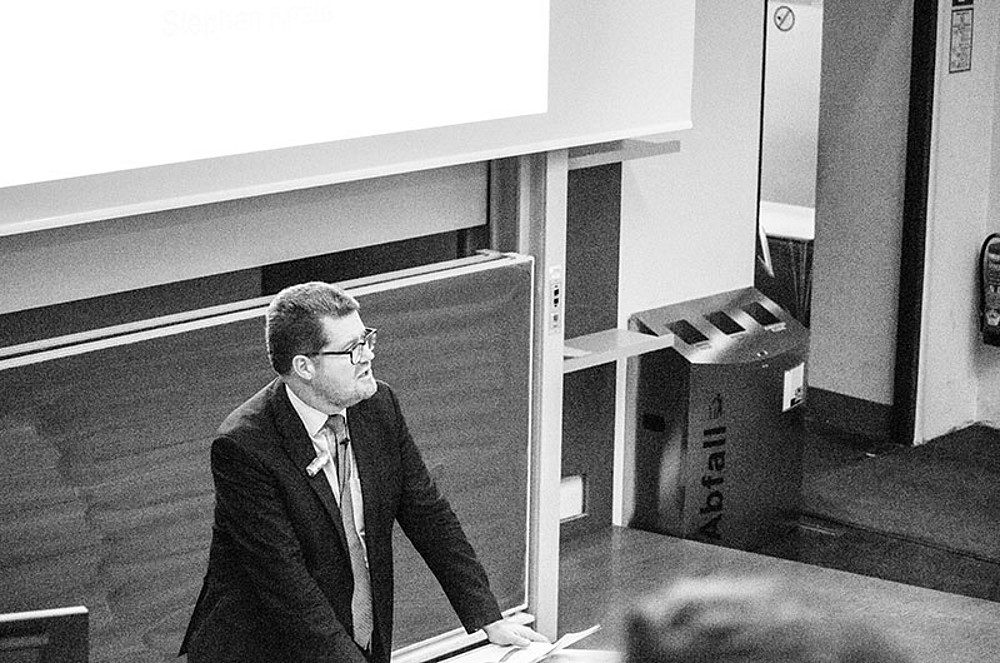
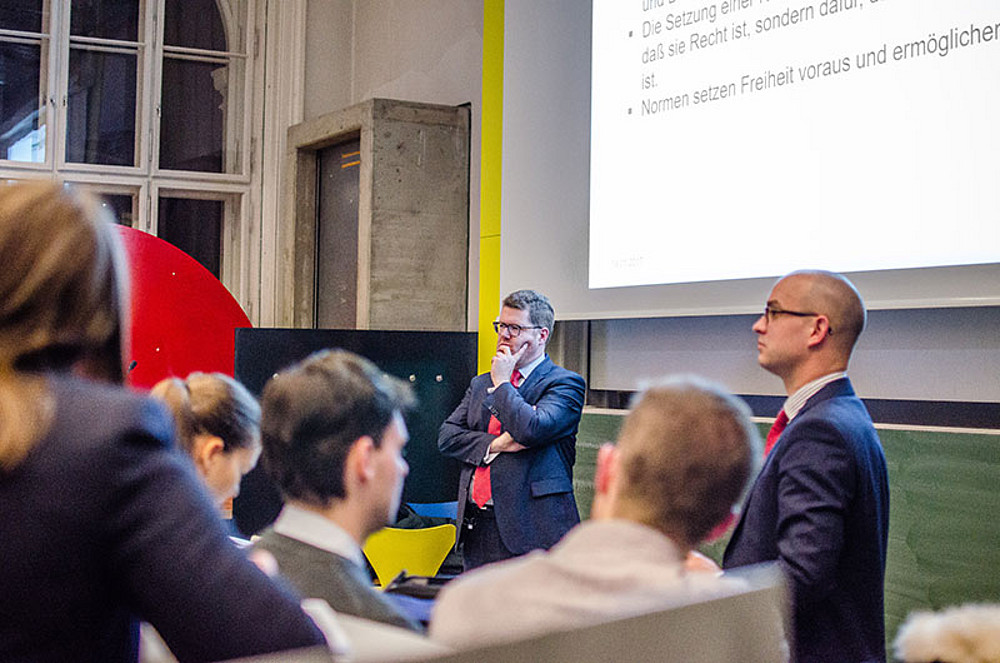
Stephan Kirste, Professor für Rechts- und Sozialphilosophie der Paris Lodron Universität Salzburg, sprach über das Menschenrecht auf Demokratie. Fotos: Héctor A. Morales Zúñiga

Stephan Kirste, Professor für Rechts- und Sozialphilosophie der Paris Lodron Universität Salzburg, sprach über das Menschenrecht auf Demokratie. Fotos: Héctor A. Morales Zúñiga

Der Rechts- und Sozialphilosoph Stephan Kirste sprach bei der Veranstaltungsreihe Graz Jurisprudence Talks

Seit November 2016 veranstaltet der Fachbereich Rechtsphilosophie und Rechtssoziologie die Veranstaltungsreihe Graz Jurisprudence Talks, in der internationale WissenschafterInnen ihre Forschungsarbeit präsentieren und mit dem Publikum diskutieren.

Nach dem Kroaten Luka Burazin war gestern Stephan Kirste von der Paris Lodron Universität Salzburg zu Gast. Der Professor für Rechts- und Sozialphilosophie präsentierte seine Forschungsarbeit zum Thema Menschenrecht auf Demokratie. In seinem Vortrag erläuterte er den inneren Zusammenhang zwischen Menschenrechten und Demokratie, den er in der positiven Freiheit verwurzelt sieht.
Positive Freiheit bedeutet Selbstbestimmung. Ein Individuum kann selbst bestimmen, wie es sich innerhalb eines Rechtsrahmens verhält. Verwirklicht wird die positive Freiheit aber nur dann, wenn dieser Rechtsrahmen auch in einem öffentlichen Diskurs errichtet wird, der für jede und jeden EinzelneN offen ist. Demokratie in diesem Sinne ist nicht auf Wahlen beschränkt sondern eingebettet in ein viel breiteres Recht auf Mitbestimmung. Die Basis dieses Rechts auf Demokratie sieht Kirste wie einen Mühlstein, den die Menschen konstant bewegen, indem sie sich an der Setzung und Veränderung ihres eigenen Rechts beteiligen: „Es ist Ausdruck der individuellen Freiheit“, so der Forscher.


Am Ende des spannenden Vortragsabends stellte sich Kirste den kritischen Fragen des Publikums. Offen blieb letztlich die Frage, was passieren würde, wenn die Demokratie durch die Demokratie selbst abgeschafft werden würde.

created by Lisa Sonnleitner & Gerhild Kastrun

Related news

Heat-resistant: Eva Preinfalk explains how cities can protect their residents

Certain demographic and some occupational groups are particularly vulnerable to high temperatures. A range of measures is needed to provide relief for everyone, explains climate economist Eva Preinfalk.

Baby health: University of Graz is seeking study participants to investigate early risk factors

Why does the body composition of babies vary so much? Some children gain a significant amount of fat mass within a few weeks, whilst others show hardly any change over the same period. “At the same time, initial observations suggest that fat distribution in all babies may follow a similar pattern, regardless of their total body fat,” explains Marco Höfler from the Institute of Movement Sciences, Sport and Health at the University of Graz. He is coordinating the research project ‘Small Bodies – Big Questions’, for which participants are currently still being sought: pregnant women and babies up to four weeks old.

In hot water: New Report reveals record losses in glaciers, permafrost and snow cover

Climate change is driving up temperatures not only in summer. Winters are also getting warmer – with dramatic consequences for glaciers, permafrost, snow cover and the freezing of lakes. The recently published cryosphere report provides specific figures for Austria. “Our monitoring shows a clear trend with record losses of ice and snow,” says project leader Wolfgang Schöner from the University of Graz.

Theologian at the University of Graz: What the excommunication of the Society of St Pius X

Following the schism involving the Society of St Pius X, there is a need for discussion. Bernd Hillebrand from the University of Graz explains why the Vatican took this step, what role anti-democratic tendencies play, and why the Society’s sacraments are no longer recognised as valid under canon law for Catholics with immediate effect.

Begin of page section:
Additional information:

University of Graz
Universitaetsplatz 3
8010 Graz
Austria
  • Contact
  • Web Editors
  • Moodle
  • UNIGRAZonline
  • Imprint
  • Data Protection Declaration
  • Accessibility Declaration
Weatherstation
Uni Graz

End of this page section. Go to overview of page sections

End of this page section. Go to overview of page sections

Begin of page section:

End of this page section. Go to overview of page sections