Begin of page section:
Page sections:

  • Go to contents (Accesskey 1)
  • Go to position marker (Accesskey 2)
  • Go to main navigation (Accesskey 3)
  • Go to sub navigation (Accesskey 4)
  • Go to additional information (Accesskey 5)
  • Go to page settings (user/language) (Accesskey 8)
  • Go to search (Accesskey 9)

End of this page section. Go to overview of page sections

Begin of page section:
Page settings:

English en
Deutsch de
Search
Login

End of this page section. Go to overview of page sections

Begin of page section:
Search:

Search for details about Uni Graz
Close

End of this page section. Go to overview of page sections


Search

Begin of page section:
Main navigation:

Page navigation:

  • University

    University
    • About the University
    • Organisation
    • Faculties
    • Library
    • Working at University of Graz
    • Campus
    Developing solutions for the world of tomorrow - that is our mission. Our students and our researchers take on the great challenges of society and carry the knowledge out.
  • Research Profile

    Research Profile
    • Our Expertise
    • Research Questions
    • Research Portal
    • Promoting Research
    • Research Transfer
    • Ethics in Research
    • Commission for Scientific Integrity
    Scientific excellence and the courage to break new ground. Research at the University of Graz creates the foundations for making the future worth living.
  • Studies

    Studies
    • Prospective Students
    • Students
    • Registration for Study Programme (Winter semester 2026/27)
    • Welcome Weeks for First Year Students
  • Community

    Community
    • International
    • Location
    • Research and Business
    • Alumni
    The University of Graz is a hub for international research and brings together scientists and business experts. Moreover, it fosters the exchange and cooperation in study and teaching.
Topics
  • Sustainable University
  • Researchers answer
  • Work for us
Close menu

End of this page section. Go to overview of page sections

Begin of page section:
You are here:

University of Graz News Campus-Entwicklung

End of this page section. Go to overview of page sections

Wednesday, 16 October 2013

Campus-Entwicklung
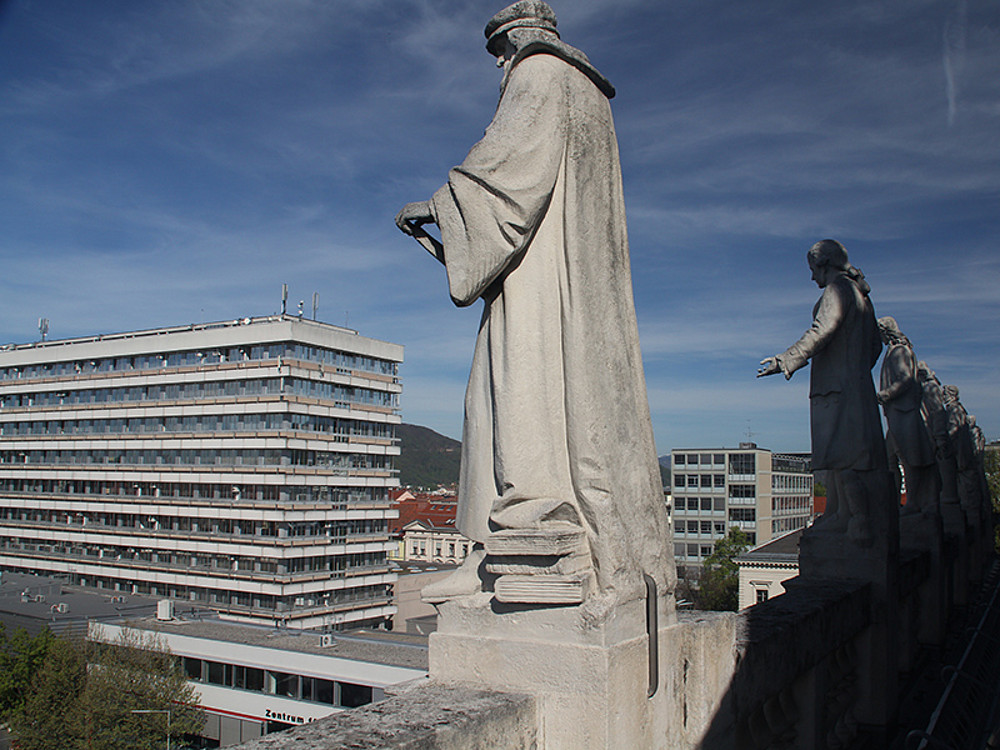
„Haus der Sprachen und Kulturen“ als Herzstück des Projekts Campus 2020

Der kürzlich erfolgte Spatenstich für den Campus der Medizinischen Universität Graz eröffnet auch für die Karl-Franzens-Universität neue Perspektiven. Mehrere von der Med Uni Graz genutzte Gebäude bzw. Bereiche – Harrachgasse 21, Universitätsplatz 4 sowie Heinrichstraße 31 – werden in naher Zukunft zur Verfügung stehen.
„Eine Jahrhundertchance“, unterstreicht Rektorin Christa Neuper die einmalige Gelegenheit, zusammenhängende Fachbereiche räumlich zusammenzuführen. Die Planungen wurden unter dem Projekttitel „Nachnutzung Medizin“ aufgenommen. Das Herzstück bildet die sogenannte Vorklinik mit einer Gesamtnutzfläche von etwa 10.000 Quadratmetern, die ab 2017 zu einem „Haus der Sprachen und Kulturen“ werden soll.

Bauleitplan Süd
„Das Projekt zur Nachnutzung Medizin ist in den sogenannten Bauleitplan Süd fest verankert, der die künftigen Baumaßnahmen an den Universitätsstandorten Graz, Leoben und Klagenfurt umfasst“, schildert Rektorin Neuper. Mit dem Bauleitplan liegt eine Reihung künftiger Bauvorhaben und -notwendigkeiten vor. „Diese Abstimmung genießt in Österreich Vorbildfunktion für die zwei übrigen Universitätsregionen Ost und West“, bestätigt Vizerektor für Finanzen, Ressourcen und Standortentwicklung Peter Riedler.

Haus der Sprachen und Kulturen

Die Umgestaltung der Infrastruktur trägt der inhaltlichen Schwerpunktsetzung der Uni Graz Rechnung. Das gegenwärtige Vorklinik-Gebäude, Harrachgasse 21, soll nach entsprechender Generalsanierung in ein „Haus der Sprachen und Kulturen“ umgewandelt werden, in dem die Sprachinstitute der Uni Graz – derzeit auf mehrere Standorte, vor allem im rund einen Kilometer entfernten Wall-Gebäude, verteilt – unter einem Dach vereint ins Zentrum des Campus geholt werden sollen. „Derzeit laufen die Detailplanungen, die mit den betroffenen Instituten diskutiert wurden“, so Vizerektor Riedler.

Strategisches Projekt: Campus-Entwicklung
Die Übersiedlung der Institute der Med Uni Graz schafft weitere Optionen für die Campus-Entwicklung, die im gleichnamigen strategischen Projekt der Uni Graz im Mittelpunkt steht. Riedler: „Rund ein Sechstel aller Flächen am Universitätsgelände können in naher Zukunft neu ausgerichtet werden und fachlich verknüpfte Bereiche räumlich näher zusammenrücken.“
Unter dem Titel Uni-Campus 2020 wachsen inhaltliche Schwerpunktsetzungen der Uni Graz örtlich weiter zusammen. „Neben dem Gewinn von Synergien steht vor allem die verbesserte Sichtbarkeit der Themen und engere Vernetzung der WissenschafterInnen und Studierenden im Mittelpunkt“, betont Rektorin Christa Neuper. Und Vizerektor Riedler ergänzt: „Die kürzeren Wege leisten auch zur Nachhaltigen Universität Graz einen wichtigen Beitrag.“

http://campusplanung.uni-graz.at/

created by Andreas Schweiger

Related news

Commissioned by NATO: University of Graz tests high-tech textiles

As part of an international project, antimicrobial and fire-resistant fabrics with UV protection are being developed in Zagreb. Pharmacists from the University of Graz are ensuring that these fabrics are skin-friendly.

The Arctic up close: ORF special feature on the University of Graz’s research station in S

Students from the University of Graz are spending two weeks conducting research at the Univerisity of Graz research station at the Sermilik Fjord in Greenland, which has been operational for three years. They are measuring glacial runoff, tracking ice melt in real time and installing weather stations. ORF is following the expedition and will be reporting on the special feature ‘Arctic Adventure’ across its various channels from 20 July.

Medicine for ants: Caffeine prolongs the life of infected insects

Black coffee stimulates us and acts against bacteria. So, can caffeine also be good for insects? Yes, confirm biologists of the University of Graz. When ants suffer from a fungal disease, they consume more caffeine and remain active for longer.

How formulas are making medicine more personalised

When Federica Caforio talks about the heart, it doesn’t sound like an operating theatre, but rather like equations, parameters and simulations. Yet this is precisely where the medical promise of her research lies: one day, clinical data will be used to create a digital twin of the heart – a virtual model that will enable a better understanding of diseases and allow for more personalised treatment plans. She will be presenting her research at the ‘ECMTB 2026’ mathematics conference.

Begin of page section:
Additional information:

University of Graz
Universitaetsplatz 3
8010 Graz
Austria
  • Contact
  • Web Editors
  • Moodle
  • UNIGRAZonline
  • Imprint
  • Data Protection Declaration
  • Accessibility Declaration
Weatherstation
Uni Graz

End of this page section. Go to overview of page sections

End of this page section. Go to overview of page sections

Begin of page section:

End of this page section. Go to overview of page sections