



Begin of page section:
Page sections:

  • Go to contents (Accesskey 1)
  • Go to position marker (Accesskey 2)
  • Go to main navigation (Accesskey 3)
  • Go to sub navigation (Accesskey 4)
  • Go to additional information (Accesskey 5)
  • Go to page settings (user/language) (Accesskey 8)
  • Go to search (Accesskey 9)

End of this page section. Go to overview of page sections

Begin of page section:
Page settings:

English en
Deutsch de
Search
Login

End of this page section. Go to overview of page sections

Begin of page section:
Search:

Search for details about Uni Graz
Close

End of this page section. Go to overview of page sections


Search

Begin of page section:
Main navigation:

Page navigation:

  • University

    University
    • About the University
    • Organisation
    • Faculties
    • Library
    • Working at University of Graz
    • Campus
    Developing solutions for the world of tomorrow - that is our mission. Our students and our researchers take on the great challenges of society and carry the knowledge out.
  • Research Profile

    Research Profile
    • Our Expertise
    • Research Questions
    • Research Portal
    • Promoting Research
    • Research Transfer
    • Ethics in Research
    • Commission for Scientific Integrity
    Scientific excellence and the courage to break new ground. Research at the University of Graz creates the foundations for making the future worth living.
  • Studies

    Studies
    • Prospective Students
    • Students
    • Registration for Study Programme (Winter semester 2026/27)
  • Community

    Community
    • International
    • Location
    • Research and Business
    • Alumni
    The University of Graz is a hub for international research and brings together scientists and business experts. Moreover, it fosters the exchange and cooperation in study and teaching.
Topics
  • Sustainable University
  • Researchers answer
  • Work for us
Close menu

End of this page section. Go to overview of page sections

Begin of page section:
You are here:

University of Graz News Bühne für Profs

End of this page section. Go to overview of page sections

Tuesday, 13 March 2018

Bühne für Profs

Forschung mit Ironie: Florian Bieber von der Uni Graz über „Wie Autokraten des Balkans am Randes des Vulkans in die EU tanzen… Fotos: Steirische Hochschulkonferenz/Lunghammer ©HELMUT LUNGHAMMER
©HELMUT LUNGHAMMER

Forschung mit Ironie: Florian Bieber von der Uni Graz über „Wie Autokraten des Balkans am Randes des Vulkans in die EU tanzen… Fotos: Steirische Hochschulkonferenz/Lunghammer

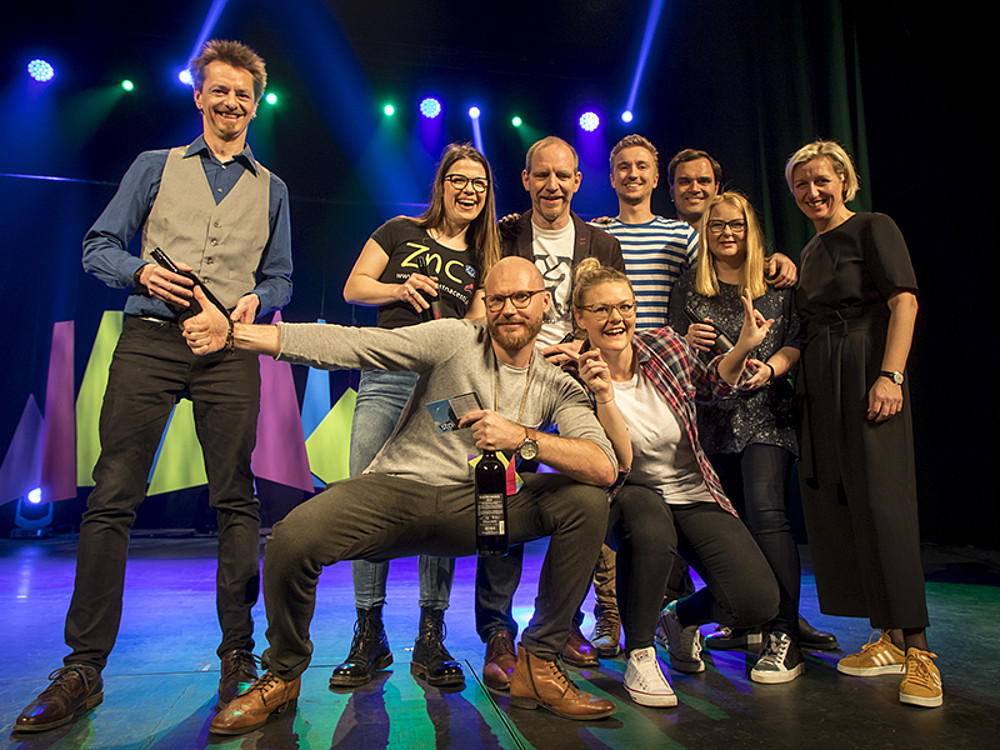
Die steirischen Slamer mit Sieger Gerald Zotter (vorne links), Campus02-Rektorin Edlinger-Ploder und Science-Slam-Mastermind Weingartner. ©HELMUT LUNGHAMMER
©HELMUT LUNGHAMMER

Die steirischen Slamer mit Sieger Gerald Zotter (vorne links), Campus02-Rektorin Edlinger-Ploder und Science-Slam-Mastermind Weingartner.

Südosteuropa-Politologe Florian Bieber begeisterte beim Science Slam

Wenn Robbie Williams auf Hochschuldidaktik trifft, ein Maschinenbauer mit der Magie des Kühlens die Physik entzaubert, und das Geheimnis gelüftet wird, wie man aus Mist Gold macht – dann stehen ForscherInnen beim Science Slam auf der Bühne.

Am 12. März 2018 bewiesen fünf WissenschafterInnen im Grazer Orpheum beim Styrian Science Slam – unter der Schirmherrschaft der Steirischen Hochschulkonferenz –, dass sich Forschung spannend, unterhaltsam und in nur sechs Minuten erklären lässt. So auch Florian Bieber, Professor für Südosteuropastudien an der Universität Graz, dem es eindrucksvoll gelang, sein Thema anschaulich auf den Punkt zu bringen. In seiner ironischen Gebrauchsanleitung verriet der international anerkannte Politologe, wie man – am Beispiel von Präsidenten und Regierungsführern am Balkan – ein guter Autokrat wird.

Die meisten Stimmen des Publikums erhielt schließlich Gerald Zotter, Maschinenbauingenieur bei qpunkt/AVL. Er begeisterte mit seiner Präsentation über die physikalische „Magie“ des Kühlens. Zotter gewann einen Reisegutschein im Wert 400 Euro – überreicht von Campus02-Rektorin Kristina Edlinger-Ploder und Science-Slam-Mastermind Bernhard Weingartner – sowie einen Startplatz für das große Österreich-Finale im Rahmen der „Langen Nacht der Forschung“ am 13. April 2018 auf dem Wiener Heldenplatz.
created by Andreas Schweiger

Related news

When stress melts away in your mouth: nicotine pouches are widespread among Styrian students

Sociologists at the University of Graz, in collaboration with VIVID – the Centre for Addiction Prevention, have carried out a survey involving more than 600 participants. Around a quarter of them use these products. The ability to use them discreetly and flexibly is a key motivation.

Desert sand, microplastics, cancer cells: David Clases awarded ERC grant for analytical method

Nanoparticles trapped in polar ice can reveal a great deal about the climate 100,000 years ago. Chemist David Clases is developing unique methods to analyse them in detail. He will now adapt these methods for use with larger particles in order to glean even more information about Earth’s history. The method can be used for a wide range of other purposes – for example, in medical diagnostics or the investigation of environmental pollution. Clases has been awarded a Proof-of-Concept Grant by the European Research Council (ERC) for this work.

Staying fit during the holidays: summer sports on the University of Graz campus

The Kleeblattlauf is not the end of the fitness term. Following last year’s successful launch, the University of Graz is once again offering summer sports on campus this year. From 30 June to 16 July 2026, there will be a free exercise programme in the open air. On the shady Südwiese (between the main building and Universitätsplatz 2), anyone interested can get in shape in the afternoons with body workouts, fascia training and yoga.

Getting even hotter: Researchers predict global warming of 1.7 degrees by 2027

While Europe is currently sweltering in the heat, global temperatures are also rising towards concerning record levels. In 2026, Earth’s surface air temperature is expected to reach 1.62 degrees, and in 2027 even 1.71 degrees Celsius above pre-industrial levels. The long-term temperature rise – an average over a 20-year period – is predicted to exceed the 1.5-degree threshold of the Paris Agreement as of 2026 already. For the first time, researchers at the University of Graz have been able to make such a forecast so far in advance. The intensifying El Niño climate event favors forecast skill and thereby facilitates a reliable computation.

Begin of page section:
Additional information:

University of Graz
Universitaetsplatz 3
8010 Graz
Austria
  • Contact
  • Web Editors
  • Moodle
  • UNIGRAZonline
  • Imprint
  • Data Protection Declaration
  • Accessibility Declaration
Weatherstation
Uni Graz

End of this page section. Go to overview of page sections

End of this page section. Go to overview of page sections

Begin of page section:

End of this page section. Go to overview of page sections

