Begin of page section:
Page sections:

  • Go to contents (Accesskey 1)
  • Go to position marker (Accesskey 2)
  • Go to main navigation (Accesskey 3)
  • Go to sub navigation (Accesskey 4)
  • Go to additional information (Accesskey 5)
  • Go to page settings (user/language) (Accesskey 8)
  • Go to search (Accesskey 9)

End of this page section. Go to overview of page sections

Begin of page section:
Page settings:

English en
Deutsch de
Search
Login

End of this page section. Go to overview of page sections

Begin of page section:
Search:

Search for details about Uni Graz
Close

End of this page section. Go to overview of page sections


Search

Begin of page section:
Main navigation:

Page navigation:

  • University

    University
    • About the University
    • Organisation
    • Faculties
    • Library
    • Working at University of Graz
    • Campus
    Developing solutions for the world of tomorrow - that is our mission. Our students and our researchers take on the great challenges of society and carry the knowledge out.
  • Research Profile

    Research Profile
    • Our Expertise
    • Research Questions
    • Research Portal
    • Promoting Research
    • Research Transfer
    • Ethics in Research
    • Commission for Scientific Integrity
    Scientific excellence and the courage to break new ground. Research at the University of Graz creates the foundations for making the future worth living.
  • Studies

    Studies
    • Prospective Students
    • Students
  • Community

    Community
    • International
    • Location
    • Research and Business
    • Alumni
    The University of Graz is a hub for international research and brings together scientists and business experts. Moreover, it fosters the exchange and cooperation in study and teaching.
  • Spotlight
Topics
  • Sustainable University
  • Researchers answer
  • Work for us
Close menu

End of this page section. Go to overview of page sections

Begin of page section:
You are here:

University of Graz News Bridging Europe

End of this page section. Go to overview of page sections

Friday, 18 October 2019

Bridging Europe

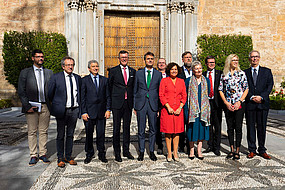
Representatives of all seven Universities involved presented, together with Pablo Martin González of the Spanish Ministery of Science, the Arqus Alliance to the public at the University of Granada. All photos: University of Granada.

Representatives of all seven Universities involved presented, together with Pablo Martin González of the Spanish Ministery of Science, the Arqus Alliance to the public at the University of Granada. All photos: University of Granada.

International university alliance “Arqus” launched – University of Graz is part of the new network

Seven universities with a shared goal: to enhance the quality of education and research through international exchange and cooperation. On Friday 18 October 2019 a presentation about the “Arqus European University Alliance” was given at a public event held by the University of Granada, the coordinating institution. The Universities of Bergen, Granada, Graz, Leipzig, Lyon, Padua and Vilnius have joined forces – with support from the European Commission – to advance the goal of an integrated European higher education system.

Martin Polaschek, Rector of the University of Graz, said: “The University of Graz is proud to be part of this ambitious network. The objectives that we and our partners have formulated harmonise fully with the objectives of the University of Graz: to advance research, to acquire and expand our knowledge and understanding, and to pass this on to our students and the wider community. In today’s times of increasing uncertainty, thanks to “fake news”, universities have an increasingly vital responsibility to play a formative role in knowledge transfer, and to show that there is never just one single version of truth. Arqus will help us to meet these aspirations and to extend our commitment to the highest quality standards. Our comprehensive cooperation and engagement across many different fields is also an excellent example of democracy in action in Europe.”

Prior to this presentation event, the rectors of the seven universities had formally established the governing body of the alliance – the Arqus Rectors’ Council – and signed a partnership agreement setting out the plans for the next three years. The proposed activities include work in the areas of shared academic programmes and mobility arrangements, inclusion and diversity, support for research activities, entrepreneurship, multilingualism and EU citizenship. Each of these areas is led by one of the partner universities.

>> Video report

About Arqus
The Arqus European University Alliance brings together the universities of Bergen, Granada, Graz, Leipzig, Lyon, Padova and Vilnius, seven longstanding comprehensive research universities who share extensive experience in joint projects in many fields, and a common profile as internationalized institutions with deep regional engagement in medium-sized cities. The Arqus European University Alliance aspires to build on the member universities’ sound prior experience in cooperation in order to achieve a high level of integration in its members’ policies and action plans in order to:

•    enhance the education of critically engaged European and global citizens who are able and willing to contribute to a multicultural, multilingual and inclusive Europe which is open to the world;  
•    increase and improve the joint research capacity of the partner universities;  
•    better respond to the grand societal challenges of the 21st century in Europe and beyond.


The principal ambition of the Arqus Alliance is to act jointly as a laboratory for institutional learning from which to move forward in the design, testing and implementation of an innovative model for deep inter-university cooperation. The Alliance aims to consolidate a joint governance structure to facilitate the development of consensual joint policies and action plans, to consolidate participative structures to facilitate cross-cutting integration at all levels of the partner institutions, and to share its experience with other groupings in order to communicate the added value to be found in its model of integration.
The Arqus Alliance aims to centre its efforts on enabling people: enabling a widely diverse student body and enhancing their learning experience; enabling a similarly diverse staff community and promoting their individual and collective professional development; enabling society at large by opening our doors and fully responding to the mission it has entrusted us.
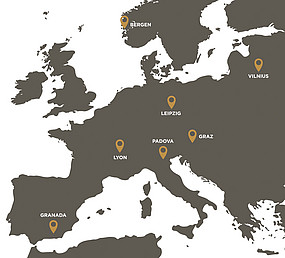
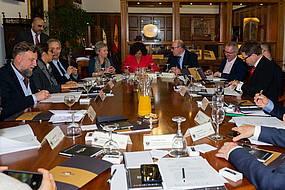
Seven universities bridge Europe to cooperate closely and comprehensively in the future.
Representatives of all seven Universities signed the cooperation contract.
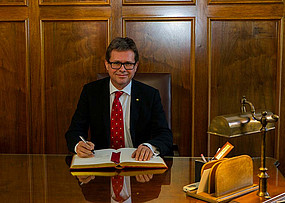
Rector Polaschek's entry in the honorary book of the University of Granada.
Fernando Galán (Universidad de Granada), Jacques Comby (Université Jean Moulin Lyon 3), Khaled Bouabdallah (Université de Lyon), Dag Rune Olsen (Universitet i Bergen), Pablo Martín González (Ministerio de Ciencias, Innovación y Universidades), Thomas Hofsäss (Universität Leipzig), Pilar Aranda Ramírez (Universidad de Granada), Rimantas Jankauskas (Vilniaus universitetas), Dorothy Kelly (Universidad de Granada), Martin Polaschek (Universität Graz), Greta Druteikiene (Vilniaus universitetas), Alessandro Paccagnella (Università degli Studi di Padova).

created by Joachim Hirtenfellner

Related news

Higher Education Strategy 2040: Austria’s universities on course for the future

Austria has 77 higher education institutions, which is above the EU average – but does this really make sense? The new Higher Education Strategy 2040 focuses on cooperation rather than mergers. As one of the six largest universities in Austria, the University of Graz plays a central role in this.

Climate research in Greenland: Old data provides new insights

The polar explorer and University of Graz professor Alfred Wegener left behind a unique collection of climate data from Greenland. A research team from the University of Graz is now analysing this 100-year-old treasure trove of data and comparing it with current measurements.

Diversity in nature and science: How we talk about plants and each other

Ginkgo, kiwi, hemp: they exist as male and female plants. Anyone who paid attention in biology class will confirm this. But is this categorisation, established by Carl von Linné almost 300 years ago, still valid today? An interdisciplinary team at the University of Graz is questioning these attributions and using this as a starting point to provide food for thought for gender-sensitive interaction between students, scientific and teaching staff.

Around the world in eight stops: the Long Night of Research at the University of Graz

On 24 April from 5 pm, you can take a short trip around the globe at the University of Graz, discovering pecularities of foreign countries or new local features in the entrance hall of the University Library. The itinerary takes you through introduced animal species, political attitudes and the omnipotence of algorithms. There will also be a programme in the historic reading hall, as well as at the UniGraz@Museum and the University Archive.

Begin of page section:
Additional information:

University of Graz
Universitaetsplatz 3
8010 Graz
Austria
  • Contact
  • Web Editors
  • Moodle
  • UNIGRAZonline
  • Imprint
  • Data Protection Declaration
  • Accessibility Declaration
Weatherstation
Uni Graz

End of this page section. Go to overview of page sections

End of this page section. Go to overview of page sections

Begin of page section:

End of this page section. Go to overview of page sections