Begin of page section:
Page sections:

  • Go to contents (Accesskey 1)
  • Go to position marker (Accesskey 2)
  • Go to main navigation (Accesskey 3)
  • Go to sub navigation (Accesskey 4)
  • Go to additional information (Accesskey 5)
  • Go to page settings (user/language) (Accesskey 8)
  • Go to search (Accesskey 9)

End of this page section. Go to overview of page sections

Begin of page section:
Page settings:

English en
Deutsch de
Search
Login

End of this page section. Go to overview of page sections

Begin of page section:
Search:

Search for details about Uni Graz
Close

End of this page section. Go to overview of page sections


Search

Begin of page section:
Main navigation:

Page navigation:

  • University

    University
    • About the University
    • Organisation
    • Faculties
    • Library
    • Working at University of Graz
    • Campus
    Developing solutions for the world of tomorrow - that is our mission. Our students and our researchers take on the great challenges of society and carry the knowledge out.
  • Research Profile

    Research Profile
    • Our Expertise
    • Research Questions
    • Research Portal
    • Promoting Research
    • Research Transfer
    • Ethics in Research
    • Commission for Scientific Integrity
    Scientific excellence and the courage to break new ground. Research at the University of Graz creates the foundations for making the future worth living.
  • Studies

    Studies
    • Prospective Students
    • Students
  • Community

    Community
    • International
    • Location
    • Research and Business
    • Alumni
    The University of Graz is a hub for international research and brings together scientists and business experts. Moreover, it fosters the exchange and cooperation in study and teaching.
  • Spotlight
Topics
  • Sustainable University
  • Researchers answer
  • Work for us
Close menu

End of this page section. Go to overview of page sections

Begin of page section:
You are here:

University of Graz News Dem grünen Herzen droht Infarkt: Trockenperioden und Starkregen setzen Wäldern zu

End of this page section. Go to overview of page sections

Tuesday, 14 March 2023

Dem grünen Herzen droht Infarkt: Trockenperioden und Starkregen setzen Wäldern zu

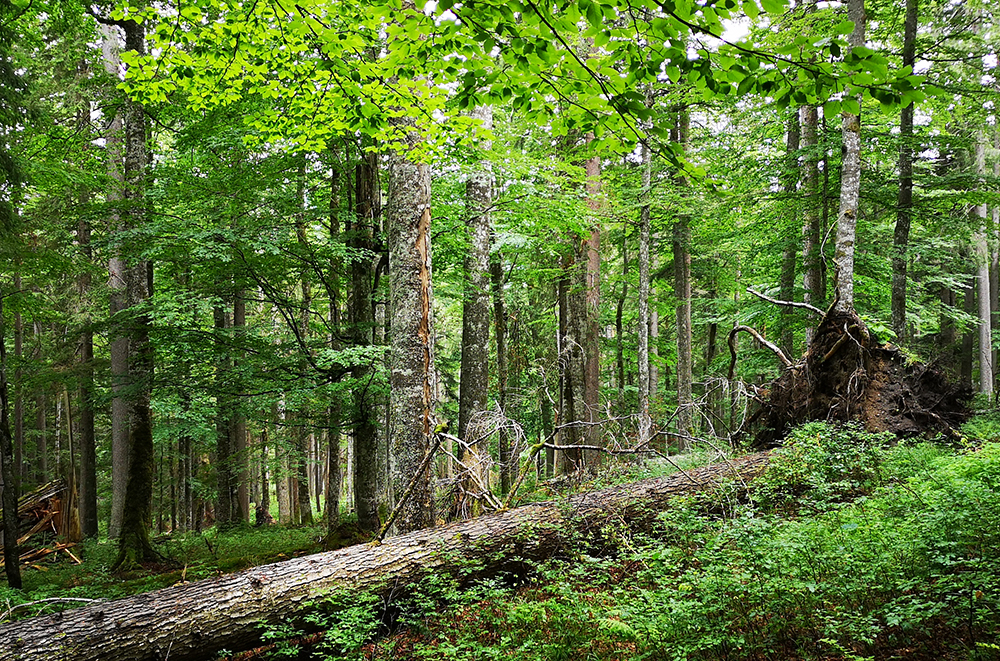
Schützt vor Bränden: Klimafitter Mischwald mit humusreichem, dunklen Waldboden. Foto: Uni Graz/Dagmar Henner

Insgesamt werden mit den extremen Trockenperioden Waldbrände in den Alpenregionen deutlich zunehmen. Die Flammen zerstören nicht nur wichtigen Baumbestand und CO2-Schlucker, sondern gefährden Häuser, Wirtschaft und Ökosysteme, warnt Dagmar Henner vom Wegener Center für Klima und Globalen Wandel der Universität Graz.

"Häufigere Waldbrände sind ein deutliches Anzeichen des Klimawandels“, betont Henner. Und das Risiko steigt rasant und nachweislich, warnt die Doktorandin. Sie hat – gemeinsam mit Klimaforscher Gottfried Kirchengast – festgestellt, dass die Feuergefahr in vielen Teilen der österreichischen Alpen und des Alpenvorlandes sehr hoch ist. >> Studie im Detail

Der geringe Niederschlag in Trockenperioden setzt den Bäumen schon zu. So werden diese zur leichten Beute für den Borkenkäfer, der sich dank des üppigen Nahrungsangebots kräftig vermehrt und in Folge die Pflanzenriesen umbringt. Diese brennen dann wie Zunder.

Feuchtere Phasen können den Wasserhaushalt der Wälder etwas ausgleichen, die angespannte Lage aber auch verschlimmern. Insbesondere Starkregen schwemmt die wertvolle Humusschicht weg. Wurde diese zuvor schon durch einen Brand in Mitleidenschaft gezogen, rinnt dann auch noch der letzte Rest davon, skizziert Henner. Die Konsequenz: Hänge rutschen ab. Der Schutz vor Lawinen geht verloren. Überschwemmungen nehmen zu.
Ein Teufelskreis? Vielmehr ein Systemkollaps. „Wir sehen am Beispiel Wald, wie sehr alles zusammenhängt, wie eng das Leben von Mensch und Natur miteinander verknüpft ist.“

Die Zerstörung schafft zugleich die Chance für Aufforstung. Klimafittere Bäume ersetzen Monokulturen aus Fichten und bilden einen gesünderen Mischwald. Henner: „Damit lassen sich die Humusschicht und die Konzentration von Kohlenstoff, der die Struktur im Boden beeinflusst, verbessern. Dadurch kann mehr Wasser aufgenommen und gespeichert werden.“ Der Haken: Das Ergebnis, ein optimiertes System Wald, wird frühestens in 20 Jahren sichtbar und wirksam.
Henner appelliert daher an alle Verantwortlichen: „Noch können wir den Wald stärken. Wir müssen aber jetzt handeln!“

created by Andreas Schweiger

Related news

Around the world in eight stops: the Long Night of Research at the University of Graz

On 24 April from 5 pm, you can take a short trip around the globe at the University of Graz, discovering pecularities of foreign countries or new local features in the entrance hall of the University Library. The itinerary takes you through introduced animal species, political attitudes and the omnipotence of algorithms. There will also be a programme in the historic reading hall, as well as at the UniGraz@Museum and the University Archive.

Studying at the University of Graz: How to enrol

Ready for a new chapter in your life with the start of your studies at the University of Graz in the winter semester 2026/27? Here you will find information on deadlines, admission procedures, registration, and everything else you need to successfully start your studies in the fall.

Interpreting data: Why studies sometimes get it wrong

Hilmar Brohmer and Ziva Korda from the Institute of Psychology, together with 500 international colleagues, have re-evaluated a hundred scientific publications and have often come to different conclusions.

Crystal-clear: AI method revolutionises solar observation

The Sun makes life on Earth possible. However, its magnetic fields can also cause massive disruption. This makes it all the more important to gain a better understanding of the processes taking place on our nearest star. A research team from the University of Graz and the High Altitude Observatory in Boulder (USA) has succeeded in doing just that. The astrophysicists have developed an AI-supported method that makes even the smallest structures on the Sun visible. The scientists are convinced that this will bring about a lasting change in solar observation and that the new method can be used for the planned European Solar Telescope.

Begin of page section:
Additional information:

University of Graz
Universitaetsplatz 3
8010 Graz
Austria
  • Contact
  • Web Editors
  • Moodle
  • UNIGRAZonline
  • Imprint
  • Data Protection Declaration
  • Accessibility Declaration
Weatherstation
Uni Graz

End of this page section. Go to overview of page sections

End of this page section. Go to overview of page sections

Begin of page section:

End of this page section. Go to overview of page sections