



Begin of page section:
Page sections:

  • Go to contents (Accesskey 1)
  • Go to position marker (Accesskey 2)
  • Go to main navigation (Accesskey 3)
  • Go to sub navigation (Accesskey 4)
  • Go to additional information (Accesskey 5)
  • Go to page settings (user/language) (Accesskey 8)
  • Go to search (Accesskey 9)

End of this page section. Go to overview of page sections

Begin of page section:
Page settings:

English en
Deutsch de
Search
Login

End of this page section. Go to overview of page sections

Begin of page section:
Search:

Search for details about Uni Graz
Close

End of this page section. Go to overview of page sections


Search

Begin of page section:
Main navigation:

Page navigation:

  • University

    University
    • About the University
    • Organisation
    • Faculties
    • Library
    • Working at University of Graz
    • Campus
    Developing solutions for the world of tomorrow - that is our mission. Our students and our researchers take on the great challenges of society and carry the knowledge out.
  • Research Profile

    Research Profile
    • Our Expertise
    • Research Questions
    • Research Portal
    • Promoting Research
    • Research Transfer
    • Ethics in Research
    • Commission for Scientific Integrity
    Scientific excellence and the courage to break new ground. Research at the University of Graz creates the foundations for making the future worth living.
  • Studies

    Studies
    • Prospective Students
    • Students
  • Community

    Community
    • International
    • Location
    • Research and Business
    • Alumni
    The University of Graz is a hub for international research and brings together scientists and business experts. Moreover, it fosters the exchange and cooperation in study and teaching.
Topics
  • Sustainable University
  • Researchers answer
  • Work for us
Close menu

End of this page section. Go to overview of page sections

Begin of page section:
You are here:

University of Graz News Body-Language

End of this page section. Go to overview of page sections

Friday, 08 November 2013

Body-Language

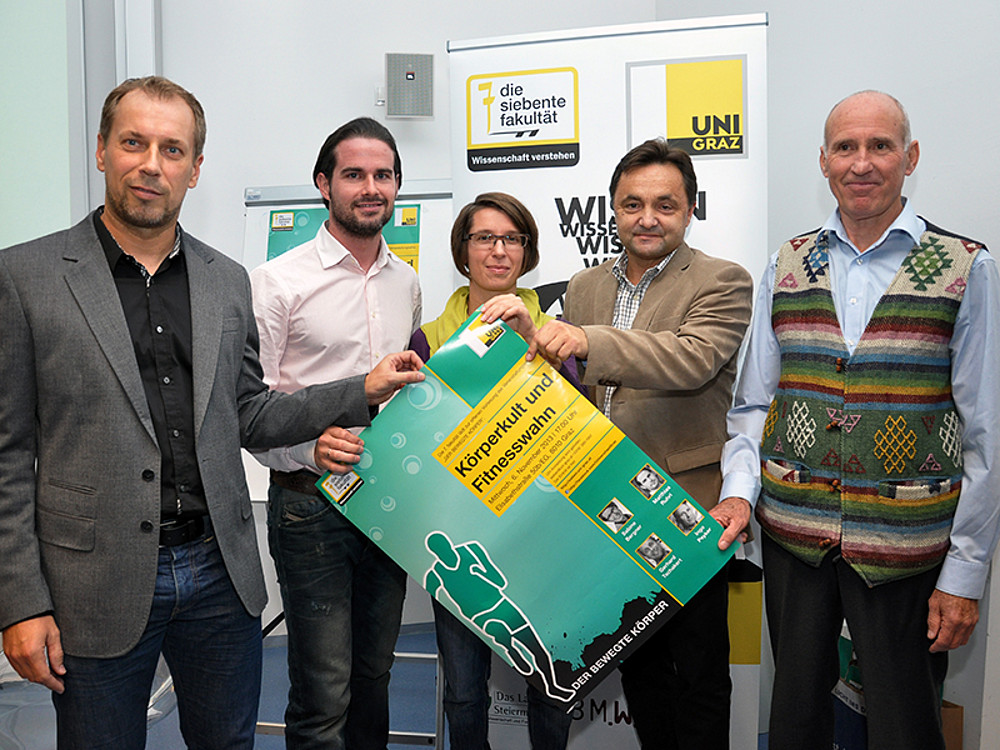
Sportwissenschafter Gerhard Tschakert, Wirtschaftsmann Matthias Ruhri, Führungskräfte-Expertin Sabine Bergner, 7. fakultäts-Erfinder Alfred Gutschelhofer und Olympiateilnehmer Ingp Peyker (v.l.)

Sportwissenschafter Gerhard Tschakert, Wirtschaftsmann Matthias Ruhri, Führungskräfte-Expertin Sabine Bergner, 7. fakultäts-Erfinder Alfred Gutschelhofer und Olympiateilnehmer Ingp Peyker (v.l.)

Fitness als Ausdrucksform: „der bewegte Körper“ auf Spuren von Konsum und Kult

Mit der kürzlich erfolgten Eröffnung des John Harris-Clubs in der Thalia und eines Fitinn-Studios im Steirerhof scheint Graz derzeit einen Fitness-Boom zu erleben. „Die Anzahl derartiger Zentren hat eher abgenommen, jene der Mitglieder hingegen ist mittlerweile auf fast eine halbe Million Österreicher angestiegen“, erklärte Wirtschafts- und Sportexperte Dr. Matthias Ruhri vom Institut für Unternehmensführung und Entrepreneurship bei der Podiumsdiskussion über Fitnesskult und Körperwahn am 6. November 2013.

Sportwissenschafter Dr. Gerhard Tschakert hatte in der Uni-Graz-Reihe „der bewegte Körper“ neben Ruhri Dr. Sabine Bergner, Expertin für Führungskräfteentwicklung an der Uni Graz, sowie Olympiateilnehmer Univ.-Prof.i.R. Dr. Ingo Peyker aufs Podium eingeladen. Und sowohl die Gäste als auch das Publikum sorgten in der Elisabethstraße 50b für eine abwechslungsreiche Debatte.

„Der Körper ersetzt ein Schriftzeichen, das die Seele ausdrückt, und wird zugleich zur Präsentationsfläche von Investitionen“, beleuchtete Ingo Peyker die Entwicklung überaus kritisch. „Der Körper ist zum Konsumgegenstand geworden.“ Sabine Bergner ortete in der Zunahme von Fitness-Interessierten die Trennung zwischen Körper und Arbeit: „Den Menschen geht im Alltag das Gefühl ab, sich zu spüren.“ Neben einer sozialen Komponente gebe es ebenso die Tendenz, „den Körper bewusst zu positionieren und an seinem Aussehen zu arbeiten“.

Die Veranstaltungsreihe „der bewegte Körper“ ist Teil der 7. fakultät, des Zentrums für Gesellschaft, Wissen und Kommunikation an der Uni Graz.

created by Andreas Schweiger

Related news

What matters in the end: moral theologian takes stock of assisted suicide

Since 1 January 2022, assisted suicide has been legal in Austria under certain conditions. This was made possible by a ruling of the Constitutional Court, which overturned the blanket ban on assisting in suicide. Four years on, it is clear that: “Although the legal framework is in place, many pressing questions remain unanswered when it comes to its practical implementation,” says Johann Platzer, a moral theologian at the University of Graz.

Noise is the signal: new simulation method enables secure communication

Researchers from Graz, Vienna and Munich have developed a new simulation method that makes it possible to calculate quantum light using classical software – a step towards secure quantum communication.

Massacre and Memory: University of Graz addresses the wounds of history

A conference on 12 and 13 June 2026 at the Jesuit Refectory will focus on trauma in Eastern and South-Eastern Europe.

Uni Vibes: An open-air stage for science and street art

At the third Uni Vibes event hosted by the University of Graz, visitors enjoyed science, music and performances on campus. Guided tours focusing on democracy, educational sciences and the Graz Centre of Physics demonstrated how research shapes community life, urban development and culture.

Begin of page section:
Additional information:

University of Graz
Universitaetsplatz 3
8010 Graz
Austria
  • Contact
  • Web Editors
  • Moodle
  • UNIGRAZonline
  • Imprint
  • Data Protection Declaration
  • Accessibility Declaration
Weatherstation
Uni Graz

End of this page section. Go to overview of page sections

End of this page section. Go to overview of page sections

Begin of page section:

End of this page section. Go to overview of page sections

