



Begin of page section:
Page sections:

  • Go to contents (Accesskey 1)
  • Go to position marker (Accesskey 2)
  • Go to main navigation (Accesskey 3)
  • Go to sub navigation (Accesskey 4)
  • Go to additional information (Accesskey 5)
  • Go to page settings (user/language) (Accesskey 8)
  • Go to search (Accesskey 9)

End of this page section. Go to overview of page sections

Begin of page section:
Page settings:

English en
Deutsch de
Search
Login

End of this page section. Go to overview of page sections

Begin of page section:
Search:

Search for details about Uni Graz
Close

End of this page section. Go to overview of page sections


Search

Begin of page section:
Main navigation:

Page navigation:

  • University

    University
    • About the University
    • Organisation
    • Faculties
    • Library
    • Working at University of Graz
    • Campus
    Developing solutions for the world of tomorrow - that is our mission. Our students and our researchers take on the great challenges of society and carry the knowledge out.
  • Research Profile

    Research Profile
    • Our Expertise
    • Research Questions
    • Research Portal
    • Promoting Research
    • Research Transfer
    • Ethics in Research
    • Commission for Scientific Integrity
    Scientific excellence and the courage to break new ground. Research at the University of Graz creates the foundations for making the future worth living.
  • Studies

    Studies
    • Prospective Students
    • Students
  • Community

    Community
    • International
    • Location
    • Research and Business
    • Alumni
    The University of Graz is a hub for international research and brings together scientists and business experts. Moreover, it fosters the exchange and cooperation in study and teaching.
  • Spotlight
Topics
  • Sustainable University
  • Researchers answer
  • Work for us
Close menu

End of this page section. Go to overview of page sections

Begin of page section:
You are here:

University of Graz News Blütezeit für Chinesische Medizin

End of this page section. Go to overview of page sections

Monday, 29 April 2013

Blütezeit für Chinesische Medizin
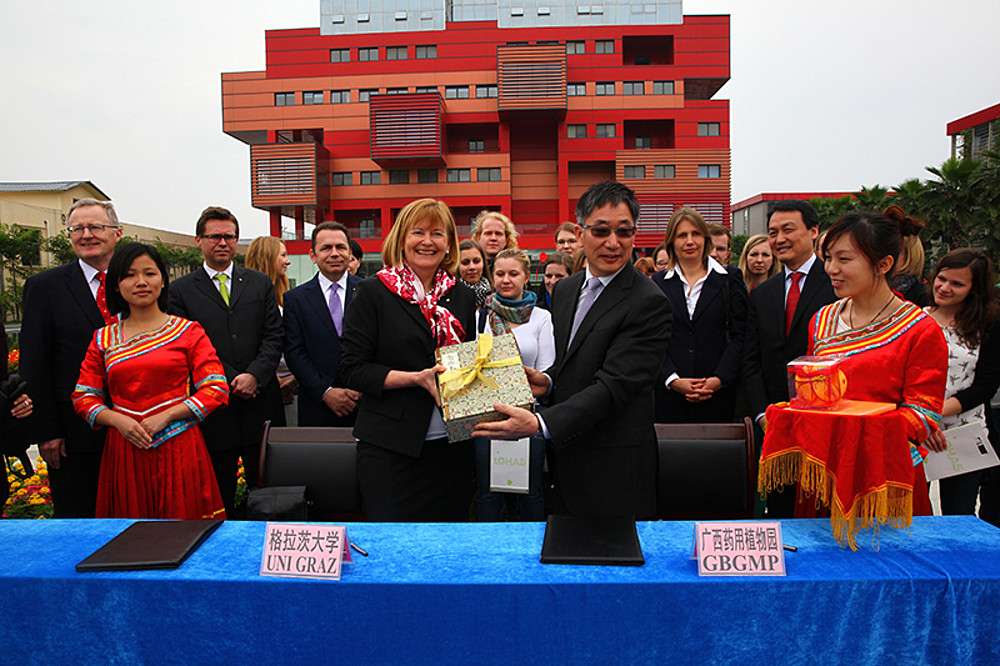
Rektorin Christa Neuper und Prof. Miao Jianhua, Direktor des Botanischen Gartens Nanning, unterzeichneten ein Kooperationsabkommen und eröffneten das neue „Joint Laboratory“ (rotes Gebäude im Hintergrund)

Rektorin Christa Neuper und Prof. Miao Jianhua, Direktor des Botanischen Gartens Nanning, unterzeichneten ein Kooperationsabkommen und eröffneten das neue „Joint Laboratory“ (rotes Gebäude im Hintergrund)

Prof. Rudolf Bauer, Rektorin Christa Neuper und Direktor Miao Jianhua (v.l.)

Prof. Rudolf Bauer, Rektorin Christa Neuper und Direktor Miao Jianhua (v.l.)

Uni Graz und weltgrößter botanischer Garten für Arzneipflanzen schließen Kooperation

Clematis und Geißblattgewächse als entzündungshemmende Arzneimittel: Das sind nur zwei Pflanzengattungen, die derzeit das Forschungszentrum für Traditionelle Chinesische Medizin (TCM) an der Uni Graz wissenschaftlich unter die Lupe nimmt. Im Rahmen des Nationalen Forschungsnetzwerkes „Drugs from Nature Targeting Inflammation“ werden die Wirkung der Medikamente aus der Natur erforscht. Dank einer neuen Kooperation mit dem weltweit größten botanischen Garten für Arzneipflanzen in Südchina werden die Aktivitäten nun ausgeweitet.

Das Interesse wächst. Arzneipflanzen aus der Traditionellen Chinesischen Medizin erleben weltweit eine Blütezeit. WissenschafterInnen des TCM-Forschungszentrums, das die Karl-Franzens-Universität in Kooperation mit der Medizinischen Universität seit 2007 betreibt, verfügen über ein hohes Maß an Know-how, das auch im TCM-Ursprungsland China enorm geschätzt wird. Rektorin Univ.-Prof. Dr. Christa Neuper konnte im April 2013 bei einem Besuch in Nanning (Südchina) die Partnerschaft vertiefen: Die Uni Graz wird künftig mit dem Guangxi Botanischen Garten für Arzneipflanzen, mit mehr als 7.000 Arten der größte der Welt, noch enger zusammenarbeiten. In einem Joint-Laboratory bündeln die Uni Graz und die chinesische Forschungsinstitution die Arbeiten, nutzen Geräte gemeinsam und tauschen ihr Wissen aus. „Neben den PharmazeutInnen soll in Zukunft auch der Botanische Garten der Uni Graz in den Wissenstransfer eingebunden werden“, erklärt Rektorin Neuper.

Entzündungshemmende Wirkstoffe
Eine der zahlreichen Gewächse, die derzeit im Rahmen des Projektes „Drugs from Nature Targeting Inflammation“ – Teil des Nationalen Forschungsnetzwerkes des Wissenschaftsfonds FWF – erforscht werden, ist die chinesische Pflanzengattung Notopterygium. „Es gibt zahlreiche Hinweise auf entzündungshemmende Substanzen, aber auch bereits nachgewiesene positive Wirkungen auf den Stoffwechsel, welche bei der Diabetes-Therapie eine Rolle spielen könnten“, so Univ.-Prof. Dr. Rudolf Bauer, Leiter des Instituts für Pharmazeutische Wissenschaften sowie des TCM-Forschungszentrums. Weitere medizinisch wirksame Stoffe werden in Clematis-und Lonicera-Arten vermutet.

Joint-Laboratory
„Auf rund 20.000 Quadratmetern stehen im Joint-Laboratory Geräte und Infrastruktur nach modernstem Standard zur Verfügung“, beschreibt Bauer. Auf der enormen Artendichte auf dem 220 Hektar großen Gelände können die ForscherInnen aus dem Vollen schöpfen, wissenschaftliche Publikationen werden gemeinsam veröffentlicht. Zudem soll der Austausch von WissenschafterInnen und Studierenden vorangetrieben werden. Erfolgreiche Beispiele dafür gibt es bereits: Grazer Studierende besuchen unter der Leitung von Pharmazie-Professor Bauer regelmäßig die von ihm organisierte Sino-Austrian Summerschool for Chinese Herbal Medicine in Nanning. 28 TeilnehmerInnen überreichte Rektorin Neuper jüngst bei ihrem Vor-Ort-Besuch die Zertifikate.

Österreichischer Garten in China
Weitere sichtbare Zeichen des Zusammenwachsens sind sowohl ein unterfertigtes Kooperationsabkommen als auch erste Pflanzungen österreichischer Flora im Botanischen Garten in Nanning. Auf etwa 1.000 Quadratmetern sollen heimische Arzneigewächse, wie Baldrian und Weißdorn, angesiedelt werden.

created by Andreas Schweiger

Related news

Greenery on the rise: over 500 new flowers, perennials and shrubs on campus

Bright blooms and fresh greenery make our hearts beat faster in spring. But it is not just us humans who delight in this colourful growth. For many animals, this splendour provides, above all, food and habitat. There has recently been an increase in this on the University of Graz campus. More than 500 native flowers, perennials and shrubs have been planted on strips of fallow land around Universitätsplatz 2.

Around the world in eight stops: the Long Night of Research at the University of Graz

On 24 April from 5 pm, you can take a short trip around the globe at the University of Graz, discovering pecularities of foreign countries or new local features in the entrance hall of the University Library. The itinerary takes you through introduced animal species, political attitudes and the omnipotence of algorithms. There will also be a programme in the historic reading hall, as well as at the UniGraz@Museum and the University Archive.

Building biological bridges: Chemist discovers an ecological tool for the pharmaceutical industry

Building a relationship on a solid foundation is also important in chemistry. To produce medicines, disinfectants or plant protection products, stable bonds between carbon atoms must be formed. Conventional chemical methods rely on environmentally harmful reagents and solvents to carry out the desired reaction. This process also produces unusable by-products. Chemist Lilla Gal has discovered an enzyme that enables the same process to take place efficiently and sustainably. The results of her research were recently published in the prestigious journal Angewandte Chemie.

Higher Education Strategy 2040: Austria’s universities on course for the future

Austria has 77 higher education institutions, which is above the EU average – but does this really make sense? The new Higher Education Strategy 2040 focuses on cooperation rather than mergers. As one of the six largest universities in Austria, the University of Graz plays a central role in this.

Begin of page section:
Additional information:

University of Graz
Universitaetsplatz 3
8010 Graz
Austria
  • Contact
  • Web Editors
  • Moodle
  • UNIGRAZonline
  • Imprint
  • Data Protection Declaration
  • Accessibility Declaration
Weatherstation
Uni Graz

End of this page section. Go to overview of page sections

End of this page section. Go to overview of page sections

Begin of page section:

End of this page section. Go to overview of page sections


