Begin of page section:
Page sections:

  • Go to contents (Accesskey 1)
  • Go to position marker (Accesskey 2)
  • Go to main navigation (Accesskey 3)
  • Go to sub navigation (Accesskey 4)
  • Go to additional information (Accesskey 5)
  • Go to page settings (user/language) (Accesskey 8)
  • Go to search (Accesskey 9)

End of this page section. Go to overview of page sections

Begin of page section:
Page settings:

English en
Deutsch de
Search
Login

End of this page section. Go to overview of page sections

Begin of page section:
Search:

Search for details about Uni Graz
Close

End of this page section. Go to overview of page sections


Search

Begin of page section:
Main navigation:

Page navigation:

  • University

    University
    • About the University
    • Organisation
    • Faculties
    • Library
    • Working at University of Graz
    • Campus
    Developing solutions for the world of tomorrow - that is our mission. Our students and our researchers take on the great challenges of society and carry the knowledge out.
  • Research Profile

    Research Profile
    • Our Expertise
    • Research Questions
    • Research Portal
    • Promoting Research
    • Research Transfer
    • Ethics in Research
    Scientific excellence and the courage to break new ground. Research at the University of Graz creates the foundations for making the future worth living.
  • Studies

    Studies
    • Prospective Students
    • Students
  • Community

    Community
    • International
    • Location
    • Research and Business
    • Alumni
    The University of Graz is a hub for international research and brings together scientists and business experts. Moreover, it fosters the exchange and cooperation in study and teaching.
  • Spotlight
Topics
  • Sustainable University
  • Researchers answer
  • Work for us
Close menu

End of this page section. Go to overview of page sections

Begin of page section:
You are here:

University of Graz News Biotrans-Award für Chemiker der Uni Graz

End of this page section. Go to overview of page sections

Friday, 31 July 2015

Biotrans-Award für Chemiker der Uni Graz

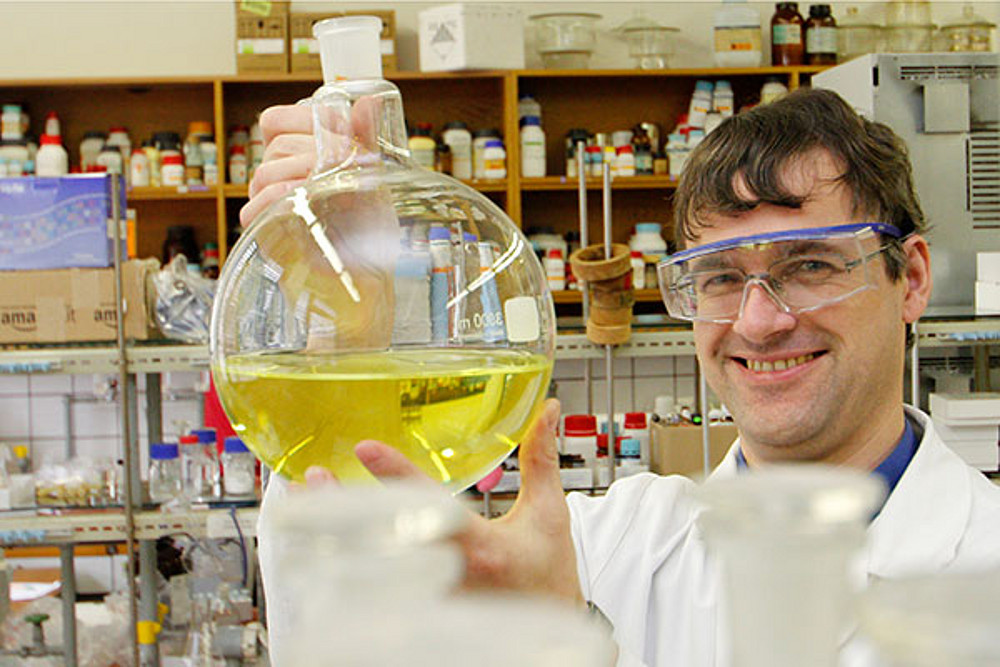
Wolfgang Kroutil. Foto: Uni Graz/Tzivanopoulos

Wolfgang Kroutil. Foto: Uni Graz/Tzivanopoulos

Wolfgang Kroutil wird für seine Forschungen auf dem Gebiet der Biokatalyse ausgezeichnet

Mit Hilfe verschiedenster Enzyme aus der Natur lassen sich chemische Produktionsprozesse vereinfachen und umweltschonender gestalten. In diesem innovativen Forschungsbereich, der so genannten Biokatalyse, leistet Univ.-Prof. Dr. Wolfgang Kroutil an der Karl-Franzens-Universität und am ACIB – Austrian Center of Industrial Biotechnology – in Graz richtungweisende Arbeit. Für seine herausragenden Leistungen erhielt der Chemiker den prestigeträchtigen Biotrans-Award. Der erstmals vergebene Preis wurde im Rahmen der zwölften internationalen Biotrans-Konferenz am 30. Juli 2015 in Wien verliehen.

Wolfgang Kroutil kann mit seiner Arbeitsgruppe auf viel beachtete Forschungserfolge verweisen. So haben die WissenschafterInnen in den letzten Jahren unter anderem nachhaltige Verfahren entwickelt, um Polymerbausteine für Spezialkunststoffe herzustellen. Dabei werden nachwachsende Rohstoffe wie Zucker und Fettsäuren als Ausgangsmaterial verwendet.
In Kooperation mit einem österreichischen Unternehmen wurden außerdem effizientere Methoden für die Erzeugung von Medikamenten entwickelt. Diese betreffen etwa Elvitegravir, das bei HIV zum Einsatz kommt, und Silodosin zur Therapie von Störungen beim Harnlassen durch Prostata-Vergrößerung. Weitere Beispiele sind Ramatroban für die Behandlung von koronarer Herzkrankheit und Asthma sowie Rivastigmin gegen Alzheimer.
Im Bereich des Pflanzenschutzes haben die ChemikerInnen der Uni Graz die bislang effizienteste Methode zur Herstellung eines natürlichen Antifraßmittels für Fichten gefunden. Als Vorbild dient ein Wirkstoff aus Pinien.

Wolfgang Kroutil leitet eine Arbeitsgruppe am Institut für Chemie der Karl-Franzens-Universität Graz und ist stellvertretender Leiter des Bereichs „Biokatalyse“ am ACIB. Seine Forschungen sind in nationale und internationale Kooperationen eingebunden sowie in den universitären Schwerpunkten „Molekulare Enzymologie und Physiologie“ sowie „Umwelt und Globaler Wandel“ verankert.
Aktuell forscht der Chemiker noch bis Mitte September 2015 in den USA, wo er sich mit dem Einsatz von Computerprogrammen zur Entwicklung und Verbesserung von Biokatalysatoren beschäftigt.

Die Biotrans-Konferenz ist der größte Kongress im Bereich Biokatalyse. Seit ihrem Debüt 1993 in Graz findet sie alle zwei Jahre statt.
Der Biotrans-Award zeichnet WissenschafterInnen bis 45 Jahre für besonders innovative Konzepte und wegweisende Forschung auf dem Gebiet der Biokatalyse aus. Der/die PreisträgerIn wird durch ein internationales Komitee bestimmt, das Mitglieder aus der Industrie sowie von Universitäten aus Japan, den USA und Europa umfasst.

created by Gudrun Pichler

Related news

Diversity buddies at the University of Graz: Support on equal terms

The University of Graz is strengthening its commitment to equal opportunities with its new Diversity Buddies. University members can find easily accessible contact persons here for questions relating to equality and diversity. All employees can get involved and take action.

When parents find it difficult to have a say

In her dissertation, translation scholar Marie Tschurtschenthaler examines how communication between compulsory schools and parents whose first language is not German works – and what role professional language mediation plays in this. Initial insights show that it is not just about language, but also about resources, responsibilities and the institutional framework.

AI in schools: Maria Bertel drafts legal guidelines for teachers

The legal expert and her team analysed the legal situation regarding the use of artificial intelligence in education as part of an EU project and answered open questions from practice.

Cosmetics in the environment: University of Graz proves danger to ants

Titanium dioxide, which is found in cosmetics, for example, is increasingly entering the environment in the form of nanoparticles. This could also put insects at risk. If ants ingest the substance in combination with the pesticide glyphosate, it disturbs the development of their offspring. Scientists at the University of Graz are drawing attention to the negative consequences of this toxic cocktail.

Begin of page section:
Additional information:

University of Graz
Universitaetsplatz 3
8010 Graz
Austria
  • Contact
  • Web Editors
  • Moodle
  • UNIGRAZonline
  • Imprint
  • Data Protection Declaration
  • Accessibility Declaration
Weatherstation
Uni Graz

End of this page section. Go to overview of page sections

End of this page section. Go to overview of page sections

Begin of page section:

End of this page section. Go to overview of page sections