Begin of page section:
Page sections:

  • Go to contents (Accesskey 1)
  • Go to position marker (Accesskey 2)
  • Go to main navigation (Accesskey 3)
  • Go to sub navigation (Accesskey 4)
  • Go to additional information (Accesskey 5)
  • Go to page settings (user/language) (Accesskey 8)
  • Go to search (Accesskey 9)

End of this page section. Go to overview of page sections

Begin of page section:
Page settings:

English en
Deutsch de
Search
Login

End of this page section. Go to overview of page sections

Begin of page section:
Search:

Search for details about Uni Graz
Close

End of this page section. Go to overview of page sections


Search

Begin of page section:
Main navigation:

Page navigation:

  • University

    University
    • About the University
    • Organisation
    • Faculties
    • Library
    • Working at University of Graz
    • Campus
    Developing solutions for the world of tomorrow - that is our mission. Our students and our researchers take on the great challenges of society and carry the knowledge out.
  • Research Profile

    Research Profile
    • Our Expertise
    • Research Questions
    • Research Portal
    • Promoting Research
    • Research Transfer
    • Ethics in Research
    • Commission for Scientific Integrity
    Scientific excellence and the courage to break new ground. Research at the University of Graz creates the foundations for making the future worth living.
  • Studies

    Studies
    • Prospective Students
    • Students
  • Community

    Community
    • International
    • Location
    • Research and Business
    • Alumni
    The University of Graz is a hub for international research and brings together scientists and business experts. Moreover, it fosters the exchange and cooperation in study and teaching.
  • Spotlight
Topics
  • Sustainable University
  • Researchers answer
  • Work for us
Close menu

End of this page section. Go to overview of page sections

Begin of page section:
You are here:

University of Graz News Biologie & Bohne

End of this page section. Go to overview of page sections

Tuesday, 30 April 2019

Biologie & Bohne
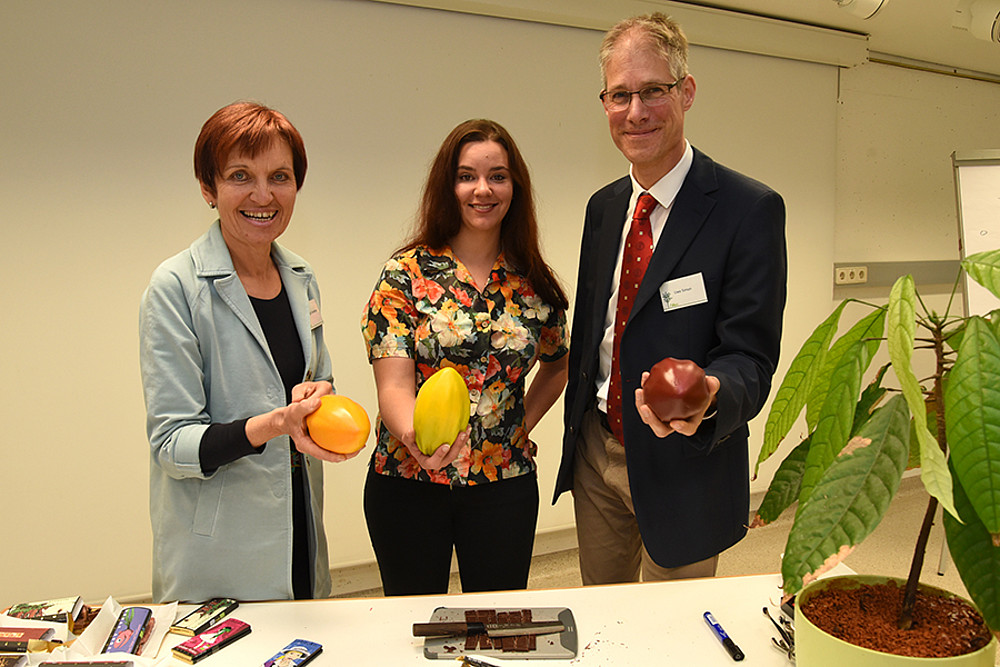
Julia Zotter (Mitte) mit Margit Delefant und Uwe Simon vom Fachdidaktikzentrum. Foto: Uni Graz/Schweiger

Julia Zotter (Mitte) mit Margit Delefant und Uwe Simon vom Fachdidaktikzentrum. Foto: Uni Graz/Schweiger

Chocolatiere Julia Zotter an der Uni Graz: nachhaltiger Kakaoanbau in Südamerika 

Auf eine sinnlich, köstliche Expedition in den Regenwald und in die Experimentierküche rund um die Kakaobohne entführte Chocolatiere Julia Zotter am 29. April 2019 im Botanischen Garten der Universität Graz. Die erfolgreiche Junior-Chefin der berühmten Schokoladen-Manufaktur hielt zwei Workshops beim Jubiläums-Symposiums des Fachdidaktikzentrums für Biologie und Umweltkunde. 
Passend zum Thema Bildung für Nachhaltige Entwicklung – einem Kernelement des Zentrums, das vor genau zehn Jahren gegründet worden war – schildete Zotter, wie sie in Brasilien und Peru mit Kakaobauern an der Qualitätsverbesserung gearbeitet und vier Jahre lang die Niederlassung in Shanghai geleitet hat. 
Neben Julia Zotter konnten Margit Delefant, stellvertretende Zentrumsleiterin, und Fachdidaktik-Professor Uwe Simon weitere renommierte ReferentInnen, darunter Harald Gropengießer von der Leibniz Universität Hannover, bei Tagung begrüßen.

created by Andreas Schweiger

Related news

Studying at the University of Graz: How to enrol

Ready for a new chapter in your life with the start of your studies at the University of Graz in the winter semester 2026/27? Here you will find information on deadlines, admission procedures, registration, and everything else you need to successfully start your studies in the fall.

Interpreting data: Why studies sometimes get it wrong

Hilmar Brohmer and Ziva Korda from the Institute of Psychology, together with 500 international colleagues, have re-evaluated a hundred scientific publications and have often come to different conclusions.

Crystal-clear: AI method revolutionises solar observation

The Sun makes life on Earth possible. However, its magnetic fields can also cause massive disruption. This makes it all the more important to gain a better understanding of the processes taking place on our nearest star. A research team from the University of Graz and the High Altitude Observatory in Boulder (USA) has succeeded in doing just that. The astrophysicists have developed an AI-supported method that makes even the smallest structures on the Sun visible. The scientists are convinced that this will bring about a lasting change in solar observation and that the new method can be used for the planned European Solar Telescope.

Von Mur bis Meer

Was das Fachdidaktikzentrum für Biologie im Unterricht bewirkt

Begin of page section:
Additional information:

University of Graz
Universitaetsplatz 3
8010 Graz
Austria
  • Contact
  • Web Editors
  • Moodle
  • UNIGRAZonline
  • Imprint
  • Data Protection Declaration
  • Accessibility Declaration
Weatherstation
Uni Graz

End of this page section. Go to overview of page sections

End of this page section. Go to overview of page sections

Begin of page section:

End of this page section. Go to overview of page sections