Begin of page section:
Page sections:

  • Go to contents (Accesskey 1)
  • Go to position marker (Accesskey 2)
  • Go to main navigation (Accesskey 3)
  • Go to sub navigation (Accesskey 4)
  • Go to additional information (Accesskey 5)
  • Go to page settings (user/language) (Accesskey 8)
  • Go to search (Accesskey 9)

End of this page section. Go to overview of page sections

Begin of page section:
Page settings:

English en
Deutsch de
Search
Login

End of this page section. Go to overview of page sections

Begin of page section:
Search:

Search for details about Uni Graz
Close

End of this page section. Go to overview of page sections


Search

Begin of page section:
Main navigation:

Page navigation:

  • University

    University
    • About the University
    • Organisation
    • Faculties
    • Library
    • Working at University of Graz
    • Campus
    Developing solutions for the world of tomorrow - that is our mission. Our students and our researchers take on the great challenges of society and carry the knowledge out.
  • Research Profile

    Research Profile
    • Our Expertise
    • Research Questions
    • Research Portal
    • Promoting Research
    • Research Transfer
    • Ethics in Research
    • Commission for Scientific Integrity
    Scientific excellence and the courage to break new ground. Research at the University of Graz creates the foundations for making the future worth living.
  • Studies

    Studies
    • Prospective Students
    • Students
  • Community

    Community
    • International
    • Location
    • Research and Business
    • Alumni
    The University of Graz is a hub for international research and brings together scientists and business experts. Moreover, it fosters the exchange and cooperation in study and teaching.
  • Spotlight
Topics
  • Sustainable University
  • Researchers answer
  • Work for us
Close menu

End of this page section. Go to overview of page sections

Begin of page section:
You are here:

University of Graz News Big Picture

End of this page section. Go to overview of page sections

Tuesday, 11 April 2023

Big Picture

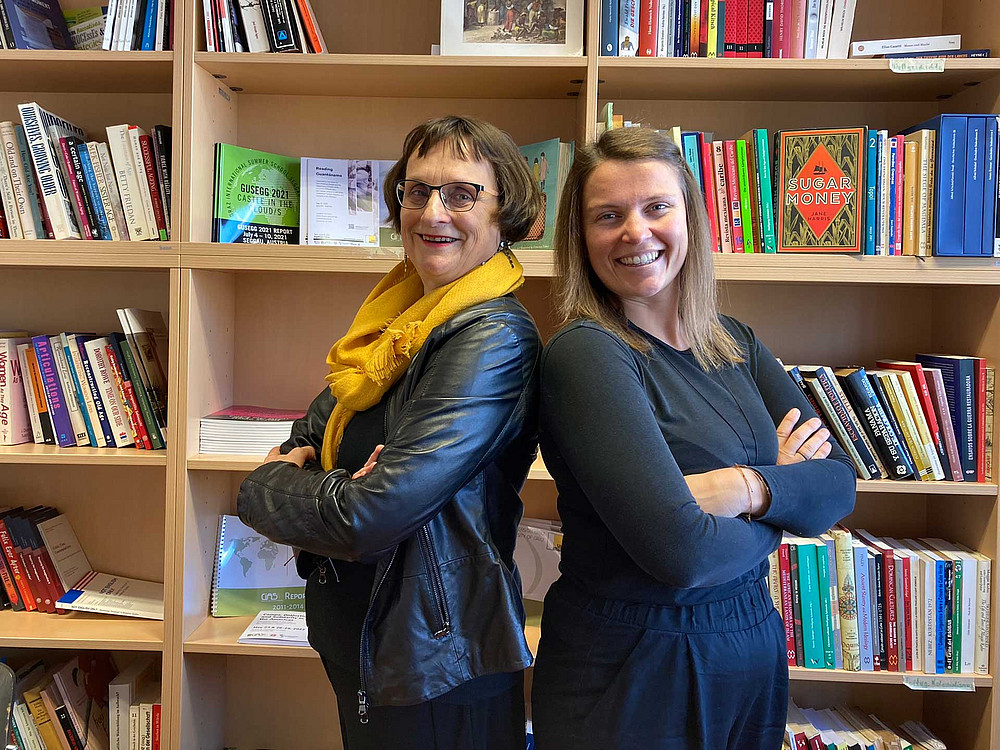
Roberta Maierhofer (links) und Nicole Haring

Roberta Maierhofer (links) und Nicole Haring: Weil der Klimawandel die gesamte Gesellschaft betrifrt, braucht es auch den kulturwissenschaftlichen Blick. Foto: Uni Graz/Schweiger

Warum sich Amerika-Studien mit dem Klimawandel beschäftigen - erklären Roberta Maierhofer und Nicole Haring

Brasilien kurbelt seine Gasförderung an. Der Regenwald im Amazonas wird radikal abgeholzt. Und die USA treibt die Erdölproduktion in Alaska voran. Trotz Klimawandel haben fossile Energien in Nord- und Südamerika nach wie vor Hochkonjunktur. Wie werden diese Abhängigkeit und dieser Zwiespalt in Literatur und Film dargestellt? Wie geht Sprache damit um? Wie nehmen es Leser:innen und Zuseher:innen wahr? Mit diesen Fragen beschäftigen sich Kulturwissenschaftler:innen am Zentrum für Inter-Amerikanische Studien der Universität Graz.

„Der Klimawandel betrifft die gesamte Gesellschaft. Es braucht daher die Geisteswissenschaften, um funktionierende, für alle annehmbare Strategien zu entwickeln“, begründet Roberta Maierhofer, Leiterin des Zentrums für Inter-Amerikanische Studien, die Auseinandersetzung mit dem Thema. „Die Moderne investiert seit über 200 Jahren in fossile Brennstoffe“, so die Forscherin, „das prägt unsere kollektive Vorstellungskraft und schränkt sie sogar stark ein.“ Politische Lösungen sind dringend notwendig, um den Planeten zu retten. Diese müssen jedoch die Beziehung zur Umwelt anders denken, um die Dimension vollständig zu erfassen und die Welt letztendlich zu verändern. „Die Sprache und die Darstellung haben hier als Ausdrucksform einen großen Anteil“, erklärt Maierhofer. „So hat etwa Science-Fiction schon immer Natur und Technik beeinflusst“, erinnert die Amerikanistin etwa an Schriftsteller wie Philip Kindred Dick.

Kollektives Gehirn
Von diesen Überlegungen ausgehend wurde ein Horizon Europe-Projekt eingereicht. Unter der Leitung von Roberta Maierhofer will eine Allianz aus Wissenschaftler:innen aus elf Ländern Denkmuster zu Klimakrise und Digitalisierung aufbrechen. „Wie können wir es schaffen, beide Themen miteinander in Bezug zu setzen, ohne dass neue Verletzlichkeiten und Ungleichheiten entstehen“, schildert Nicole Haring, ÖAW-Stipendiatin am Zentrum für Inter-Amerikanische Studien. Unter dem Einfluss von Migration, demographischem Wandel, kultureller Diversität, sozialer Vielfalt oder Geschlechterunterschieden will der interdisziplinäre Forschungsverbund neue Konzepte erschließen, die Menschen und Gesellschaft nicht spalten.
Maierhofer betont die umfassende Betrachtung eines „Big Picture“: „Wir brauchen ein kollektives Gehirn, das Disziplinen vereint und andere Methoden denkt.“ Haring fügt an: „Einen Zugang dazu ermöglichen Literatur- und Kulturwissenschaft in Ergänzung mit der Soziologie.“

created by Andreas Schweiger

Related news

Around the world in eight stops: the Long Night of Research at the University of Graz

On 24 April from 5 pm, you can take a short trip around the globe at the University of Graz, discovering pecularities of foreign countries or new local features in the entrance hall of the University Library. The itinerary takes you through introduced animal species, political attitudes and the omnipotence of algorithms. There will also be a programme in the historic reading hall, as well as at the UniGraz@Museum and the University Archive.

Studying at the University of Graz: How to enrol

Ready for a new chapter in your life with the start of your studies at the University of Graz in the winter semester 2026/27? Here you will find information on deadlines, admission procedures, registration, and everything else you need to successfully start your studies in the fall.

Interpreting data: Why studies sometimes get it wrong

Hilmar Brohmer and Ziva Korda from the Institute of Psychology, together with 500 international colleagues, have re-evaluated a hundred scientific publications and have often come to different conclusions.

Crystal-clear: AI method revolutionises solar observation

The Sun makes life on Earth possible. However, its magnetic fields can also cause massive disruption. This makes it all the more important to gain a better understanding of the processes taking place on our nearest star. A research team from the University of Graz and the High Altitude Observatory in Boulder (USA) has succeeded in doing just that. The astrophysicists have developed an AI-supported method that makes even the smallest structures on the Sun visible. The scientists are convinced that this will bring about a lasting change in solar observation and that the new method can be used for the planned European Solar Telescope.

Begin of page section:
Additional information:

University of Graz
Universitaetsplatz 3
8010 Graz
Austria
  • Contact
  • Web Editors
  • Moodle
  • UNIGRAZonline
  • Imprint
  • Data Protection Declaration
  • Accessibility Declaration
Weatherstation
Uni Graz

End of this page section. Go to overview of page sections

End of this page section. Go to overview of page sections

Begin of page section:

End of this page section. Go to overview of page sections