



Begin of page section:
Page sections:

  • Go to contents (Accesskey 1)
  • Go to position marker (Accesskey 2)
  • Go to main navigation (Accesskey 3)
  • Go to sub navigation (Accesskey 4)
  • Go to additional information (Accesskey 5)
  • Go to page settings (user/language) (Accesskey 8)
  • Go to search (Accesskey 9)

End of this page section. Go to overview of page sections

Begin of page section:
Page settings:

English en
Deutsch de
Search
Login

End of this page section. Go to overview of page sections

Begin of page section:
Search:

Search for details about Uni Graz
Close

End of this page section. Go to overview of page sections


Search

Begin of page section:
Main navigation:

Page navigation:

  • University

    University
    • About the University
    • Organisation
    • Faculties
    • Library
    • Working at University of Graz
    • Campus
    Developing solutions for the world of tomorrow - that is our mission. Our students and our researchers take on the great challenges of society and carry the knowledge out.
  • Research Profile

    Research Profile
    • Our Expertise
    • Research Questions
    • Research Portal
    • Promoting Research
    • Research Transfer
    • Ethics in Research
    • Commission for Scientific Integrity
    Scientific excellence and the courage to break new ground. Research at the University of Graz creates the foundations for making the future worth living.
  • Studies

    Studies
    • Prospective Students
    • Students
    • Registration for Study Programme (Winter semester 2026/27)
    • Study Days 22-26 June 2026
  • Community

    Community
    • International
    • Location
    • Research and Business
    • Alumni
    The University of Graz is a hub for international research and brings together scientists and business experts. Moreover, it fosters the exchange and cooperation in study and teaching.
Topics
  • Sustainable University
  • Researchers answer
  • Work for us
Close menu

End of this page section. Go to overview of page sections

Begin of page section:
You are here:

University of Graz News Bienentag #5

End of this page section. Go to overview of page sections

Wednesday, 19 May 2021

Bienentag #5

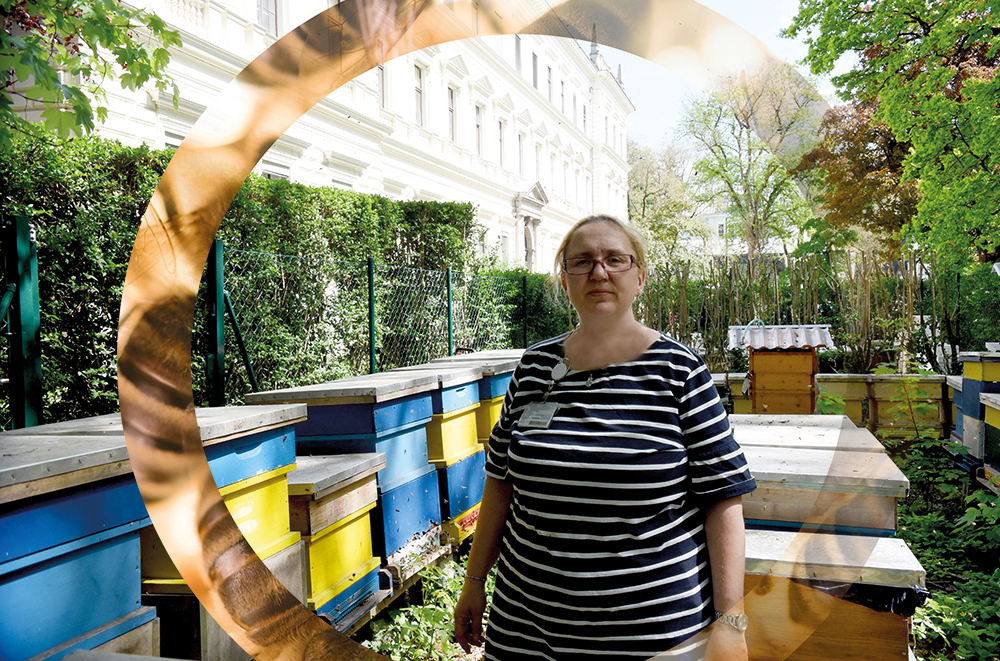
Jutta Vollmann: "Bienen gehören zu den am besten untersuchten Lebewesen, und trotzdem wissen wir so vieles noch nicht.“ Foto: Uni Graz/Schweiger

Jutta Vollmann: "Bienen gehören zu den am besten untersuchten Lebewesen, und trotzdem wissen wir so vieles noch nicht.“ Foto: Uni Graz/Schweiger

Herrscherin über drei Millionen: Jutta Vollmann betreut die Bienenhaltung an der Uni Graz

Es summt und schwirrt an der Ecke des Gebäudes Universitätsplatz 2. Hochbetrieb in eineinhalb Metern Höhe. „Wir haben Glück“, sagt Jutta Vollmann und schaut zum Himmel. „Denn wenn Schlechtwetter aufzieht, sind die Bienen angriffslustiger, auch Parfumstoffe in Shampoos und Duschbädern mögen sie nicht.“ Die Biologin kennt die Insekten vom Flügel bis zum Fühler. Jutta Vollmann ist für die Haltung der Honigbienen an der Universität Graz verantwortlich. Sie erzählt:

„Wir halten insgesamt bis zu 100 Völker an zwei Standorten, am Campus und im Botanischen Garten. Die Größe dieser Völker ist unterschiedlich Im Winter hat ein Volk ungefähr zwischen 10.000 und 15.000 Bienen, im Sommer zwischen 30.000 und 35.000. Es gibt jeweils eine Königin, die Masse machen die Arbeiterinnen aus, bis zum August gibt es für die Produktion von Nachkommen männliche Drohnen. Diese werden im Herbst recht unsanft aus dem Stock geworfen. In sogenannten schwarmreichen Jahren muss ich darauf achten, dass unsere Völker nicht abschwärmen. Da hängen die Bienen dann in den benachbarten Bäumen. Da kann es schon passieren, dass ich die Uni-Feuerwehr um Unterstützung bitten muss.
Natürlich produzieren die Bienen auch Honig, in guten Jahren können bis zu 25 Kilo pro Volk zusammenkommen. Doch das steht bei uns nicht im Vordergrund. Wir betreuen die Bienen sowohl für Forschungsprojekte als auch für die Lehre. Ich bereite alles Notwendige für die Versuchsanordnungen vor. Ich arbeite mit den einzelnen Gruppen zusammen, unterstütze sie mit Tipps aus meiner praktischen Erfahrung heraus. Ich selbst habe mich in meiner Diplomarbeit mit dem Temperaturhaushalt der Bienen beschäftigt. Ich habe mir auch vorgenommen, an meiner Dissertation weiterzuarbeiten. Da schaue ich mir an, wie sich negative Einflüsse während der Larvenentwicklung auf die erwachsenen Tiere auswirken. Bienen sind sehr lernfähig und enorm leistungsstark, was sie mit dem kleinen Gehirn alles schaffen, fasziniert mich immer wieder. Sie gehören zu den am besten untersuchten Lebewesen, und trotzdem wissen wir so vieles noch nicht.“

Rund um den Weltbienentag am 20. Mai

  • Bienentag #4: Warum können Bienen sich selbst heilen?
  • Bienentag #3: Wie künstliche Intelligenz hilft, Bienen zu schützen
  • Bienentag #2: Warum sind Honigbiene und Mensch so eng verbunden?
  • Bienentag #1: Die Welt fliegt auf Spitzenforschung der Uni Graz

created by Andreas Schweiger

Related news

Getting even hotter: Researchers predict global warming of 1.7 degrees by 2027

While Europe is currently sweltering in the heat, global temperatures are also rising towards concerning record levels. In 2026, Earth’s surface air temperature is expected to reach 1.62 degrees, and in 2027 even 1.71 degrees Celsius above pre-industrial levels. The long-term temperature rise – an average over a 20-year period – is predicted to exceed the 1.5-degree threshold of the Paris Agreement as of 2026 already. For the first time, researchers at the University of Graz have been able to make such a forecast so far in advance. The intensifying El Niño climate event favors forecast skill and thereby facilitates a reliable computation.

Forest fire at Rosenhain: Volunteer fire brigade carried out an evacuation drill at the Jesuit refectory

Thick smoke in the stairwell, flames at the edge of the forest, people missing in the Jesuit refectory at the University of Graz: at Rosenhain, the Graz Volunteer Fire Brigade carried out a drill simulating a scenario that is becoming increasingly realistic given the heat and drought

Full effort in the heat: the Sports Centre was in full swing at the Kleeblattlauf

On 19 June 2026, 2,000 runners and hundreds of supporters made their way to the Rosenhain for a sporting end-of-term event.

Save, invest or guarantee: What Austrians expect from the state

Austria needs to make savings. But where? And what should the Republic actually be spending its money on? The answers are provided by the initial findings of a major study involving the University of Graz. 99 per cent of those surveyed are in favour of the state ensuring healthcare provision. Almost three-quarters would like to see more public funding for education, whilst only around three per cent are in favour of cuts in this sector.

Begin of page section:
Additional information:

University of Graz
Universitaetsplatz 3
8010 Graz
Austria
  • Contact
  • Web Editors
  • Moodle
  • UNIGRAZonline
  • Imprint
  • Data Protection Declaration
  • Accessibility Declaration
Weatherstation
Uni Graz

End of this page section. Go to overview of page sections

End of this page section. Go to overview of page sections

Begin of page section:

End of this page section. Go to overview of page sections


