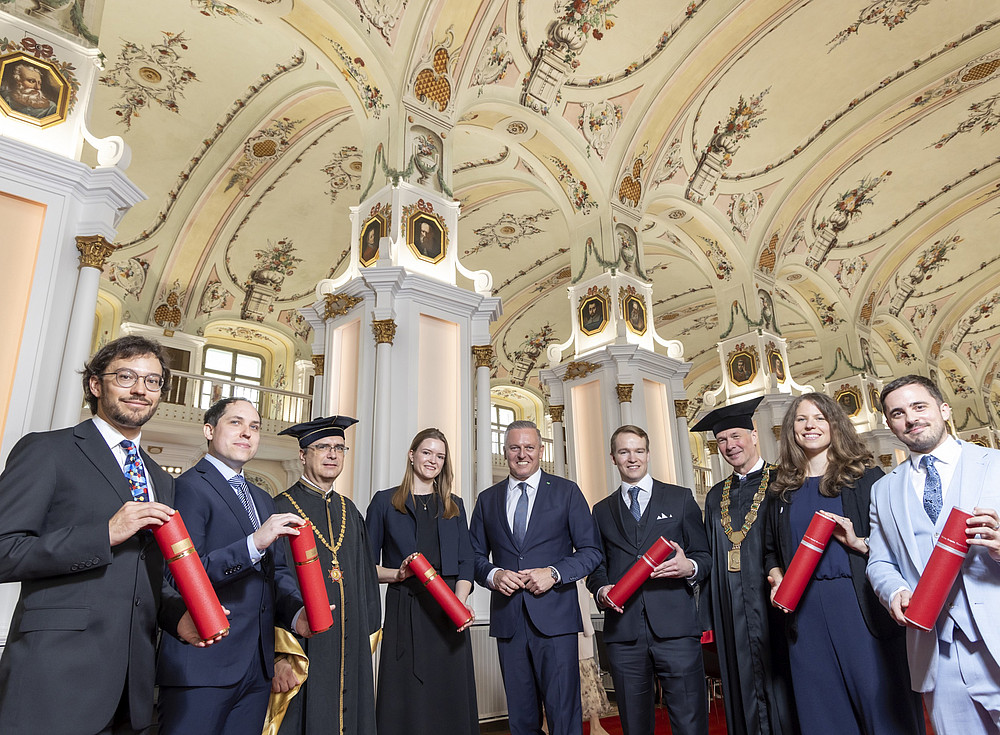
“This award is the result of many years of hard work and great discipline. I would like to congratulate you on this,” emphasised Peter Riedler, Rector of the University of Graz, at the start of the ceremony. “Especially in a time of great social change, we need individuals like you who combine knowledge with foresight and a sense of responsibility. Today’s Sub Auspiciis graduation of our six young researchers is a testament to Styria’s strength as a centre of research.”
“A Sub Auspiciis doctorate is far more than an academic qualification – it is an expression of extraordinary perseverance, curiosity and intellectual passion,” emphasised Graz University of Technology Rector Horst Bischof. “Those who follow this path demonstrate not only academic excellence, but also the courage to ask new questions and challenge existing boundaries. I warmly congratulate the six Graz graduates on this outstanding achievement.”
“As Governor of Styria, I offer my warmest congratulations to all doctoral candidates on their extraordinary success. The ‘Sub Auspiciis’ doctorate ranks among the highest and most distinguished honours in an academic career and is a cause for particular pride. With great talent, remarkable diligence and admirable perseverance, you have achieved exceptional academic and scientific accomplishments. In doing so, you not only exemplify personal excellence, but also represent the University of Graz in an exemplary manner as a centre of education, research and academic excellence. I wish you all the very best for your future professional and personal lives, every success, and continued curiosity, drive and inspiration,” says Mario Kunasek.
The sub auspiciis doctoral graduates of the University of Graz
Christian Bundschuh (Dissertation subject: Pharmacy)
Christian Bundschuh was born in Tyrol. He discovered his passion for chemistry as early as primary school – sparked by an open day at a grammar school, which left such a lasting impression on him that he decided early on to pursue a career in chemistry. At the Bundesrealgymnasium on Adolf-Pichler-Platz in Innsbruck, he deepened this interest through, among other things, chemistry practicals. He found his way into higher education via career guidance and chose molecular biology and biochemistry at the University of Graz because he was drawn to the “link” between various life science disciplines. His interest in medicine also grew during his studies. He also completed a degree in human medicine in Graz and Heidelberg. “I am particularly motivated by the further development of virological sequencing – that is, the opportunity to establish and optimise methods to characterise viruses with ever-greater precision,” says Christian Bundschuh. Today, he works as a specialist in medical and chemical laboratory diagnostics, with a focus on virological and molecular diagnostics. Since completing his Master’s in Biochemistry, mass spectrometry has also been one of his key areas of interest, which he is currently deepening through further study.
Peter Hartmann (PhD subject: Chemistry)
Peter Hartmann was born in Hallein (Salzburg) in 1997. He developed an interest in the natural sciences at an early age – shaped by a childhood spent close to nature, with a father who was a geologist, and his curiosity about the ‘why’ behind the phenomena he observed. At school, this approach led him from biology to chemistry; the support of his chemistry teacher and his active participation in the Austrian Chemistry Olympiad were also decisive factors. After completing his school-leaving certificate, he studied chemistry in the NAWI-Graz programme at Graz University of Technology and the University of Graz, gradually shifting his focus towards theoretical chemistry. “I am fascinated by describing chemical processes using quantum chemical models in such a way that they become explainable, predictable and can be specifically optimised,” says Peter Hartmann. In his PhD thesis, he combined the further development of density functional theory with applications to medically and environmentally relevant systems. Today, he conducts research as a postdoctoral fellow at the University of Graz in computational chemistry, focusing, among other things, on sustainable materials, more efficient syntheses and catalytic systems. Alongside his research, he is involved in teaching and finds balance in nature, music and sport.
Lena Parigger (PhD subject: Biochemistry and Molecular Biomedicine)
Lena Parigger, born in Graz in 1998, grew up with a strong appreciation for education and achievement and took an interest in many different subject areas during her school years. After completing a Bachelor’s degree in Molecular Biology at the University of Graz, she went on to earn a Master’s degree in Biotechnology at Graz University of Technology, specialising in protein and environmental biotechnology. During the COVID-19 pandemic – prompted by the cancellation of a planned laboratory placement in the Netherlands – she found her way into bioinformatics. “I was particularly fascinated by the extent to which computer-aided methods can make experimental research more targeted and efficient,” says Lena Parigger. In her PhD thesis, she explored new innovative approaches to monitoring viral mutations and the development of antiviral drugs. Today, she works in pharmaceutical research on digital and data-driven methods to make drug development more resource-efficient and safer. Outside of work, she volunteers for nature conservation in Styria and finds balance in sport, music and learning languages; she is currently immersing herself in Japanese – not least because Japan plays a significant role in pharmaceutical research.
PhD graduates under the auspices of Graz University of Technology
Hannah Brunner (PhD subject: Computer Engineering)
Hannah Brunner, born in 1995 in St. Bartholomä (near Graz), attended the HTL Bulme Graz-Gösting after secondary school, specialising in electronics and telecommunications. “Originally, I wanted to stick with music, but I was simply fascinated by the interplay between hardware and software. You write code, and something actually happens in the real world. What’s more, technology never gets boring – by the time you’ve learnt something new, it’s usually already outdated,” says Hannah Brunner. After completing her school-leaving certificate, she went on to study “Information and Computer Engineering” at Graz University of Technology (Bachelor’s and Master’s degrees). She worked as a software developer and teaching assistant, and from 2020 as a university assistant at the Institute of Technical Informatics, where she wrote her dissertation on the scalability and sustainability of the Internet of Things. “I was particularly interested in ‘battery-free computing’. This involves working with long-lasting ultra-low-power components and managing to perform meaningful tasks using as little energy as possible.” She has been working as a systems engineer at Infineon since 2023. Away from electronics and the Internet of Things, Hannah Brunner’s passion lies, among other things, with Ultimate Frisbee: from 2020 to 2023, she played for the Austrian mixed national team and spent several years coaching at FSV Augärtner Ultimate Graz.
Samuel Hörmann (PhD subject: Electrical Engineering)
Samuel Hörmann was born in Freistadt, Upper Austria, in 1995. He graduated with distinction from HTL Steyr in the field of mechatronics, specialising in precision engineering. His fascination with photonics began whilst he was studying for his Bachelor’s degree in Physics at Graz University of Technology. “I’m fascinated by the combination of physics and technology. Because they use light, photonic sensors present a particular challenge. It’s all about precision at the nanometre level,” he says. He first came into contact with his current employer, ams OSRAM, whilst working on his Master’s thesis in technical physics. This continued during his PhD research, titled “Waveguide Design for Integrated Photonic Sensors”, which he undertook as part of a joint project between the company and Graz University of Technology. “It was a unique opportunity to apply my passion for high-tech to the development of a biosensor that could revolutionise the detection of diseases,” says Samuel Hörmann, whose enthusiasm for technology was instilled in him by his father and brother. Outside of sensor technology, he is also an avid marathon runner and enjoys reading fantasy novels and philosophical literature.
Thomas Steiner (Dissertation subject: Thermal Energy Engineering)
Thomas Steiner was born in Klagenfurt in 1995 and grew up in St. Andrä im Lavanttal. After graduating with distinction from Stiftsgymnasium St. Paul im Lavanttal and completing his military service with the Austrian Armed Forces, he studied Process Engineering at Graz University of Technology (Bachelor’s and Master’s degrees within the minimum study period). “I chose process engineering because, at the BeST information fair, the course was presented to me as both very challenging and highly promising. In the end, the friendly student at the Graz University of Technology information stand was also a deciding factor, as he raved so much about process engineering – even though he himself was a software development student,” recalls Thomas Steiner with a smile. Since 2020, he has been working as a researcher at the K1 Competence Centre BEST in Graz. He wrote his PhD thesis on the modelling of chemical looping processes – a climate-friendly technology for energy and hydrogen production – at the Institute of Thermal Engineering. “The topic is highly topical and holds great potential to contribute to the green transition,” says Steiner. He describes his time as a student at Graz University of Technology as “intense periods of study alternating with plenty of partying, wonderful memories and close friendships”. Alongside technology, particularly digital media, his interests also include sport and, currently, the renovation work on his parents’ house in Carinthia.
Doctorate under the auspices of the Federal President
The doctorate sub auspiciis praesidentis rei publicae is one of Austria’s highest academic honours. In its current form, under the auspices of the Federal President, it has existed since 1952; however, its historical roots in Austria date back to 1624/1625, representing a tradition of academic excellence spanning more than 400 years.